Discounted Products
-
 Leo Creation 144 TC Cotton Double Jaipuri Prints Flat Bedsheet(Pack of 1, Blue, Gree, Red, Grey, Light Grey)
Original price was: ₹2,999.00.₹329.00Current price is: ₹329.00.
Leo Creation 144 TC Cotton Double Jaipuri Prints Flat Bedsheet(Pack of 1, Blue, Gree, Red, Grey, Light Grey)
Original price was: ₹2,999.00.₹329.00Current price is: ₹329.00.
-
 Home Garage 210 TC Cotton King Floral Fitted (Elastic) Bedsheet(Pack of 1, Grey)
Original price was: ₹999.00.₹299.00Current price is: ₹299.00.
Home Garage 210 TC Cotton King Floral Fitted (Elastic) Bedsheet(Pack of 1, Grey)
Original price was: ₹999.00.₹299.00Current price is: ₹299.00.
-
 Goodrik 140 TC Cotton Double 3D Printed Flat Bedsheet(Pack of 1, Brown)
Original price was: ₹499.00.₹229.00Current price is: ₹229.00.
Goodrik 140 TC Cotton Double 3D Printed Flat Bedsheet(Pack of 1, Brown)
Original price was: ₹499.00.₹229.00Current price is: ₹229.00.
-
 GLOBALSHOP 350 TC Microfiber Double Floral Flat Bedsheet(Pack of 1, Multicolor)
Original price was: ₹1,250.00.₹263.00Current price is: ₹263.00.
GLOBALSHOP 350 TC Microfiber Double Floral Flat Bedsheet(Pack of 1, Multicolor)
Original price was: ₹1,250.00.₹263.00Current price is: ₹263.00.
-
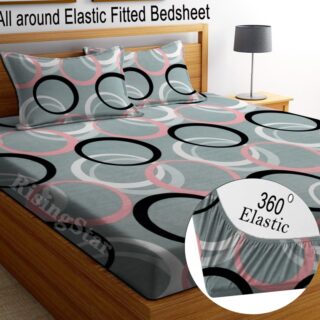 RisingStar 250 TC Microfiber King Printed Fitted (Elastic) Bedsheet(Pack of 1, FITTED-ROUND-CIRCLES-PREMIUM)
Original price was: ₹2,299.00.₹299.00Current price is: ₹299.00.
RisingStar 250 TC Microfiber King Printed Fitted (Elastic) Bedsheet(Pack of 1, FITTED-ROUND-CIRCLES-PREMIUM)
Original price was: ₹2,299.00.₹299.00Current price is: ₹299.00.
-
 Home Garage 210 TC Cotton King Floral Fitted (Elastic) Bedsheet(Pack of 1, Fitted Black Green)
Original price was: ₹1,299.00.₹299.00Current price is: ₹299.00.
Home Garage 210 TC Cotton King Floral Fitted (Elastic) Bedsheet(Pack of 1, Fitted Black Green)
Original price was: ₹1,299.00.₹299.00Current price is: ₹299.00.
-
 Home Garage 180 TC Cotton King 3D Printed Flat Bedsheet(Pack of 1, White)
Original price was: ₹999.00.₹229.00Current price is: ₹229.00.
Home Garage 180 TC Cotton King 3D Printed Flat Bedsheet(Pack of 1, White)
Original price was: ₹999.00.₹229.00Current price is: ₹229.00.
-
 Home Sizzler 153 cm (5 ft) Polyester Room Darkening Window Curtain (Pack Of 2)(Floral, Maroon)
Original price was: ₹799.00.₹299.00Current price is: ₹299.00.
Home Sizzler 153 cm (5 ft) Polyester Room Darkening Window Curtain (Pack Of 2)(Floral, Maroon)
Original price was: ₹799.00.₹299.00Current price is: ₹299.00.
-
 Panipat Textile Hub 152.4 cm (5 ft) Polyester Window Curtain (Pack Of 2)(Solid, Aqua)
Original price was: ₹1,899.00.₹299.00Current price is: ₹299.00.
Panipat Textile Hub 152.4 cm (5 ft) Polyester Window Curtain (Pack Of 2)(Solid, Aqua)
Original price was: ₹1,899.00.₹299.00Current price is: ₹299.00.
-
 Home Sizzler 214 cm (7 ft) Polyester Semi Transparent Door Curtain (Pack Of 2)(Floral, Maroon)
Original price was: ₹1,199.00.₹399.00Current price is: ₹399.00.
Home Sizzler 214 cm (7 ft) Polyester Semi Transparent Door Curtain (Pack Of 2)(Floral, Maroon)
Original price was: ₹1,199.00.₹399.00Current price is: ₹399.00.
-
 Home Sizzler 153 cm (5 ft) Polyester Room Darkening Window Curtain (Pack Of 2)(Floral, Brown)
Original price was: ₹799.00.₹299.00Current price is: ₹299.00.
Home Sizzler 153 cm (5 ft) Polyester Room Darkening Window Curtain (Pack Of 2)(Floral, Brown)
Original price was: ₹799.00.₹299.00Current price is: ₹299.00.
-
 Stella Creations 214 cm (7 ft) Polyester Room Darkening Door Curtain (Pack Of 2)(Abstract, Brown)
Original price was: ₹1,299.00.₹449.00Current price is: ₹449.00.
Stella Creations 214 cm (7 ft) Polyester Room Darkening Door Curtain (Pack Of 2)(Abstract, Brown)
Original price was: ₹1,299.00.₹449.00Current price is: ₹449.00.
-
 Homefab India 152.5 cm (5 ft) Polyester Room Darkening Window Curtain (Pack Of 2)(Floral, Light Blue)
Original price was: ₹1,199.00.₹319.00Current price is: ₹319.00.
Homefab India 152.5 cm (5 ft) Polyester Room Darkening Window Curtain (Pack Of 2)(Floral, Light Blue)
Original price was: ₹1,199.00.₹319.00Current price is: ₹319.00.
-
 Urban Home 214 cm (7 ft) PVC Transparent Door Curtain Single Curtain(Solid, Off White)
Original price was: ₹699.00.₹203.00Current price is: ₹203.00.
Urban Home 214 cm (7 ft) PVC Transparent Door Curtain Single Curtain(Solid, Off White)
Original price was: ₹699.00.₹203.00Current price is: ₹203.00.
-
 Panipat Textile Hub 213 cm (7 ft) Polyester Door Curtain (Pack Of 2)(Solid, Brown)
Original price was: ₹1,199.00.₹349.00Current price is: ₹349.00.
Panipat Textile Hub 213 cm (7 ft) Polyester Door Curtain (Pack Of 2)(Solid, Brown)
Original price was: ₹1,199.00.₹349.00Current price is: ₹349.00.
Introduction
I deal with PDFs almost every day — reports, invoices, contracts, worksheets, receipts, training materials… you name it. And one thing that always seems to happen is that instead of getting one neat PDF file, I end up with five, ten, or sometimes twenty separate ones that all belong together.
Maybe it’s:
- scanned pages that came out as individual PDFs,
- chapters downloaded separately,
- invoices generated one-by-one,
- or documents different people sent me in parts.
And suddenly I need to send one clean file instead of a messy folder full of PDFs.
That’s where merging PDFs becomes incredibly useful.
Instead of attaching ten separate files to an email (and confusing the recipient), you can combine them into one single PDF in the correct order. It looks professional, it’s easier to share, easier to store, and much easier to find later.
The good news? You don’t need expensive software or technical skills to merge PDFs anymore. Whether you’re on Windows, Mac, or just using a browser, there are simple tools that can do this in seconds.
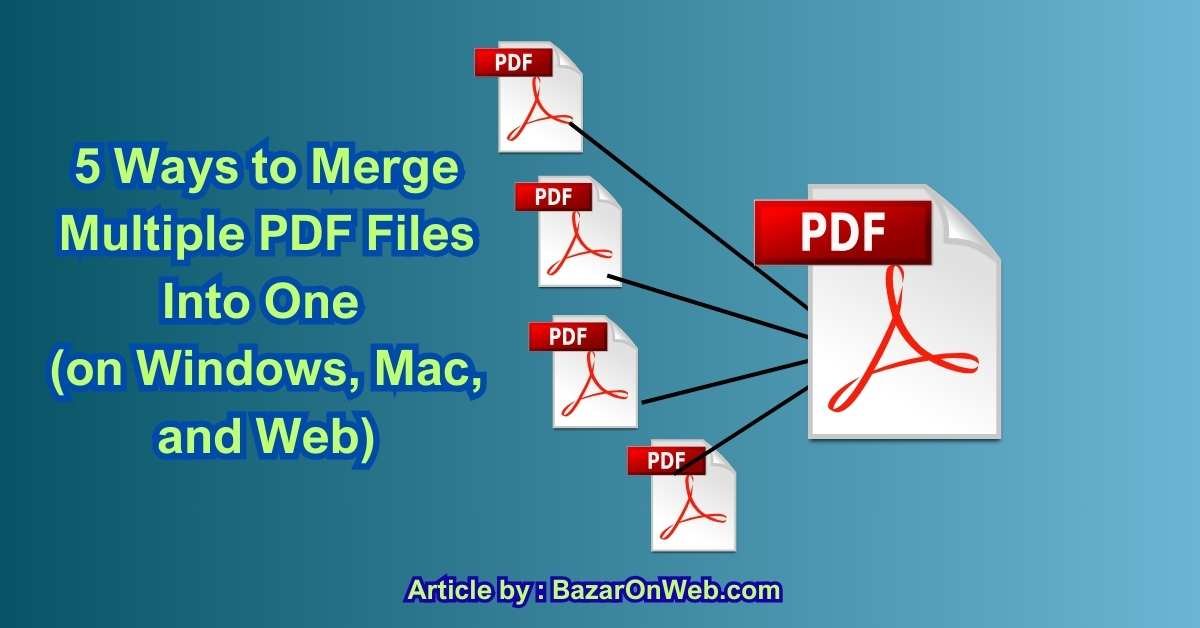
In this guide, I’ll show you five easy ways to merge multiple PDFs into one — starting with the simplest online method, then moving into desktop tools for Windows and Mac, and finally covering privacy-friendly offline options.
Let’s start with the easiest method that works on almost any device.
Method 1: Merge PDFs Using an Online Tool (Works on Windows, Mac & Mobile)
If you just need to merge a few PDF files quickly and you don’t want to install anything, online PDF merge tools are the fastest option.
They work directly in your browser and support Windows, Mac, Linux, tablets, and even phones.
When this method is best
I recommend this method when:
- You’re using a shared or work computer
- You don’t want to install software
- You’re merging files only occasionally
- The PDFs are not highly sensitive or confidential
Popular online PDF merge tools
Some commonly used ones are:
- iLovePDF
- Smallpdf
- PDF Merge (PDFMerge.com)
- Adobe Acrobat Online
(Any reputable PDF merge site works similarly.)
Step-by-step: How to merge PDFs online
Step 1: Open an online PDF merge website
Open your browser and search for:
“merge PDF online”
Choose a well-known, trusted website.
Step 2: Upload your PDF files
Click the Select Files or Upload button and choose the PDF files from your computer.
You can usually:
- Select multiple files at once
- Drag and drop files into the page
Step 3: Arrange the file order
Once uploaded, the site will show your PDFs in a list.
You can drag them into the correct order:
- Page 1 first
- Then page 2
- And so on
This step is important because the merged file follows this exact sequence.
Step 4: Click “Merge” or “Combine”
Click the button labeled Merge PDF, Combine, or similar.
The tool will process your files (usually takes just a few seconds).
Step 5: Download the merged PDF
Once done, you’ll see a Download button.
Click it and save your new merged PDF to your computer.
That’s it — your multiple PDFs are now one clean file.
Why I like this method
I personally love this option because:
- It’s extremely fast
- No learning curve
- Works anywhere
- No setup needed
If I just need to merge five invoices before sending them or combine some scanned documents quickly, this is my go-to solution.
Important privacy note
Because this method uploads your files to a third-party website, you should not use it for:
- legal contracts
- medical records
- confidential company documents
- personal identity documents
For sensitive data, it’s better to use offline desktop tools (which I’ll cover in the next methods).
Pros and cons of online PDF merging
Pros:
- No installation required
- Works on any device
- Very easy for beginners
Cons:
- Requires internet
- File size limits on free versions
- Not ideal for private or sensitive files
Summary of Method 1
| Feature | Value |
|---|---|
| Platform | Windows, Mac, Web, Mobile |
| Cost | Usually free |
| Difficulty | Very easy |
| Privacy | Moderate (files uploaded online) |
| Best for | Quick, casual PDF merging |
Method 2: Merge PDFs on Windows Using Free Desktop Software
If you merge PDFs often, work with confidential documents, or simply prefer not uploading files to the web, using a desktop application on Windows is the best option.
This method keeps everything on your computer, gives you more control over file size and order, and works even without internet access.
When this method is best
I use this method when:
- The PDFs contain sensitive information
- The files are very large
- I need to merge PDFs frequently
- I’m working offline or on a slow connection
One of the most reliable free tools for Windows is PDFsam Basic (PDF Split and Merge).
Step-by-step: Merge PDFs on Windows with PDFsam
Step 1: Install PDFsam Basic
- Search for “PDFsam Basic download”
- Download and install the free version
- Launch the program
Step 2: Choose “Merge”
Once the app opens, click on Merge from the main menu.
Step 3: Add your PDF files
Click Add and select the PDFs you want to merge.
You can also drag and drop files into the window.
Step 4: Arrange the file order
Drag the files up or down to put them in the correct sequence.
Step 5: Choose output location
Select where the merged PDF should be saved and name the file.
Step 6: Click “Run”
Click Run, and the program will generate your merged PDF locally.
That’s it — no uploads, no limits, no privacy concerns.
Why I like this method
- Works offline
- Keeps files private
- Handles very large PDFs easily
- No internet dependency
The interface is simple enough that you don’t need technical knowledge, but powerful enough for daily professional use.
Pros and Cons of Method 2
Pros:
- Free and offline
- No file size limits
- Better privacy
- Reliable for large documents
Cons:
- Requires installation
- Only available on desktop
- Interface is basic
Method 3: Merge PDFs on Mac Using Built-In Preview App
Mac users have a hidden advantage — you can merge PDFs without installing anything at all.
macOS comes with a built-in app called Preview, and it includes surprisingly powerful PDF tools.
When this method is best
This method is perfect when:
- You’re on a Mac
- You want a quick, clean solution
- You don’t want third-party tools
- You value simplicity
I love this approach because it’s already there — no downloads, no ads, no setup.
Step-by-step: Merge PDFs on Mac with Preview
Step 1: Open the first PDF in Preview
Double-click a PDF — it usually opens in Preview by default.
Step 2: Show thumbnails
In the menu, click:
- View → Thumbnails
You’ll now see a sidebar with pages.
Step 3: Drag additional PDFs into the sidebar
Open Finder and drag the other PDF files into the thumbnail panel.
They’ll appear as full document blocks or individual pages depending on your settings.
Step 4: Arrange pages and documents
Drag the pages or entire PDFs into the correct order.
You can rearrange, delete, or reorder anything visually.
Step 5: Save the merged PDF
Click:
- File → Export as PDF
or - File → Save
Name your merged file and save it.
Why I love this method
- No software needed
- Very intuitive
- Visual drag-and-drop ordering
- Completely free
- Works offline
For Mac users, this is honestly one of the easiest ways to merge PDFs anywhere.
Pros and Cons of Method 3
Pros:
- Built into macOS
- No installation
- Free
- Highly visual and user-friendly
Cons:
- Only available on Mac
- Not ideal for batch merging hundreds of files
Quick Comparison
| Feature | Method 2 (Windows App) | Method 3 (Mac Preview) |
|---|---|---|
| Platform | Windows | Mac |
| Internet Required | No | No |
| Privacy | High | High |
| File Size Limits | None | None |
| Ease of Use | Easy | Very easy |
| Best For | Frequent merging | Quick merges |
Here you go — Method 4, Method 5, and a detailed comparison table (~1200 words) in the same Jessica-style tone 😊
Method 4: Merge PDFs Using Adobe Acrobat (Windows & Mac)
If you already use Adobe Acrobat for work or school, you may not realize that it includes a very powerful PDF merging tool. This is a great option for professionals who handle PDFs daily and want advanced control over formatting, quality, and output.
When this method is best
This method is ideal if:
- You already have Adobe Acrobat installed
- You work with PDFs every day
- You need high-quality output and formatting consistency
- You handle business, legal, or print-ready documents
Step-by-step: Merge PDFs with Adobe Acrobat
Step 1: Open Adobe Acrobat
Launch Adobe Acrobat (not just the Reader — the full version).
Step 2: Choose “Combine Files”
Go to:
- Tools → Combine Files
Step 3: Add PDFs
Click Add Files and select the PDFs you want to merge.
Step 4: Arrange file order
Drag files into the correct sequence.
Step 5: Click “Combine”
Click Combine, and Acrobat will generate the merged PDF.
Step 6: Save the file
Save the merged file to your desired location.
Why people use this method
- High-quality output
- Excellent compatibility
- Handles very complex PDFs
- Professional-grade formatting
Pros and Cons
Pros:
- Extremely reliable
- Best formatting retention
- Professional output
- Supports OCR and compression
Cons:
- Paid software
- Overkill for casual users
Method 5: Merge PDFs Using Command Line (Advanced Users)
This method is for people who like automation, scripting, or working with large batches of files.
When this method is best
Use this if:
- You merge hundreds of PDFs regularly
- You like automation
- You are comfortable with command line
- You need batch processing
A popular tool for this is PDFtk.
Step-by-step: Merge PDFs with PDFtk
Step 1: Install PDFtk
Install PDFtk on Windows or Mac.
Step 2: Open Command Prompt or Terminal
Step 3: Run merge command
Example:
pdftk file1.pdf file2.pdf file3.pdf cat output merged.pdf
This merges the files into merged.pdf.
Why this method is useful
- Fast for large batches
- Scriptable
- No GUI needed
- Excellent for servers and workflows
Pros and Cons
Pros:
- Automation-friendly
- Fast for large jobs
- Very powerful
Cons:
- Not beginner-friendly
- No visual preview
Comparison Table
| Method | Platform | Internet Needed | Cost | Ease of Use | Privacy | Best For |
|---|---|---|---|---|---|---|
| Online Tools | All | Yes | Free | Very Easy | Medium | Quick merges |
| Windows App | Windows | No | Free | Easy | High | Frequent merges |
| Mac Preview | Mac | No | Free | Very Easy | High | Quick local merges |
| Adobe Acrobat | Win/Mac | No | Paid | Easy | High | Professional work |
| Command Line | Win/Mac | No | Free | Advanced | High | Automation |
Summary
- Method 4 is ideal for professionals who need premium output.
- Method 5 is perfect for automation and power users.
- The comparison table helps you choose based on your needs.
Conclusion
Merging PDF files used to feel like a technical task reserved for IT professionals or people with expensive software. Today, it’s something anyone can do in a few clicks — whether you’re working on Windows, Mac, or simply using a browser.
What really matters is choosing the method that fits your situation.
If you need something quick and convenient, online tools are perfect for occasional use. They’re fast, simple, and work on almost any device. If privacy or file size is a concern, offline tools on Windows and Mac give you full control without uploading anything to the internet. For professionals working with contracts, reports, or print-ready documents, Adobe Acrobat offers the most reliable and polished results. And for power users or teams dealing with hundreds of files, command-line tools bring automation and efficiency into the process.
From my experience, the best method is the one that fits your workflow, not necessarily the most advanced one. If merging PDFs is something you do once a month, you don’t need complex software. If it’s part of your daily work, investing in a reliable offline or professional solution will save you time and frustration in the long run.
What I love about having multiple options is that it removes the feeling of being “stuck.” No matter what device you’re on, what files you’re working with, or how often you need to merge PDFs, there’s always a solution available. That flexibility is what makes modern digital work so much easier than it used to be.
Once you’ve merged your PDFs into a single, clean document, everything becomes simpler — sharing, storing, reviewing, printing, and archiving. It’s a small step that makes a big difference in keeping digital work organized and professional.
Disclaimer (Bazaronweb.com)
The information in this article is provided for educational and general guidance purposes only. Software availability, features, and system behavior may vary depending on operating system version, device configuration, and third-party tools used. Bazaronweb.com is not responsible for data loss, formatting changes, or system issues resulting from following this guide.
All product names, trademarks, and brands mentioned belong to their respective owners. Bazaronweb.com is not affiliated with Adobe, Apple, Microsoft, or any third-party software provider mentioned.

- Why iPhone Gets Hot During Normal Use and What It’s Actually Telling You

- Why Android Phones Start Lagging After Months of Use and What’s Really Causing It

- Why iPhone Becomes Slow Over Time Even If You Never Install New Apps

- Why iPhone Storage Fills Up Even When You Delete Photos and How to Fix It Properly

- Why Windows 11 Feels Slow After Updates and How to Fix It Without Resetting Your PC

Products
-
![Apple Watch Ultra 3 [GPS + Cellular 49mm] Running & Multisport Smartwatch w/Rugged Titanium Case w/Black Titanium Milanese Loop - M. Satellite Communications, Advanced Health & Fitness Tracking](https://bazaronweb.com/retailstores/wp-content/uploads/2025/09/apple-watch-320x320.jpg) Apple Watch Ultra 3 [GPS + Cellular 49mm] Running & Multisport Smartwatch w/Rugged Titanium Case w/Black Titanium Milanese Loop - M. Satellite Communications, Advanced Health & Fitness Tracking
Apple Watch Ultra 3 [GPS + Cellular 49mm] Running & Multisport Smartwatch w/Rugged Titanium Case w/Black Titanium Milanese Loop - M. Satellite Communications, Advanced Health & Fitness Tracking
-
 Apple iPad mini (A17 Pro): Apple Intelligence, 8.3-inch Liquid Retina Display, 256GB, Wi-Fi 6E, 12MP Front/12MP Back Camera, Touch ID, All-Day Battery Life — Purple
-
 Apple AirPods Max Wireless Over-Ear Headphones, Active Noise Cancelling, Transparency Mode, Personalized Spatial Audio, Dolby Atmos, Bluetooth Headphones for iPhone – Space Gray
-
 Apple AirPods Pro 2 Wireless Earbuds, Active Noise Cancellation, Hearing Aid Feature, Bluetooth Headphones, Transparency, Personalized Spatial Audio, High-Fidelity Sound, H2 Chip, USB-C Charging
-
Leo Creation 144 TC Cotton Double Jaipuri Prints Flat Bedsheet(Pack of 1, Blue, Gree, Red, Grey, Light Grey)
Original price was: ₹2,999.00.₹329.00Current price is: ₹329.00.
Leave a Reply