Discounted Products
-
 Home Garage 210 TC Cotton King Floral Fitted (Elastic) Bedsheet(Pack of 1, Grey)
Original price was: ₹999.00.₹299.00Current price is: ₹299.00.
Home Garage 210 TC Cotton King Floral Fitted (Elastic) Bedsheet(Pack of 1, Grey)
Original price was: ₹999.00.₹299.00Current price is: ₹299.00.
-
 Goodrik 140 TC Cotton Double 3D Printed Flat Bedsheet(Pack of 1, Brown)
Original price was: ₹499.00.₹229.00Current price is: ₹229.00.
Goodrik 140 TC Cotton Double 3D Printed Flat Bedsheet(Pack of 1, Brown)
Original price was: ₹499.00.₹229.00Current price is: ₹229.00.
-
 GLOBALSHOP 350 TC Microfiber Double Floral Flat Bedsheet(Pack of 1, Multicolor)
Original price was: ₹1,250.00.₹263.00Current price is: ₹263.00.
GLOBALSHOP 350 TC Microfiber Double Floral Flat Bedsheet(Pack of 1, Multicolor)
Original price was: ₹1,250.00.₹263.00Current price is: ₹263.00.
-
 RisingStar 250 TC Microfiber King Printed Fitted (Elastic) Bedsheet(Pack of 1, FITTED-ROUND-CIRCLES-PREMIUM)
Original price was: ₹2,299.00.₹299.00Current price is: ₹299.00.
RisingStar 250 TC Microfiber King Printed Fitted (Elastic) Bedsheet(Pack of 1, FITTED-ROUND-CIRCLES-PREMIUM)
Original price was: ₹2,299.00.₹299.00Current price is: ₹299.00.
-
 Home Garage 210 TC Cotton King Floral Fitted (Elastic) Bedsheet(Pack of 1, Fitted Black Green)
Original price was: ₹1,299.00.₹299.00Current price is: ₹299.00.
Home Garage 210 TC Cotton King Floral Fitted (Elastic) Bedsheet(Pack of 1, Fitted Black Green)
Original price was: ₹1,299.00.₹299.00Current price is: ₹299.00.
-
 Home Garage 180 TC Cotton King 3D Printed Flat Bedsheet(Pack of 1, White)
Original price was: ₹999.00.₹229.00Current price is: ₹229.00.
Home Garage 180 TC Cotton King 3D Printed Flat Bedsheet(Pack of 1, White)
Original price was: ₹999.00.₹229.00Current price is: ₹229.00.
-
 Panipat Textile Hub 152.4 cm (5 ft) Polyester Window Curtain (Pack Of 2)(Solid, Aqua)
Original price was: ₹1,899.00.₹299.00Current price is: ₹299.00.
Panipat Textile Hub 152.4 cm (5 ft) Polyester Window Curtain (Pack Of 2)(Solid, Aqua)
Original price was: ₹1,899.00.₹299.00Current price is: ₹299.00.
-
 Home Sizzler 214 cm (7 ft) Polyester Semi Transparent Door Curtain (Pack Of 2)(Floral, Maroon)
Original price was: ₹1,199.00.₹399.00Current price is: ₹399.00.
Home Sizzler 214 cm (7 ft) Polyester Semi Transparent Door Curtain (Pack Of 2)(Floral, Maroon)
Original price was: ₹1,199.00.₹399.00Current price is: ₹399.00.
-
 Home Sizzler 153 cm (5 ft) Polyester Room Darkening Window Curtain (Pack Of 2)(Floral, Brown)
Original price was: ₹799.00.₹299.00Current price is: ₹299.00.
Home Sizzler 153 cm (5 ft) Polyester Room Darkening Window Curtain (Pack Of 2)(Floral, Brown)
Original price was: ₹799.00.₹299.00Current price is: ₹299.00.
-
 Stella Creations 214 cm (7 ft) Polyester Room Darkening Door Curtain (Pack Of 2)(Abstract, Brown)
Original price was: ₹1,299.00.₹449.00Current price is: ₹449.00.
Stella Creations 214 cm (7 ft) Polyester Room Darkening Door Curtain (Pack Of 2)(Abstract, Brown)
Original price was: ₹1,299.00.₹449.00Current price is: ₹449.00.
-
 Homefab India 152.5 cm (5 ft) Polyester Room Darkening Window Curtain (Pack Of 2)(Floral, Light Blue)
Original price was: ₹1,199.00.₹319.00Current price is: ₹319.00.
Homefab India 152.5 cm (5 ft) Polyester Room Darkening Window Curtain (Pack Of 2)(Floral, Light Blue)
Original price was: ₹1,199.00.₹319.00Current price is: ₹319.00.
-
 Urban Home 214 cm (7 ft) PVC Transparent Door Curtain Single Curtain(Solid, Off White)
Original price was: ₹699.00.₹203.00Current price is: ₹203.00.
Urban Home 214 cm (7 ft) PVC Transparent Door Curtain Single Curtain(Solid, Off White)
Original price was: ₹699.00.₹203.00Current price is: ₹203.00.
-
 Panipat Textile Hub 213 cm (7 ft) Polyester Door Curtain (Pack Of 2)(Solid, Brown)
Original price was: ₹1,199.00.₹349.00Current price is: ₹349.00.
Panipat Textile Hub 213 cm (7 ft) Polyester Door Curtain (Pack Of 2)(Solid, Brown)
Original price was: ₹1,199.00.₹349.00Current price is: ₹349.00.
-
 Home Sizzler 214 cm (7 ft) Polyester Semi Transparent Door Curtain (Pack Of 2)(Floral, Brown)
Original price was: ₹999.00.₹349.00Current price is: ₹349.00.
Home Sizzler 214 cm (7 ft) Polyester Semi Transparent Door Curtain (Pack Of 2)(Floral, Brown)
Original price was: ₹999.00.₹349.00Current price is: ₹349.00.
-
 Panipat Textile Hub 213 cm (7 ft) Polyester Semi Transparent Door Curtain (Pack Of 2)(Floral, Brown)
Original price was: ₹899.00.₹299.00Current price is: ₹299.00.
Panipat Textile Hub 213 cm (7 ft) Polyester Semi Transparent Door Curtain (Pack Of 2)(Floral, Brown)
Original price was: ₹899.00.₹299.00Current price is: ₹299.00.
Introduction
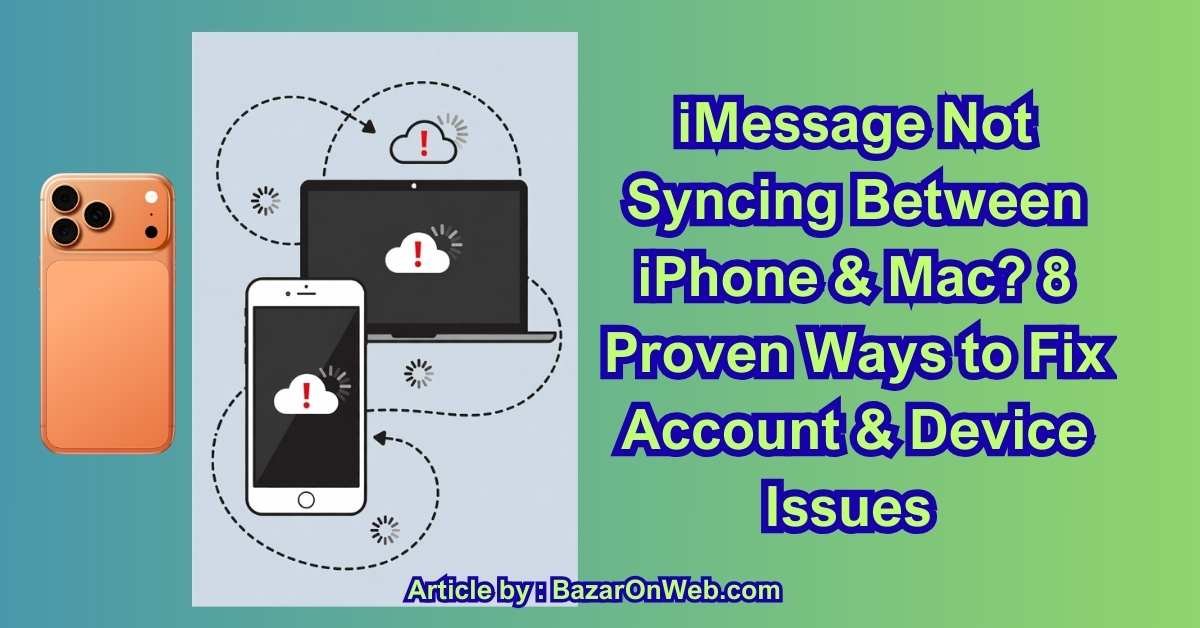
For Apple users, iMessage is more than a messaging app — it’s a seamless communication ecosystem. One conversation can start on an iPhone during a commute, continue on a Mac during work hours, and finish later on an iPad at home. When everything syncs correctly, the experience feels effortless. Messages appear instantly across devices, photos and videos transfer smoothly, and conversation history stays consistent everywhere.
But when iMessage stops syncing between iPhone and Mac, that seamless continuity breaks. Messages delivered on the iPhone never show up on the Mac. Replies typed on macOS stay stuck locally. Entire conversation threads appear incomplete or outdated. For some users, only new messages sync — old history remains missing. Others see blue bubbles on one device and green SMS responses on another. iMessage may appear signed in on both devices, yet syncing remains frozen.
This issue is surprisingly common. Apple devices rely on several underlying systems to keep iMessage synchronized:
-
Apple ID login and verification
-
end-to-end encrypted message routing
-
Wi-Fi and cellular network connectivity
-
device trust and continuity handoff
-
iCloud syncing permissions
-
two-factor authentication
-
message storage settings
-
software version compatibility
If any of these layers fail, syncing stops — even if sending and receiving messages still works individually on each device.
The good news is that the cause is almost always fixable at home. Whether the problem is linked to Apple ID authentication, network limitations, disabled services, outdated OS versions, incorrect settings, or internal data corruption, troubleshooting in the right order restores full functionality in most cases.
Below are the first three proven methods that resolve the majority of iMessage syncing failures between iPhone and Mac. These steps start with the fundamentals — login and identity — then progress into feature-specific configuration.
Fix 1: Ensure Both Devices Are Logged Into the Same Apple ID
It sounds obvious, but this is the single most common cause of iMessage sync failure: the iPhone and Mac are signed in to different Apple IDs. Because messages are encrypted and tied to specific Apple ID accounts, even minor login discrepancies break syncing completely.
Start by confirming the Apple ID in use on each device.
On iPhone:
Settings → Your Name (Apple ID)
Check the email address listed.
Then verify the address iMessage is using:
Settings → Messages → Send & Receive
Under “You can receive iMessages to and reply from,” confirm the email and number.
If the phone number or email on this screen differs from your Apple ID name, syncing may fail.
On Mac:
Messages app → Settings → iMessage
Confirm the Apple ID listed at the top.
Also verify the phone number and email checkboxes under “You can be reached for messages at.”
Both devices must show the same contact points — especially the same phone number and email address.
If you discover a mismatch:
-
Sign out of iMessage on the Mac
-
Restart the Mac
-
Sign back in using the same Apple ID as the iPhone
-
Recheck phone number/email reachability
Many users forget that Mac can continue using an older Apple ID even after iPhone credentials are updated — especially if the Mac hasn’t rebooted recently.
Once accounts align, syncing often resumes automatically within a few minutes.
Why this works:
iMessage routing depends entirely on identity association. If Apple ID identity is split, conversation history cannot merge — even if both devices appear online and functional.
Fix 2: Enable iMessage Syncing in iCloud (Required for Full Message History)
Even if the same Apple ID is active, syncing can still fail due to iCloud settings. Messages only synchronize across devices when iCloud storage is turned on for messages — otherwise, each device maintains its own independent message database.
Many users mistakenly assume that signing into iMessage automatically syncs full history, but that’s not true. Apple requires an additional step: activating Messages in iCloud.
On iPhone:
Settings → Your Name → iCloud → Show All → Messages
Turn ON.
On Mac:
Messages app → Settings → iMessage → Enable Messages in iCloud
Turn ON.
If the feature is disabled on even one device, syncing remains partial or broken.
There’s another critical detail: iCloud must show enough available storage to support message syncing. High-resolution images and videos sent through iMessage can consume gigabytes, especially if stored for years. If iCloud lacks free space, sync attempts will silently fail.
To check storage on iPhone:
Settings → Your Name → iCloud → Manage Account Storage
If storage is full, free space or upgrade your plan.
After enabling iCloud sync on both devices, expect syncing to take time — especially if message history is large. It’s normal for the Mac to display “Downloading messages from iCloud…” for minutes or hours. During this stage, performance may slow temporarily.
Why this works:
iMessage syncing between devices is not peer-to-peer. Instead, messages sync through iCloud servers. If iCloud sync is disabled, devices never exchange history — they only send/receive new message events individually.
Fix 3: Confirm Phone Number and Email Reachability Settings Match Across Devices
Even when Apple ID is correct and Messages in iCloud is enabled, syncing may still fail if the iPhone and Mac do not share identical contact points.
iMessage uses “reachability” settings to determine how messages attach to identity. If iPhone receives messages at a phone number, but Mac receives messages only at an email address, thread continuity breaks.
To align settings, review “Send & Receive” on both devices.
On iPhone:
Settings → Messages → Send & Receive
Ensure:
-
the phone number is checked
-
the correct Apple ID email address is checked
-
“Start new conversations from” uses the same entry you want synced
On Mac:
Messages → Settings → iMessage → You can be reached at
Ensure the same number and email addresses are selectable and checked.
If the Mac does not show the phone number:
-
Sign out of iMessage on macOS
-
Sign back in
-
Wait for number registration to complete
Phone number visibility on Mac depends on proper authentication via Apple ID keychain trust — which is why rebooting, signing back in, or verifying two-factor authentication may be necessary.
Once settings match, send a message from the device that was previously missing updates. If conversation threads merge, syncing is restored. If not, proceed to the next steps (next parts).
Why this works:
iMessage delivery is endpoint-based. If identity endpoints don’t match, messages fragment across devices. Matching endpoints unifies identity and restores full conversation continuity.
Fix 4: Check Device Time, Date, Region & System Software Version Match
While it may seem unrelated at first glance, mismatched time and date settings are a proven cause of iMessage sync failure. iMessage relies on encryption handshakes, token timestamps, iCloud validation, and server authentication — and all of those processes depend on accurate time alignment across devices. If your Mac and iPhone are even a few minutes apart, encryption keys may be rejected, breaking sync but allowing local messaging to continue.
The first step is confirming automatic time controls.
On iPhone:
Settings → General → Date & Time → Set Automatically → ON
Ensure the region and time zone are correct.
On Mac:
System Settings → General → Date & Time → Set Automatically → ON
Verify network time synchronization is active.
If you previously changed regions — for travel, VPN use, international messaging, or App Store restrictions — those settings can interfere with identity validation. Ensure the region matches across devices, or at minimum, corresponds to your Apple ID region.
Next, confirm software version compatibility. iMessage syncing works best when both devices run reasonably current operating systems. If your iPhone is on iOS 17 and your Mac is on macOS Monterey, syncing may remain inconsistent.
Update both devices:
On iPhone:
Settings → General → Software Update
On Mac:
System Settings → General → Software Update
After updating, restart both devices. Restarting flushes cached routing tables and resets cryptographic handshakes that iMessage depends on.
While it may not feel like a direct fix, date/time alignment and OS updates resolve an entire category of syncing failures. When devices agree on region, time zone, timestamp, and OS protocols, iMessage server communication becomes clean and reliable again.
For many users, syncing resumes shortly after reboot — especially when larger message archives begin reloading from iCloud.
Fix 5: Reset Network and iMessage Connections (Cellular, Wi-Fi, and Apple Servers)
If settings look correct but messages still won’t sync, the next step is forcing a clean network reconnect. iMessage relies on active routing between your iPhone, Mac, Apple’s servers, and iCloud. When one link pauses or corrupts, sync activity silently stops.
Begin with a basic toggle:
On iPhone:
Settings → Messages → Turn iMessage OFF
Wait 10 seconds
Turn it ON again
You’ll see a brief activation message — this reconnects the phone number to Apple servers and often restores missing sync traffic.
Then do the same on Mac:
Messages → Settings → iMessage → Sign Out
Quit Messages
Reopen app
Sign in again
This refreshes token trust and identity routing.
If syncing still fails, restart network pathways.
On iPhone:
Settings → General → Transfer or Reset → Reset Network Settings
This clears Wi-Fi passwords, DNS tables, VPN configs, and cellular routing. It does NOT delete data.
On Mac, toggle Wi-Fi OFF/ON, disconnect and reconnect to the same network, or switch to another.
Next, ensure your iPhone is using cellular data for iMessage activation:
Settings → Cellular → Toggle ON iMessage support
Without cellular authentication, some carriers block server activation — especially after SIM card changes or mobile plan resets.
Also test hotspot mode or switch networks entirely. If iMessage suddenly syncs on another connection, the issue lies in router settings, captive portals, DNS routing, or ISP filtering.
Advanced users can reset DNS to a public provider:
Google DNS:
8.8.8.8
8.8.4.4
Cloudflare DNS:
1.1.1.1
1.0.0.1
Network resets work because iMessage sync is not just a local feature — it is a live process using Apple Push Notification Service (APNs), end-to-end encryption, identity servers, and external routing. Repairing network pathways restores message delivery continuity between devices.
Fix 6: Enable Text Message Forwarding and Verify Handoff & Continuity Settings
Many users think iMessage syncing is broken because SMS or earlier messages do not appear on the Mac. In reality, Apple separates iMessages (blue bubbles) from SMS/MMS text messages (green bubbles). iMessage sync uses the Apple ID cloud system, but SMS syncing uses a different feature: Text Message Forwarding. Without it, SMS messages remain iPhone-only.
To enable text syncing:
On iPhone:
Settings → Messages → Text Message Forwarding → Select your Mac
When enabled, SMS messages are routed to macOS and appear inside the same Messages app.
If the Mac does not appear in the list, check that both devices are:
-
signed into the same Apple ID
-
connected to Wi-Fi
-
nearby with Bluetooth ON
-
unlocked
-
using two-factor authentication
If activation attempts fail, toggle iMessage OFF and ON again on iPhone, and sign out/sign in again on Mac.
Next, verify Handoff and Continuity — the core Apple ecosystem features that allow data flow between devices.
On iPhone:
Settings → General → AirPlay & Handoff → Handoff → ON
On Mac:
System Settings → General → AirDrop & Handoff → Allow Handoff → ON
Handoff allows messages, calls, and app states to transfer across devices. When disabled, syncing reliability decreases dramatically.
Finally, confirm Bluetooth is enabled on both devices — not for data transfer, but for identity proximity. Continuity relies on Bluetooth to confirm that both devices belong to the same user in the same physical space.
After enabling these settings, restart the Messages app on Mac, send a new text from either device, and check whether the thread updates. Once syncing begins, older messages often repopulate gradually.
Text Message Forwarding and Handoff are critical because Apple designed syncing as a multi-layer ecosystem — not just cloud-based. When routing, forwarding, and continuity services are disabled, full message continuity cannot exist. Enabling them restores cross-device communication and fixes many cases where conversations update on iPhone but not on Mac.
Fix 7: Reset iCloud Sync, Re-Sync Messages, and Rebuild Conversation Indexing
If messages still refuse to sync between iPhone and Mac after checking account identity, iCloud activation, device reachability, OS versions, and continuity settings, the next step is refreshing iCloud messaging sync altogether. In many cases, sync stalls due to outdated database indexing stored in the cloud. Resetting message syncing forces Apple servers to rebuild and redistribute your message archive, which often restores missing conversations and corrects sync routing errors.
Start on the iPhone, because it remains the origin device for message identity.
On iPhone:
Settings → Your Name → iCloud → Show All → Messages → Turn OFF iCloud syncing
When prompted, select “Disable and Download Messages.” This option ensures that messages remain stored on the phone rather than being removed.
Wait 30 seconds, then turn Messages in iCloud ON again.
What happens next is important: iCloud begins re-uploading and re-indexing message history stored on the device. For users with years of attachments, videos, group chats, and high-resolution media, this process may take significant time. During the rebuild phase, message results may appear temporarily incomplete — that is normal.
On Mac:
Open Messages → Settings → iMessage → Turn OFF “Enable Messages in iCloud.”
Quit the Messages app completely.
Wait 30 seconds.
Turn syncing ON again.
The Mac will begin downloading the refreshed cloud archive.
Because iMessage history is end-to-end encrypted, iCloud uses secure cryptographic pointers linked to Apple ID trust, device tokens, and notification routing. If those pointers become outdated or corrupted, devices may stop receiving sync instructions even though messages remain intact in storage. Re-syncing replaces damaged references and forces the Mac and iPhone to start fresh with the newest version of your conversation database.
For users who recently upgraded to a new device — such as upgrading to a new iPhone or restoring a Mac from backup — re-syncing is often the decisive fix that restores full message continuity.
To monitor progress on Mac, look at the Messages app status area; it may show, “Downloading Messages from iCloud…” This message can remain for minutes or hours depending on archive size and connection speed.
If syncing continues to fail even after refreshing iCloud, proceed to the final repair method — fully resetting iMessage connectivity at system level.
Fix 8: Reset iMessage Activation, Rebuild Keychain Trust, and Reauthorize Devices
When every other fix has been exhausted and messages still refuse to sync, the root cause is almost always identity trust failure between devices. iMessage depends on encrypted trust relationships among iPhone, Mac, Apple ID, Keychain, and iCloud servers. If any trust token becomes invalid — which can happen quietly after password changes, 2FA updates, carrier changes, SIM swaps, device resets, macOS migrations, or long gaps between Mac logins — message sync breaks at its foundation.
The solution is to force Apple’s authentication chain to rebuild from scratch. This process sounds technical, but it is straightforward.
Begin by resetting iMessage activation on iPhone:
Settings → Messages → Turn OFF iMessage
Settings → FaceTime → Turn OFF FaceTime
Restart iPhone
Turn both services back ON
During reactivation, your phone number is re-registered with Apple servers under the correct digital signature. iMessage will show “Waiting for activation…” — then “Activated.” Syncing may resume immediately afterward.
Next, rebuild trust on Mac:
Messages → Settings → iMessage → Sign Out
Quit Messages
Restart Mac
Reopen Messages and sign in again
macOS will request permission to use iCloud Keychain. Approve it.
This step refreshes encryption tokens tied to your Mac login and ensures the device is re-linked to your Apple ID message identity.
If activation still fails, turn Keychain off and back on:
On iPhone:
Settings → Your Name → iCloud → Keychain → OFF
Restart iPhone
Turn Keychain ON again
On Mac:
System Settings → Apple ID → iCloud → Passwords & Keychain → OFF
Restart Mac
Turn Keychain ON again
This clears outdated device trust entries and forces regeneration of secure messaging keys.
Finally, check device trust approval status:
On iPhone, under Apple ID settings, scroll to the bottom; ensure the Mac appears in the trusted device list.
On Mac, do the same.
If a device is missing, its trust level may have been removed automatically by Apple due to inactivity or risk detection. Signing back into iMessage usually restores trust automatically, but occasionally Apple ID password reset may be required.
Once trust and activation are reset, test message continuity by sending:
-
one iMessage from iPhone
-
one iMessage from Mac
-
one SMS from iPhone
If the conversation syncs across devices, the identity link is restored — and the issue is solved.
This final step works because iMessage syncing is fundamentally an identity synchronization problem, not a messaging problem. When identity trust is rebuilt, all other components fall into place.
Conclusion
When iMessage sync stops working between iPhone and Mac, it can disrupt the seamless communication flow Apple users depend on. Messages land on one device but not the other, conversation history breaks apart, media disappears, and notifications lose context. For many users, the experience is confusing — especially when everything appears to be signed in, online, and functioning. But as this guide shows, syncing problems aren’t random. They happen for specific, fixable reasons.
The eight solutions outlined here approach the problem from every angle, starting with identity and account structure, then moving through device configuration, network reliability, continuity settings, and internal database integrity. By working through each step, users can eliminate guesswork and systematically uncover the root cause.
The early fixes focus on the essentials: verifying that the same Apple ID is in use on both devices, enabling Messages in iCloud, and ensuring phone number and email reachability match. These steps alone solve a large share of sync failures — particularly when users upgrade devices, reset logins, or manage multiple Apple IDs.
The next set of fixes explore deeper areas of alignment. Correct date and time settings may seem trivial, but they are vital for cryptographic time stamps and secure message routing. Software version consistency ensures device compatibility. Resetting network connections, Wi-Fi routing, DNS paths, and activation signals helps restore communication links with Apple servers.
From there, the guide addresses continuity features that operate behind the scenes. Handoff, Text Message Forwarding, Apple ID trust, and Keychain permissions all contribute to message delivery and synchronization. When these components are disabled or disrupted, iMessage may continue functioning locally — but syncing will collapse.
Finally, the advanced repair methods target the underlying message database, cloud indexing, and trust architecture. Rebuilding message indexing through iCloud and resetting device authorization signals gives Apple’s encrypted messaging ecosystem a clean foundation to work with. These steps are powerful because they address not just symptoms, but root-level causes.
Once syncing is restored, users can prevent future issues by maintaining a few habits:
-
keeping iPhone and Mac updated
-
avoiding multiple Apple IDs for messaging
-
leaving device region and time settings on automatic
-
checking iCloud storage availability
-
restarting devices periodically
-
re-authenticating after password changes
With these best practices in place, iMessage can continue delivering the seamless continuity Apple is known for — allowing conversations to move effortlessly between devices with accuracy, security, and reliability.
Most importantly, users should feel reassured: a syncing breakdown is rarely permanent. With the right sequence of troubleshooting steps, iMessage sync can be restored on almost any device, even after complex account or system changes.
If the process ever feels overwhelming, simply return to the steps in this guide — and let the system rebuild itself in the background. Once restored, iMessage syncing quickly becomes invisible again, working quietly and reliably just beneath the surface.
Disclaimer (Bazaronweb.com)
The information provided in this article is for educational and troubleshooting purposes only. Results may vary depending on device model, iOS/macOS version, Apple ID configuration, iCloud settings, network environment, and hardware condition. Bazaronweb.com is not responsible for data loss, device changes, account access issues, or system errors that may occur from applying these steps.
Apple, iMessage, macOS, iPhone, and all related product names are trademarks of Apple Inc. Bazaronweb.com is not affiliated with Apple.

- How to Transcribe Audio Live on Your iPhone

- Killer Network Service: Is It a Virus or Safe to Disable?

- How to Set Up Parental Controls on Windows 11: A Step-by-Step Guide

- How to Extract Audio From a Video: Easy Ways to Save Audio

- How to Set a Photo Album as Your Wallpaper on iPhone: Step-by-Step Guide

Products
-
![Apple Watch Ultra 3 [GPS + Cellular 49mm] Running & Multisport Smartwatch w/Rugged Titanium Case w/Black Titanium Milanese Loop - M. Satellite Communications, Advanced Health & Fitness Tracking](https://bazaronweb.com/retailstores/wp-content/uploads/2025/09/apple-watch-320x320.jpg) Apple Watch Ultra 3 [GPS + Cellular 49mm] Running & Multisport Smartwatch w/Rugged Titanium Case w/Black Titanium Milanese Loop - M. Satellite Communications, Advanced Health & Fitness Tracking
Apple Watch Ultra 3 [GPS + Cellular 49mm] Running & Multisport Smartwatch w/Rugged Titanium Case w/Black Titanium Milanese Loop - M. Satellite Communications, Advanced Health & Fitness Tracking
-
 Apple iPad mini (A17 Pro): Apple Intelligence, 8.3-inch Liquid Retina Display, 256GB, Wi-Fi 6E, 12MP Front/12MP Back Camera, Touch ID, All-Day Battery Life — Purple
-
 Apple AirPods Max Wireless Over-Ear Headphones, Active Noise Cancelling, Transparency Mode, Personalized Spatial Audio, Dolby Atmos, Bluetooth Headphones for iPhone – Space Gray
-
 Apple AirPods Pro 2 Wireless Earbuds, Active Noise Cancellation, Hearing Aid Feature, Bluetooth Headphones, Transparency, Personalized Spatial Audio, High-Fidelity Sound, H2 Chip, USB-C Charging
-
Home Garage 210 TC Cotton King Floral Fitted (Elastic) Bedsheet(Pack of 1, Grey)
Original price was: ₹999.00.₹299.00Current price is: ₹299.00.
Leave a Reply