Discounted Products
-
 Home Garage 210 TC Cotton King Floral Fitted (Elastic) Bedsheet(Pack of 1, Grey)
Original price was: ₹999.00.₹299.00Current price is: ₹299.00.
Home Garage 210 TC Cotton King Floral Fitted (Elastic) Bedsheet(Pack of 1, Grey)
Original price was: ₹999.00.₹299.00Current price is: ₹299.00.
-
 Goodrik 140 TC Cotton Double 3D Printed Flat Bedsheet(Pack of 1, Brown)
Original price was: ₹499.00.₹229.00Current price is: ₹229.00.
Goodrik 140 TC Cotton Double 3D Printed Flat Bedsheet(Pack of 1, Brown)
Original price was: ₹499.00.₹229.00Current price is: ₹229.00.
-
 GLOBALSHOP 350 TC Microfiber Double Floral Flat Bedsheet(Pack of 1, Multicolor)
Original price was: ₹1,250.00.₹263.00Current price is: ₹263.00.
GLOBALSHOP 350 TC Microfiber Double Floral Flat Bedsheet(Pack of 1, Multicolor)
Original price was: ₹1,250.00.₹263.00Current price is: ₹263.00.
-
 RisingStar 250 TC Microfiber King Printed Fitted (Elastic) Bedsheet(Pack of 1, FITTED-ROUND-CIRCLES-PREMIUM)
Original price was: ₹2,299.00.₹299.00Current price is: ₹299.00.
RisingStar 250 TC Microfiber King Printed Fitted (Elastic) Bedsheet(Pack of 1, FITTED-ROUND-CIRCLES-PREMIUM)
Original price was: ₹2,299.00.₹299.00Current price is: ₹299.00.
-
 Home Garage 210 TC Cotton King Floral Fitted (Elastic) Bedsheet(Pack of 1, Fitted Black Green)
Original price was: ₹1,299.00.₹299.00Current price is: ₹299.00.
Home Garage 210 TC Cotton King Floral Fitted (Elastic) Bedsheet(Pack of 1, Fitted Black Green)
Original price was: ₹1,299.00.₹299.00Current price is: ₹299.00.
-
 Home Garage 180 TC Cotton King 3D Printed Flat Bedsheet(Pack of 1, White)
Original price was: ₹999.00.₹229.00Current price is: ₹229.00.
Home Garage 180 TC Cotton King 3D Printed Flat Bedsheet(Pack of 1, White)
Original price was: ₹999.00.₹229.00Current price is: ₹229.00.
-
 Panipat Textile Hub 152.4 cm (5 ft) Polyester Window Curtain (Pack Of 2)(Solid, Aqua)
Original price was: ₹1,899.00.₹299.00Current price is: ₹299.00.
Panipat Textile Hub 152.4 cm (5 ft) Polyester Window Curtain (Pack Of 2)(Solid, Aqua)
Original price was: ₹1,899.00.₹299.00Current price is: ₹299.00.
-
 Home Sizzler 214 cm (7 ft) Polyester Semi Transparent Door Curtain (Pack Of 2)(Floral, Maroon)
Original price was: ₹1,199.00.₹399.00Current price is: ₹399.00.
Home Sizzler 214 cm (7 ft) Polyester Semi Transparent Door Curtain (Pack Of 2)(Floral, Maroon)
Original price was: ₹1,199.00.₹399.00Current price is: ₹399.00.
-
 Home Sizzler 153 cm (5 ft) Polyester Room Darkening Window Curtain (Pack Of 2)(Floral, Brown)
Original price was: ₹799.00.₹299.00Current price is: ₹299.00.
Home Sizzler 153 cm (5 ft) Polyester Room Darkening Window Curtain (Pack Of 2)(Floral, Brown)
Original price was: ₹799.00.₹299.00Current price is: ₹299.00.
-
 Stella Creations 214 cm (7 ft) Polyester Room Darkening Door Curtain (Pack Of 2)(Abstract, Brown)
Original price was: ₹1,299.00.₹449.00Current price is: ₹449.00.
Stella Creations 214 cm (7 ft) Polyester Room Darkening Door Curtain (Pack Of 2)(Abstract, Brown)
Original price was: ₹1,299.00.₹449.00Current price is: ₹449.00.
-
 Homefab India 152.5 cm (5 ft) Polyester Room Darkening Window Curtain (Pack Of 2)(Floral, Light Blue)
Original price was: ₹1,199.00.₹319.00Current price is: ₹319.00.
Homefab India 152.5 cm (5 ft) Polyester Room Darkening Window Curtain (Pack Of 2)(Floral, Light Blue)
Original price was: ₹1,199.00.₹319.00Current price is: ₹319.00.
-
 Urban Home 214 cm (7 ft) PVC Transparent Door Curtain Single Curtain(Solid, Off White)
Original price was: ₹699.00.₹203.00Current price is: ₹203.00.
Urban Home 214 cm (7 ft) PVC Transparent Door Curtain Single Curtain(Solid, Off White)
Original price was: ₹699.00.₹203.00Current price is: ₹203.00.
-
 Panipat Textile Hub 213 cm (7 ft) Polyester Door Curtain (Pack Of 2)(Solid, Brown)
Original price was: ₹1,199.00.₹349.00Current price is: ₹349.00.
Panipat Textile Hub 213 cm (7 ft) Polyester Door Curtain (Pack Of 2)(Solid, Brown)
Original price was: ₹1,199.00.₹349.00Current price is: ₹349.00.
-
 Home Sizzler 214 cm (7 ft) Polyester Semi Transparent Door Curtain (Pack Of 2)(Floral, Brown)
Original price was: ₹999.00.₹349.00Current price is: ₹349.00.
Home Sizzler 214 cm (7 ft) Polyester Semi Transparent Door Curtain (Pack Of 2)(Floral, Brown)
Original price was: ₹999.00.₹349.00Current price is: ₹349.00.
-
 Panipat Textile Hub 213 cm (7 ft) Polyester Semi Transparent Door Curtain (Pack Of 2)(Floral, Brown)
Original price was: ₹899.00.₹299.00Current price is: ₹299.00.
Panipat Textile Hub 213 cm (7 ft) Polyester Semi Transparent Door Curtain (Pack Of 2)(Floral, Brown)
Original price was: ₹899.00.₹299.00Current price is: ₹299.00.
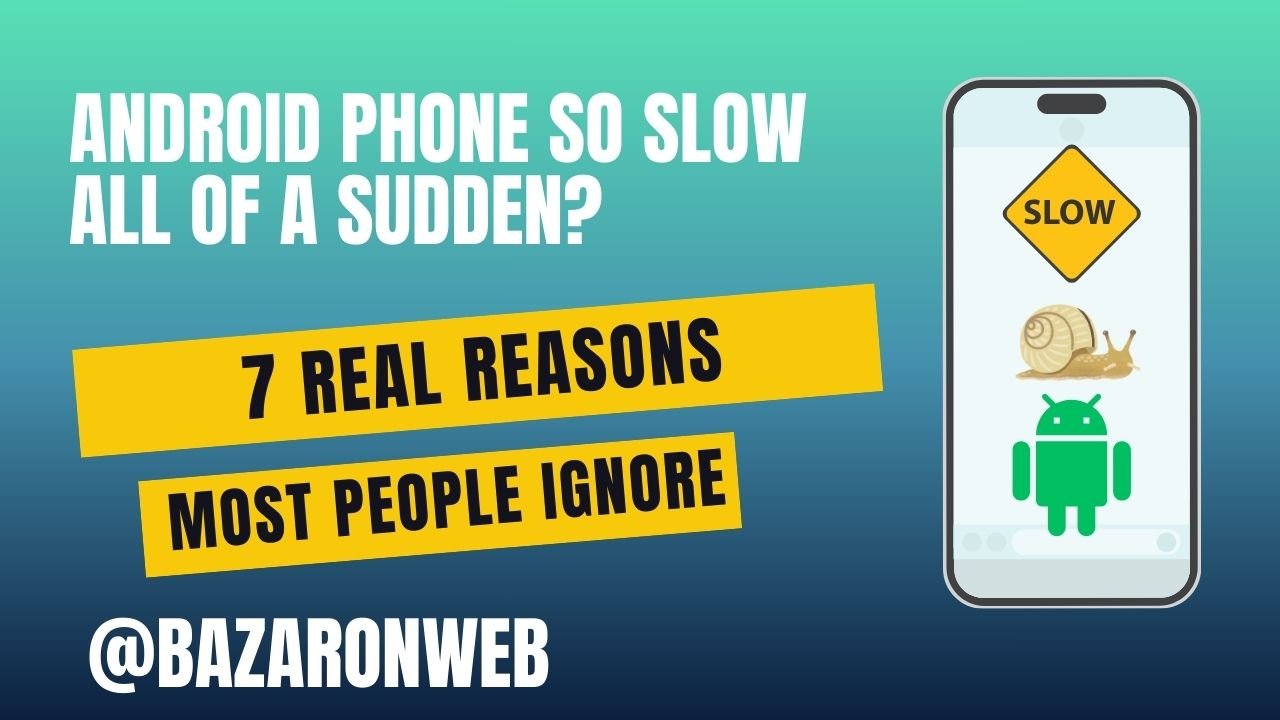
When an Android phone suddenly starts feeling slow, the first reaction is usually panic mixed with confusion. It was working fine yesterday. I didn’t drop it. I didn’t install anything strange. So what changed?
The truth is, Android phones rarely slow down for one dramatic reason. Most of the time, it’s a few quiet, everyday issues stacking up in the background—things we don’t notice until the phone starts lagging, freezing, or taking forever to open apps.
Let’s start with the first three reasons, because these are the most common—and also the most ignored.
Reason 1: Too Many Apps Running in the Background (Even When You Think They’re Closed)
This one surprises a lot of people.
You might think that once you exit an app or swipe it away from recent apps, it’s gone. But on Android, that’s not always true. Many apps continue running quietly in the background, using RAM, CPU, and sometimes even internet and battery.
Apps that commonly run in the background include:
-
Social media apps (Instagram, Facebook, Snapchat)
-
Messaging apps (WhatsApp, Telegram, Messenger)
-
Shopping apps
-
Fitness and health trackers
-
Cloud storage apps
-
Email apps with constant sync
Individually, these apps don’t seem heavy. But when 10–15 of them are active at the same time, your phone starts struggling to keep up.
What happens internally is simple:
Your phone’s RAM gets overloaded. When RAM is full, Android starts aggressively closing and reopening apps. That’s when you notice:
-
Apps taking longer to open
-
The home screen freezing briefly
-
Keyboard lag while typing
-
Apps restarting instead of resuming
This slowdown often feels sudden because background activity builds up gradually. One day, your phone crosses a threshold—and performance drops.
Why most people ignore this:
-
There’s no warning saying “too many apps running”
-
The phone still technically works, just slower
-
Swiping apps away gives a false sense of closure
If your phone becomes noticeably faster right after a restart but slows down again within a day or two, background apps are almost always the reason.
Reason 2: Storage Is Almost Full (Even If You Didn’t Get a Warning Yet)
Android phones need free storage to function properly, not just to save files.
When internal storage drops below a certain level (usually around 10–15%), Android struggles to:
-
Cache temporary files
-
Load apps smoothly
-
Process updates efficiently
-
Manage system operations
And here’s the tricky part:
Your phone can be technically usable even when storage is critically low—so the slowdown feels mysterious.
You may notice:
-
Apps taking longer to launch
-
Camera lag or failure to save photos
-
Random stutters while scrolling
-
System UI delays
-
Slower app switching
What makes this worse is that storage isn’t just photos and videos. A huge portion is taken up by:
-
App cache
-
App data
-
Messaging media
-
Offline downloads
-
System temporary files
So even if you delete a few files, performance may not improve at all—because the real storage pressure remains.
Why most people miss this:
-
Storage charts often label space as “System” or “Other”
-
Deleting visible files doesn’t help much
-
The phone doesn’t always show a clear “low storage” alert early enough
Android slows down before storage is completely full. By the time you see constant warnings, performance has already taken a hit.
Reason 3: Recent System Updates Changed How Your Phone Behaves
This one is subtle—and very common.
Android system updates are meant to improve security and features, but they can temporarily (or sometimes permanently) affect performance, especially on older or mid-range devices.
After an update, your phone may:
-
Re-index apps and files
-
Rebuild system cache
-
Enable new background services
-
Increase system resource usage
-
Change battery or performance management rules
All of this happens quietly. From your perspective, the phone just feels slower “for no reason.”
In some cases, apps also haven’t fully optimized themselves for the new Android version yet. Until they update, they may:
-
Use more CPU
-
Consume more RAM
-
Load slower
-
Crash or stutter
This is why people often say:
“My phone became slow right after an update.”
They’re not imagining it.
Why this slowdown feels sudden:
-
The update happens once
-
System behavior changes immediately
-
Background processes spike for days afterward
Why people ignore it:
-
Updates are assumed to be purely positive
-
The phone still works, just not smoothly
-
There’s no clear message saying “performance may dip temporarily”
On devices with limited RAM or older processors, updates can push the hardware closer to its limits—making everyday tasks feel heavier than before.
Jessica’s Honest Take 📱
When an Android phone slows down suddenly, it’s almost never because the phone “gave up.” It’s usually because background load, storage pressure, or system changes crossed a line all at once. These first three reasons alone explain the slowdown for a majority of users—and the best part is, they’re fixable once you know where to look.
If the first three reasons explained why your phone started slowing down, the next four explain why it stays slow even when you feel like you haven’t done anything wrong. These are the deeper, quieter issues—things Android rarely explains clearly, but that have a very real impact on everyday performance.
Reason 4: Battery Health & Power Management Are Quietly Throttling Performance
This is one of the most misunderstood reasons Android phones slow down.
As your phone battery ages, it doesn’t just lose charge capacity—it also becomes less stable at delivering power. To prevent sudden shutdowns or overheating, Android automatically limits performance when it detects battery stress.
What this means in real life:
-
Apps open slower
-
Animations feel choppy
-
The phone hesitates during multitasking
-
Performance drops even when battery percentage looks fine
Android doesn’t usually show a warning that says “Your phone is slower because of battery health.” Instead, it silently adjusts performance to protect the hardware.
You’ll notice this more if:
-
Your phone is over 2 years old
-
Battery drains faster than before
-
Phone slows down when battery is below 30%
-
Performance improves briefly while charging
Why most people ignore this:
-
Battery health isn’t clearly visible on many Android phones
-
Users assume slowdown = “old phone”
-
Charging temporarily hides the problem
In reality, Android is intentionally holding back performance to keep the phone stable. It’s protective—but frustrating if you don’t know it’s happening.
Reason 5: Your Phone Is Overheating (Even When It Doesn’t Feel Hot)
Heat is one of the fastest ways to kill performance.
Modern Android phones constantly monitor temperature. When internal temperature rises—even slightly—Android reduces CPU and GPU speed to prevent damage. This is called thermal throttling, and it can make a powerful phone feel painfully slow.
Common causes of overheating:
-
Heavy background apps
-
Mobile data + GPS + Bluetooth running together
-
Poor signal strength (phone works harder)
-
Gaming or video streaming
-
Charging while using the phone
-
Hot weather or direct sunlight
What makes this tricky is that your phone may not feel burning hot. Even moderate warmth can trigger throttling.
Symptoms you’ll notice:
-
Phone slows down after a few minutes of use
-
Scrolling becomes jittery
-
Apps lag more as time passes
-
Camera app opens very slowly
-
Performance drops during video calls or navigation
Why people miss this:
-
No obvious “overheating” alert
-
Slowness comes and goes
-
Restart temporarily fixes it
Your phone isn’t failing—it’s protecting itself. But repeated overheating trains Android to stay cautious, keeping performance lower more often.
Reason 6: Animations and Visual Effects Are Too Heavy for Your Phone Now
This reason surprises almost everyone.
Android’s animations—app opening effects, transitions, scrolling physics—look smooth and modern. But they also consume processing power, especially after system updates.
When your phone was new, these animations felt effortless. Over time:
-
Apps become heavier
-
Android adds visual polish
-
Hardware stays the same
The result?
Animations start becoming a bottleneck.
You’ll experience:
-
Lag when opening apps
-
Delay when switching between screens
-
Stutter when going back to the home screen
-
Slowness that feels “visual” rather than functional
Why most people ignore this:
-
Animations feel cosmetic, not technical
-
The phone isn’t “broken,” just slow
-
Few users explore developer settings
In reality, reducing animation load can instantly make a phone feel faster—without deleting anything or changing apps.
This is why some phones feel dramatically smoother after small UI adjustments, even though the hardware hasn’t changed.
Reason 7: Your Phone Has Simply Aged—And Software Has Moved On
This is the hardest reason to accept, but also the most honest.
Android apps and operating systems are constantly evolving. They’re built for:
-
Faster processors
-
More RAM
-
Better graphics
-
New AI-based features
Your phone, however, stays the same.
Over time:
-
Apps demand more memory
-
Background services increase
-
Security layers get heavier
-
Multitasking expectations rise
Even if you use your phone carefully, software eventually outgrows hardware.
Signs this is happening:
-
Phone struggles with apps it once handled easily
-
System updates feel heavier
-
Multitasking becomes painful
-
Lag appears even after cleanup
Why people resist this idea:
-
The phone still “works”
-
It wasn’t cheap
-
There’s no clear failure point
But slowdown due to aging isn’t sudden—it’s cumulative. One day, you just notice it.
That doesn’t always mean replacement is necessary. It just means expectations need adjusting, and optimization becomes more important than ever.
Jessica’s Real Talk 📱
When an Android phone slows down all of a sudden, it’s rarely because of one dramatic failure. It’s usually because battery health, heat, visuals, and software growth quietly crossed a limit together. None of these issues announce themselves clearly—but once you understand them, the slowdown stops feeling mysterious or personal.
Conclusion
When an Android phone suddenly starts feeling slow, it’s easy to blame age, bad luck, or assume it’s time for a replacement. But as you’ve seen across all seven reasons, slowdown is rarely caused by one single issue. It’s usually the result of multiple small factors stacking up quietly over time—background apps, storage pressure, system updates, battery health, overheating, heavy animations, and software outgrowing hardware.
What makes this slowdown feel so frustrating is that Android doesn’t clearly explain why it’s happening. There’s no single alert saying, “Your phone is slow because your battery is aging” or “Your phone is struggling due to thermal throttling.” Instead, performance just fades gradually—until one day it becomes impossible to ignore.
The good news is that slowdown doesn’t automatically mean your phone is failing. In many cases, it’s simply working harder than it should. Understanding these hidden causes gives you back control. Once you know what to look for, you can make smarter decisions—whether that’s adjusting habits, changing a few settings, or optimizing how your phone is used day to day.
Another important takeaway is expectation management. Phones don’t slow down out of spite or planned failure; they slow down because software evolves faster than hardware. Recognizing this helps you stop chasing “quick fixes” and instead focus on realistic, sustainable improvements.
Most importantly, sudden slowness is not a personal mistake. It’s a natural outcome of how modern smartphones work. With awareness and a few informed choices, you can often restore a surprising amount of smoothness—and at the very least, understand why your phone behaves the way it does.
A slow phone feels stressful. A slow phone you understand feels manageable.
Disclaimer
This article is published by Bazaronweb for informational and educational purposes only. Android performance, features, and settings may vary depending on device manufacturer, model, and software version. Users should review settings carefully before making changes. Bazaronweb is not responsible for device issues, data loss, or performance changes resulting from the use of this information.

- How to Transcribe Audio Live on Your iPhone

- Killer Network Service: Is It a Virus or Safe to Disable?

- How to Set Up Parental Controls on Windows 11: A Step-by-Step Guide

- How to Extract Audio From a Video: Easy Ways to Save Audio

- How to Set a Photo Album as Your Wallpaper on iPhone: Step-by-Step Guide

Products
-
![Apple Watch Ultra 3 [GPS + Cellular 49mm] Running & Multisport Smartwatch w/Rugged Titanium Case w/Black Titanium Milanese Loop - M. Satellite Communications, Advanced Health & Fitness Tracking](https://bazaronweb.com/retailstores/wp-content/uploads/2025/09/apple-watch-320x320.jpg) Apple Watch Ultra 3 [GPS + Cellular 49mm] Running & Multisport Smartwatch w/Rugged Titanium Case w/Black Titanium Milanese Loop - M. Satellite Communications, Advanced Health & Fitness Tracking
Apple Watch Ultra 3 [GPS + Cellular 49mm] Running & Multisport Smartwatch w/Rugged Titanium Case w/Black Titanium Milanese Loop - M. Satellite Communications, Advanced Health & Fitness Tracking
-
 Apple iPad mini (A17 Pro): Apple Intelligence, 8.3-inch Liquid Retina Display, 256GB, Wi-Fi 6E, 12MP Front/12MP Back Camera, Touch ID, All-Day Battery Life — Purple
-
 Apple AirPods Max Wireless Over-Ear Headphones, Active Noise Cancelling, Transparency Mode, Personalized Spatial Audio, Dolby Atmos, Bluetooth Headphones for iPhone – Space Gray
-
 Apple AirPods Pro 2 Wireless Earbuds, Active Noise Cancellation, Hearing Aid Feature, Bluetooth Headphones, Transparency, Personalized Spatial Audio, High-Fidelity Sound, H2 Chip, USB-C Charging
-
Home Garage 210 TC Cotton King Floral Fitted (Elastic) Bedsheet(Pack of 1, Grey)
Original price was: ₹999.00.₹299.00Current price is: ₹299.00.
Leave a Reply