Discounted Products
-
 Home Garage 210 TC Cotton King Floral Fitted (Elastic) Bedsheet(Pack of 1, Grey)
Original price was: ₹999.00.₹299.00Current price is: ₹299.00.
Home Garage 210 TC Cotton King Floral Fitted (Elastic) Bedsheet(Pack of 1, Grey)
Original price was: ₹999.00.₹299.00Current price is: ₹299.00.
-
 Goodrik 140 TC Cotton Double 3D Printed Flat Bedsheet(Pack of 1, Brown)
Original price was: ₹499.00.₹229.00Current price is: ₹229.00.
Goodrik 140 TC Cotton Double 3D Printed Flat Bedsheet(Pack of 1, Brown)
Original price was: ₹499.00.₹229.00Current price is: ₹229.00.
-
 GLOBALSHOP 350 TC Microfiber Double Floral Flat Bedsheet(Pack of 1, Multicolor)
Original price was: ₹1,250.00.₹263.00Current price is: ₹263.00.
GLOBALSHOP 350 TC Microfiber Double Floral Flat Bedsheet(Pack of 1, Multicolor)
Original price was: ₹1,250.00.₹263.00Current price is: ₹263.00.
-
 RisingStar 250 TC Microfiber King Printed Fitted (Elastic) Bedsheet(Pack of 1, FITTED-ROUND-CIRCLES-PREMIUM)
Original price was: ₹2,299.00.₹299.00Current price is: ₹299.00.
RisingStar 250 TC Microfiber King Printed Fitted (Elastic) Bedsheet(Pack of 1, FITTED-ROUND-CIRCLES-PREMIUM)
Original price was: ₹2,299.00.₹299.00Current price is: ₹299.00.
-
 Home Garage 210 TC Cotton King Floral Fitted (Elastic) Bedsheet(Pack of 1, Fitted Black Green)
Original price was: ₹1,299.00.₹299.00Current price is: ₹299.00.
Home Garage 210 TC Cotton King Floral Fitted (Elastic) Bedsheet(Pack of 1, Fitted Black Green)
Original price was: ₹1,299.00.₹299.00Current price is: ₹299.00.
-
 Home Garage 180 TC Cotton King 3D Printed Flat Bedsheet(Pack of 1, White)
Original price was: ₹999.00.₹229.00Current price is: ₹229.00.
Home Garage 180 TC Cotton King 3D Printed Flat Bedsheet(Pack of 1, White)
Original price was: ₹999.00.₹229.00Current price is: ₹229.00.
-
 Panipat Textile Hub 152.4 cm (5 ft) Polyester Window Curtain (Pack Of 2)(Solid, Aqua)
Original price was: ₹1,899.00.₹299.00Current price is: ₹299.00.
Panipat Textile Hub 152.4 cm (5 ft) Polyester Window Curtain (Pack Of 2)(Solid, Aqua)
Original price was: ₹1,899.00.₹299.00Current price is: ₹299.00.
-
 Home Sizzler 214 cm (7 ft) Polyester Semi Transparent Door Curtain (Pack Of 2)(Floral, Maroon)
Original price was: ₹1,199.00.₹399.00Current price is: ₹399.00.
Home Sizzler 214 cm (7 ft) Polyester Semi Transparent Door Curtain (Pack Of 2)(Floral, Maroon)
Original price was: ₹1,199.00.₹399.00Current price is: ₹399.00.
-
 Home Sizzler 153 cm (5 ft) Polyester Room Darkening Window Curtain (Pack Of 2)(Floral, Brown)
Original price was: ₹799.00.₹299.00Current price is: ₹299.00.
Home Sizzler 153 cm (5 ft) Polyester Room Darkening Window Curtain (Pack Of 2)(Floral, Brown)
Original price was: ₹799.00.₹299.00Current price is: ₹299.00.
-
 Stella Creations 214 cm (7 ft) Polyester Room Darkening Door Curtain (Pack Of 2)(Abstract, Brown)
Original price was: ₹1,299.00.₹449.00Current price is: ₹449.00.
Stella Creations 214 cm (7 ft) Polyester Room Darkening Door Curtain (Pack Of 2)(Abstract, Brown)
Original price was: ₹1,299.00.₹449.00Current price is: ₹449.00.
-
 Homefab India 152.5 cm (5 ft) Polyester Room Darkening Window Curtain (Pack Of 2)(Floral, Light Blue)
Original price was: ₹1,199.00.₹319.00Current price is: ₹319.00.
Homefab India 152.5 cm (5 ft) Polyester Room Darkening Window Curtain (Pack Of 2)(Floral, Light Blue)
Original price was: ₹1,199.00.₹319.00Current price is: ₹319.00.
-
 Urban Home 214 cm (7 ft) PVC Transparent Door Curtain Single Curtain(Solid, Off White)
Original price was: ₹699.00.₹203.00Current price is: ₹203.00.
Urban Home 214 cm (7 ft) PVC Transparent Door Curtain Single Curtain(Solid, Off White)
Original price was: ₹699.00.₹203.00Current price is: ₹203.00.
-
 Panipat Textile Hub 213 cm (7 ft) Polyester Door Curtain (Pack Of 2)(Solid, Brown)
Original price was: ₹1,199.00.₹349.00Current price is: ₹349.00.
Panipat Textile Hub 213 cm (7 ft) Polyester Door Curtain (Pack Of 2)(Solid, Brown)
Original price was: ₹1,199.00.₹349.00Current price is: ₹349.00.
-
 Home Sizzler 214 cm (7 ft) Polyester Semi Transparent Door Curtain (Pack Of 2)(Floral, Brown)
Original price was: ₹999.00.₹349.00Current price is: ₹349.00.
Home Sizzler 214 cm (7 ft) Polyester Semi Transparent Door Curtain (Pack Of 2)(Floral, Brown)
Original price was: ₹999.00.₹349.00Current price is: ₹349.00.
-
 Panipat Textile Hub 213 cm (7 ft) Polyester Semi Transparent Door Curtain (Pack Of 2)(Floral, Brown)
Original price was: ₹899.00.₹299.00Current price is: ₹299.00.
Panipat Textile Hub 213 cm (7 ft) Polyester Semi Transparent Door Curtain (Pack Of 2)(Floral, Brown)
Original price was: ₹899.00.₹299.00Current price is: ₹299.00.
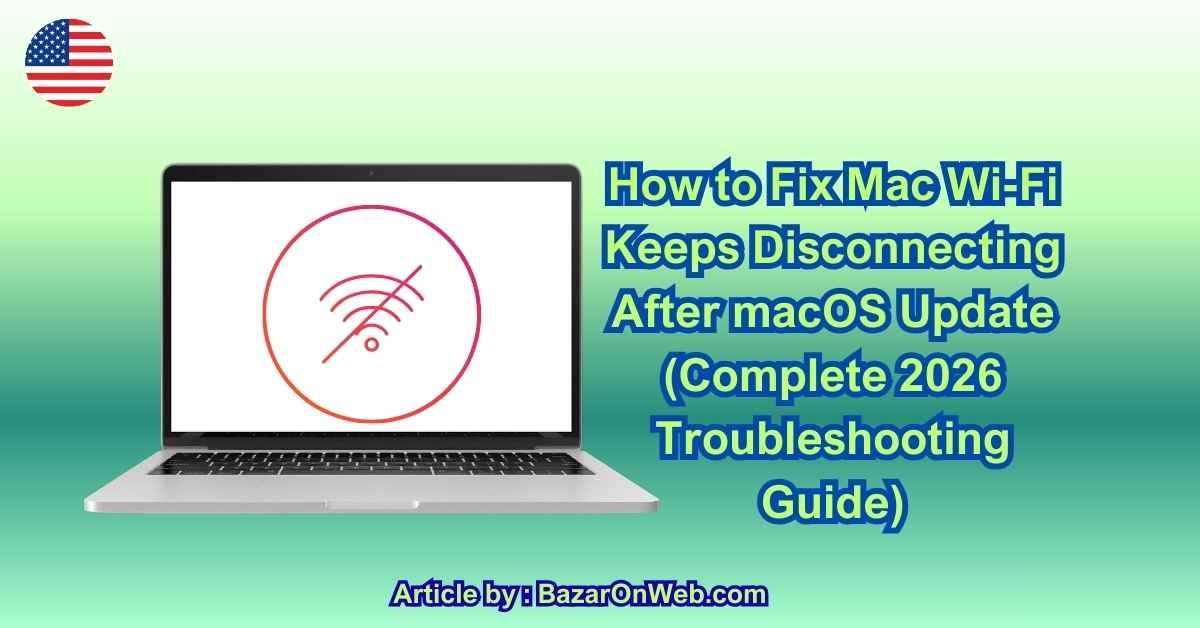
Hey, it’s Jessica.
There are few things more frustrating than your Mac randomly disconnecting from Wi-Fi — especially right after a macOS update. One minute you’re on a Zoom call, uploading files, or working inside Google Docs… and the next minute, your internet drops. Again.
If this started happening after a recent macOS update, you’re not alone. Wi-Fi instability is one of the most searched Mac issues after major updates. And the worst part? It’s unpredictable. Sometimes it reconnects automatically. Sometimes it refuses to. Sometimes it works fine for hours and then drops repeatedly.
The good news is this: in most cases, the issue is software-related — not hardware failure. And that means we can fix it.
In this guide, I’ll walk you step by step through why your Mac Wi-Fi keeps disconnecting after a macOS update and exactly how to fix it properly — without jumping straight to extreme resets.
Let’s take this calmly and solve it systematically.
Why Wi-Fi Problems Often Happen After macOS Updates
After a macOS update, several things change in the background:
-
Network drivers are refreshed
-
Security protocols are updated
-
Firewall settings may reset
-
DNS and network configuration files can conflict
-
Router compatibility issues may surface
Your Mac may still have old network cache files trying to work with a new system environment. That mismatch often causes:
-
Random disconnections
-
Slow speeds
-
“Connected but no internet” errors
-
Wi-Fi icon flickering on and off
The key is refreshing your network environment cleanly.
Step 1: Restart Both Your Mac and Router (Properly)
Before we touch advanced settings, do this correctly — not casually.
-
Shut down your Mac completely.
-
Unplug your Wi-Fi router from power.
-
Wait at least 60 seconds.
-
Plug the router back in.
-
Wait until it fully reconnects to the internet.
-
Turn your Mac back on.
Why this works:
Routers build up temporary memory errors. macOS updates sometimes conflict with existing network sessions. A clean reboot on both ends resets that handshake.
If Wi-Fi still disconnects, move to the next step.
Step 2: Forget and Reconnect to Your Wi-Fi Network
Sometimes your saved Wi-Fi configuration becomes corrupted after updates.
Here’s how to reset it:
-
Click the Apple menu.
-
Go to System Settings.
-
Click Network.
-
Select Wi-Fi.
-
Click Details next to your network.
-
Choose Forget This Network.
-
Confirm.
Now reconnect by selecting your Wi-Fi again and entering the password.
This forces your Mac to create a fresh network profile.
Step 3: Check If It’s Only One Network
This is important.
Ask yourself:
Does Wi-Fi disconnect everywhere — or only at home?
Try connecting:
-
To a mobile hotspot
-
At a coffee shop
-
At work
If the problem only happens on one router, the issue may be router compatibility rather than macOS.
If it happens everywhere, it’s likely a system-level issue.
Step 4: Disable Wi-Fi Auto-Join for Weak Networks
Sometimes your Mac keeps switching between networks automatically.
Go to:
System Settings → Network → Wi-Fi → Details
Turn off:
-
Auto-Join for weak or secondary networks
If you have both:
-
2.4 GHz
-
5 GHz
Your Mac might keep switching between them.
Consider temporarily using only one band to test stability.
Step 5: Renew DHCP Lease
This refreshes your IP address assignment.
-
Go to System Settings.
-
Click Network.
-
Select Wi-Fi.
-
Click Details.
-
Go to TCP/IP.
-
Click Renew DHCP Lease.
This clears possible IP conflicts.
After renewing, monitor your connection for at least 15–20 minutes.
Step 6: Disable Bluetooth Temporarily
This sounds strange — but it works.
Bluetooth and Wi-Fi share the same frequency spectrum. After some macOS updates, interference increases.
Turn off Bluetooth temporarily:
System Settings → Bluetooth → Toggle Off
If Wi-Fi stabilizes, interference was likely the issue.
Step 7: Remove Old Network Configuration Files (Advanced Fix)
If the problem persists, we move into deeper cleanup.
macOS stores network configuration files that sometimes conflict after updates.
Here’s what to do:
-
Open Finder.
-
Click Go in the top menu.
-
Hold Option key and click Library.
-
Go to Preferences → SystemConfiguration.
Look for these files:
-
com.apple.airport.preferences.plist
-
com.apple.network.identification.plist
-
NetworkInterfaces.plist
-
preferences.plist
Move them to your Desktop (don’t delete yet).
Restart your Mac.
macOS will recreate fresh network configuration files automatically.
This solves many persistent disconnection problems.
Step 8: Check Firewall and Security Settings
After updates, firewall rules may change.
Go to:
System Settings → Network → Firewall
If enabled, temporarily turn it off and test Wi-Fi.
Also check:
System Settings → Privacy & Security
Ensure no security app or VPN is blocking network access.
VPNs are common causes of random disconnects after updates.
Step 9: Reset DNS Settings
Sometimes DNS servers conflict after macOS updates.
Go to:
System Settings → Network → Wi-Fi → Details → DNS
If you see unusual or old DNS entries, remove them.
You can try adding:
8.8.8.8
8.8.4.4
(These are Google’s public DNS servers.)
Apply changes and test.
Step 10: Check for Background System Indexing
After major updates, macOS re-indexes files (Spotlight indexing).
This can temporarily cause:
-
High CPU usage
-
Network instability
-
Slower Wi-Fi performance
Open Activity Monitor and check if:
-
mds
-
mdworker
are consuming high CPU.
If yes, give your Mac time to finish indexing (usually a few hours).
Step 11: Update Router Firmware
This is overlooked but important.
macOS updates sometimes introduce new Wi-Fi standards or security protocols.
If your router firmware is outdated, compatibility issues appear.
Log into your router settings and check for firmware updates.
Updating the router often stabilizes post-update Wi-Fi problems.
Step 12: Disable Private Wi-Fi Address (Testing Only)
macOS sometimes enables Private Wi-Fi Address automatically.
Go to:
System Settings → Network → Wi-Fi → Details
Turn off:
Private Wi-Fi Address (temporarily)
Test if connection stabilizes.
If it does, your router may struggle with dynamic MAC addresses.
Common Signs It’s NOT a Software Problem
Sometimes it’s hardware.
Watch for:
-
Wi-Fi not detecting any networks at all
-
Extremely weak signal even near router
-
Mac overheating heavily
-
Random restarts
If those appear, it may require hardware diagnostics.
But in most cases — especially right after a macOS update — it’s configuration conflict, not hardware failure.
When your Mac Wi-Fi keeps disconnecting after a macOS update, it’s usually caused by:
-
Corrupted network configuration files
-
Router compatibility issues
-
VPN or firewall conflicts
-
DNS problems
-
DHCP lease conflicts
-
Auto-join switching networks
The solution isn’t panicking or immediately reinstalling macOS.
It’s systematic troubleshooting.
Creating a New Network Location (Highly Effective Fix)
If your Mac Wi-Fi keeps disconnecting and none of the earlier fixes stabilized it, creating a new network location can completely reset hidden configuration conflicts.
macOS allows multiple “network environments.” Sometimes the default one becomes corrupted after an update.
Here’s how to create a fresh one:
-
Open System Settings.
-
Go to Network.
-
Click the three-dot menu and look for Locations (on some versions it appears inside Network settings).
-
Click Edit Locations.
-
Click the + icon.
-
Name it something like “WiFi Reset.”
-
Click Done.
Now reconnect to your Wi-Fi network under this new location.
This forces macOS to build a fresh network configuration without leftover cached rules.
Many persistent disconnect issues disappear instantly after this step.
Boot Into Safe Mode to Diagnose Conflicts
Safe Mode loads macOS with minimal drivers and disables third-party startup items.
If Wi-Fi works perfectly in Safe Mode, the problem is likely caused by:
-
VPN software
-
Antivirus
-
Firewall tools
-
Network monitoring apps
-
Startup utilities
To boot into Safe Mode (Apple Silicon Mac):
-
Shut down your Mac.
-
Press and hold the power button until startup options appear.
-
Select your disk.
-
Hold Shift and click “Continue in Safe Mode.”
Test Wi-Fi for 10–15 minutes.
If it stays stable, restart normally and remove recently installed apps one by one until you find the conflict.
Reset NVRAM (Intel Macs Only)
If you’re using an Intel-based Mac, resetting NVRAM can help with network instability.
-
Shut down your Mac.
-
Turn it on.
-
Immediately press and hold:
Option + Command + P + R -
Hold for about 20 seconds.
This resets:
-
Network preferences
-
Display settings
-
Some system-level configurations
Apple Silicon Macs do this automatically, so this step is not required for newer models.
Use Terminal to Flush DNS Cache
Sometimes DNS conflicts cause intermittent disconnections.
You can flush the DNS cache manually:
-
Open Terminal.
-
Type:
-
Press Enter.
-
Enter your Mac password.
There won’t be a confirmation message — that’s normal.
This clears cached DNS records and often fixes “Connected but no internet” drops.
Turn Off Wi-Fi Auto Power Saving (Advanced Tip)
Some Macs enable power-saving behavior that temporarily reduces Wi-Fi strength.
Open Terminal and type:
Check if aggressive power saving is active.
You can also:
-
Keep your Mac plugged in during heavy Wi-Fi usage.
-
Disable “Slightly dim display on battery.”
-
Avoid low battery usage during video calls.
Power-saving adjustments sometimes stabilize unstable connections.
Reinstall macOS (Last Resort, But Safe)
If Wi-Fi instability began immediately after an update and persists through all troubleshooting, reinstalling macOS can repair damaged system components.
Important:
This does NOT delete your files if done properly.
Steps:
-
Back up your Mac using Time Machine.
-
Shut down.
-
Hold the power button (Apple Silicon) or Command + R (Intel) to enter Recovery.
-
Choose Reinstall macOS.
-
Follow instructions.
This replaces system files while preserving personal data.
Only use this if:
-
Wi-Fi disconnects constantly
-
All configuration resets failed
-
Safe Mode did not help
Long-Term Prevention Strategy
To avoid Wi-Fi instability after future macOS updates:
-
Always restart your Mac after updating.
-
Restart your router after major macOS upgrades.
-
Avoid stacking multiple VPN or firewall apps.
-
Keep router firmware updated.
-
Don’t use outdated Wi-Fi extenders.
-
Keep at least 20% free storage on your Mac.
-
Avoid installing beta macOS on work devices.
Stable network performance depends on both your Mac and your router working in sync.
Conclusion
When your Mac Wi-Fi keeps disconnecting after a macOS update, it’s rarely hardware failure.
In most cases, it’s caused by:
-
Corrupted network configuration files
-
DNS conflicts
-
DHCP lease issues
-
VPN or firewall interference
-
Router compatibility problems
-
Background indexing after updates
The solution is structured troubleshooting — not random resets.
Start simple:
Restart devices.
Forget the network.
Renew DHCP.
Move deeper only if necessary:
Remove configuration files.
Create a new network location.
Flush DNS.
Test Safe Mode.
macOS updates change underlying network frameworks. Sometimes your Mac just needs a clean network environment to stabilize again.
With the right steps, your Wi-Fi can become just as stable — or even more stable — than before the update.
Disclaimer
This guide is for informational purposes only. Steps may vary slightly depending on your macOS version and Mac model. Always back up your data before performing advanced troubleshooting or reinstalling macOS.

- How to Transcribe Audio Live on Your iPhone

- Killer Network Service: Is It a Virus or Safe to Disable?

- How to Set Up Parental Controls on Windows 11: A Step-by-Step Guide

- How to Extract Audio From a Video: Easy Ways to Save Audio

- How to Set a Photo Album as Your Wallpaper on iPhone: Step-by-Step Guide

Products
-
![Apple Watch Ultra 3 [GPS + Cellular 49mm] Running & Multisport Smartwatch w/Rugged Titanium Case w/Black Titanium Milanese Loop - M. Satellite Communications, Advanced Health & Fitness Tracking](https://bazaronweb.com/retailstores/wp-content/uploads/2025/09/apple-watch-320x320.jpg) Apple Watch Ultra 3 [GPS + Cellular 49mm] Running & Multisport Smartwatch w/Rugged Titanium Case w/Black Titanium Milanese Loop - M. Satellite Communications, Advanced Health & Fitness Tracking
Apple Watch Ultra 3 [GPS + Cellular 49mm] Running & Multisport Smartwatch w/Rugged Titanium Case w/Black Titanium Milanese Loop - M. Satellite Communications, Advanced Health & Fitness Tracking
-
 Apple iPad mini (A17 Pro): Apple Intelligence, 8.3-inch Liquid Retina Display, 256GB, Wi-Fi 6E, 12MP Front/12MP Back Camera, Touch ID, All-Day Battery Life — Purple
-
 Apple AirPods Max Wireless Over-Ear Headphones, Active Noise Cancelling, Transparency Mode, Personalized Spatial Audio, Dolby Atmos, Bluetooth Headphones for iPhone – Space Gray
-
 Apple AirPods Pro 2 Wireless Earbuds, Active Noise Cancellation, Hearing Aid Feature, Bluetooth Headphones, Transparency, Personalized Spatial Audio, High-Fidelity Sound, H2 Chip, USB-C Charging
-
Home Garage 210 TC Cotton King Floral Fitted (Elastic) Bedsheet(Pack of 1, Grey)
Original price was: ₹999.00.₹299.00Current price is: ₹299.00.
Leave a Reply