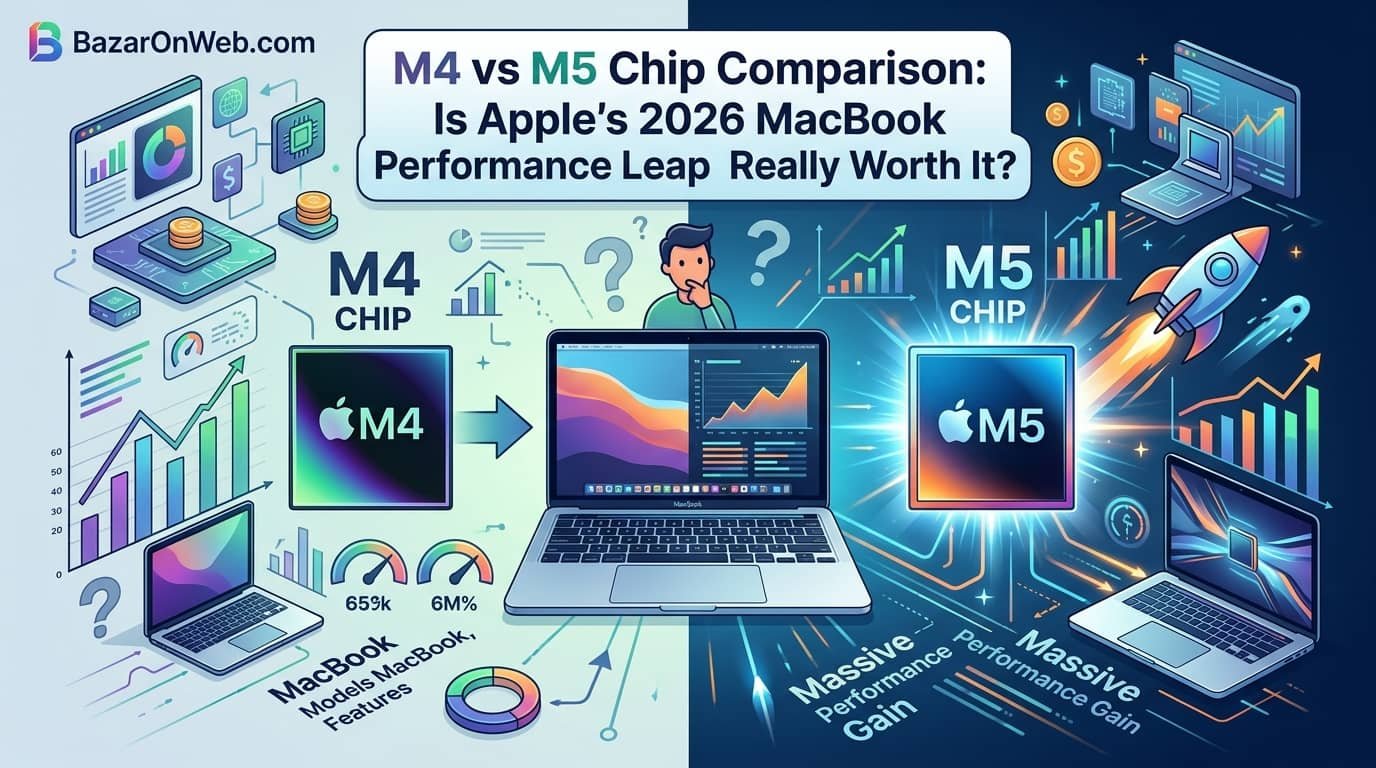
M4 vs M5 Chip Comparison: Is Apple’s 2026 MacBook Performance Leap Really Worth It?

M4 vs M5 Chip Comparison Is Apple’s 2026 MacBook Performance Leap Really Worth It

Hi, I’m Jessica, and if you’ve been shopping for a new MacBook lately, you’ve probably noticed how confusing Apple’s chip lineup has become. Just when many users finally understood the differences between the M1, M2, M3, and M4 chips, Apple introduced the M5 generation in the latest 2026 MacBook Pro lineup. For everyday users, the differences may sound like marketing language. But for creators, developers, students, AI professionals, and multitaskers, these changes can actually affect battery life, thermal efficiency, rendering speed, and overall workflow performance in a very real way.

The biggest conversation surrounding Apple Silicon right now revolves around AI optimization and power efficiency in macOS Tahoe. Apple has redesigned how machine learning tasks interact with the Neural Engine, GPU, memory bandwidth, and system scheduling. Both the M4 and M5 chips are heavily optimized for these next-generation AI features, but the M5 pushes things even further with improved thermal handling, faster unified memory access, and stronger sustained performance under demanding workloads.

If you are trying to decide whether an M4 MacBook is enough for your needs or whether upgrading to an M5 model makes sense in 2026, this guide breaks everything down in simple, practical terms without unnecessary technical confusion.

Apple’s Transition Into AI-Focused Silicon Architecture

Apple’s chip evolution is no longer only about CPU speed improvements. The company is now designing processors around artificial intelligence workloads, on-device machine learning, and energy-efficient computing. This shift became obvious with the M3 generation, but the M4 and M5 chips represent Apple’s most aggressive AI-focused hardware redesign so far.

The M4 chip introduced major enhancements in Neural Engine performance, allowing macOS Tahoe to process AI-assisted tasks more efficiently while consuming less power. Features such as live transcription, image enhancement, smart search indexing, AI-assisted writing, predictive automation, and contextual Siri improvements became smoother because the chip was designed specifically for those workloads. Apple optimized the architecture so background AI tasks could run continuously without creating significant battery drain or overheating problems.

The M5 chip continues this direction but expands the performance ceiling dramatically. Apple improved workload balancing between CPU, GPU, and Neural Engine cores to prevent bottlenecks during professional multitasking. This matters for users running large language models locally, editing 8K footage, training lightweight AI systems, compiling large codebases, or managing virtual production environments.

What makes the transition especially important is how Apple balances raw performance with battery efficiency. Traditional high-performance laptops often increase speed by increasing heat and power draw. Apple instead focuses on maximizing work per watt. The M5 chip demonstrates this philosophy by delivering stronger sustained performance while maintaining battery efficiency levels that remain difficult for competitors to match.

CPU Performance Differences Between M4 and M5 Chips

The CPU architecture improvements between the M4 and M5 chips are noticeable, especially under sustained workloads. While casual users may not immediately recognize dramatic differences during simple tasks like browsing or streaming, professionals working with heavy applications will experience measurable gains.

The M4 chip already performs exceptionally well in day-to-day computing. Applications launch instantly, multitasking feels effortless, and macOS Tahoe runs with excellent responsiveness. For students, office workers, content consumers, and even moderate creative professionals, the M4 chip delivers more than enough processing power for modern workloads.

However, the M5 chip introduces improved efficiency cores and significantly faster performance cores. Apple redesigned cache structures and scheduling optimizations to improve how demanding applications distribute workloads. As a result, rendering projects, software compilation, virtualization environments, and high-end creative applications complete tasks more quickly while maintaining lower thermal stress.

One important difference is sustained performance consistency. The M4 performs brilliantly in short bursts but can throttle slightly during prolonged high-intensity workloads. The M5 handles these situations much better because of thermal and efficiency improvements. Users editing long-form 8K videos, running AI simulations, or handling advanced engineering software will especially notice the stability improvements.

Another advantage is parallel processing optimization. The M5 chip processes multiple professional applications simultaneously with less slowdown. Creative users working with Final Cut Pro, Logic Pro, Blender, Adobe Creative Cloud, and AI-assisted workflows together will benefit from the stronger workload management capabilities built into the newer architecture.

GPU Improvements and Graphics Performance in 2026 MacBooks

Graphics performance has become increasingly important in modern laptops because GPU acceleration now powers everything from video editing to AI-enhanced image processing. Apple significantly improved graphics architecture with the M4 series, but the M5 takes another major leap forward.

The M4 GPU introduced advanced ray tracing improvements, dynamic caching enhancements, and better media engine support. These changes benefited creators working with motion graphics, photography, video rendering, animation, and gaming. macOS Tahoe also leverages GPU acceleration more efficiently for AI-assisted visual effects and interface rendering.

The M5 GPU builds on these improvements with higher sustained graphical throughput and more intelligent resource allocation. Professional users handling 3D rendering, cinematic production, advanced simulations, and GPU-heavy AI tasks will see the largest benefits. Applications can maintain stronger rendering speeds over extended periods without severe thermal slowdowns.

Gaming performance has also improved noticeably. Although Macs are still not positioned primarily as gaming machines, the M5 delivers better compatibility with modern graphics-intensive titles and cloud gaming environments. Apple’s Metal optimization framework works more effectively on M5 hardware, reducing frame instability and improving visual consistency.

Video creators gain major advantages as well. Real-time timeline playback, multi-layer editing, AI-assisted scene detection, and export speeds perform better on M5 systems. The upgraded media engine handles multiple ProRes and high-resolution streams with reduced latency.

For most general consumers, the M4 GPU already feels extremely fast. But users pushing professional visual workloads daily will likely appreciate the added stability and performance headroom that the M5 GPU architecture provides.

Neural Engine Enhancements and AI Processing Capabilities

One of the most important differences between the M4 and M5 chips involves the Neural Engine. Apple’s long-term vision increasingly depends on local AI processing rather than relying entirely on cloud-based systems. That makes Neural Engine performance critical for future macOS experiences.

The M4 chip introduced impressive AI acceleration capabilities that improved speech recognition, image generation assistance, contextual automation, live translation, and predictive system behavior. macOS Tahoe uses these capabilities extensively to create smoother AI-assisted experiences while minimizing power consumption.

The M5 Neural Engine expands performance significantly, allowing more advanced AI models to run locally with better speed and efficiency. Tasks that previously required partial cloud assistance can now execute directly on-device more effectively. This improves privacy, responsiveness, and offline functionality.

Users working with AI development tools benefit substantially from these upgrades. Lightweight machine learning model training, local inference systems, AI-assisted editing tools, and data processing workflows all operate more efficiently on M5 hardware. Developers and researchers especially benefit from faster neural computation and reduced latency during experimental workloads.

The improvements also help regular consumers in subtle ways. Features like smart search indexing, voice enhancement during calls, photo organization, predictive typing, and contextual app recommendations feel more fluid because AI tasks are processed more intelligently behind the scenes.

As AI becomes central to productivity software, Apple’s Neural Engine improvements may become even more important than raw CPU speed. In that sense, the M5 chip represents Apple preparing Macs for the next phase of computing rather than simply increasing benchmark numbers.

Battery Efficiency and Thermal Performance Comparison

Battery life remains one of Apple Silicon’s strongest advantages, and both the M4 and M5 chips continue that trend. However, the way these chips achieve efficiency differs slightly, especially under demanding workloads.

The M4 chip already offers excellent power management. macOS Tahoe intelligently allocates workloads between efficiency cores and performance cores to maximize battery life during mixed usage. Users can comfortably handle browsing, office work, streaming, communication, and moderate creative tasks throughout the day without worrying about charging frequently.

The M5 improves efficiency further through architectural refinements and enhanced thermal regulation. Instead of simply reducing power consumption, Apple optimized workload distribution to prevent unnecessary energy spikes during intensive processing. This creates more stable battery behavior even when performing demanding tasks like rendering, AI processing, or multitasking with professional applications.

Thermal improvements are equally important. The M4 chip occasionally becomes warm during prolonged heavy workloads, especially in thinner MacBook Air designs. The M5 handles heat more effectively through smarter system balancing and improved efficiency at higher performance levels.

This matters because excessive heat directly impacts sustained performance. When systems overheat, processors throttle speeds to protect internal components. The M5’s improved thermal efficiency allows it to maintain stronger performance for longer periods without noticeable slowdowns.

For travelers, students, remote workers, and digital creators working away from power sources, these efficiency improvements make a meaningful difference. Users can complete demanding tasks while maintaining longer unplugged usage times, which continues to separate Apple Silicon laptops from many competing Windows systems.

macOS Tahoe Optimization and Real-World User Experience

Hardware alone does not define the user experience. Apple’s advantage comes from its ability to integrate hardware and software together, and macOS Tahoe demonstrates how tightly optimized the M4 and M5 platforms have become.

The operating system includes multiple AI-enhanced features designed specifically for Apple Silicon architecture. These include smarter resource management, adaptive battery optimization, intelligent background processing, contextual automation, and AI-assisted productivity tools. Both M4 and M5 systems benefit significantly from these optimizations.

On M4 devices, macOS Tahoe already feels extremely polished and responsive. Window management, multitasking, application launching, and workflow transitions happen smoothly. The system intelligently prioritizes workloads to maintain responsiveness even when multiple applications remain active simultaneously.

The M5 elevates the experience further by improving responsiveness under heavier multitasking conditions. Professional users working with large files, multiple monitors, AI workflows, and creative applications experience fewer slowdowns during extended sessions. Memory management improvements also reduce performance drops when handling massive datasets or complex production environments.

Apple also improved background AI processing efficiency. Tasks like photo indexing, intelligent organization, transcription, and contextual learning occur more quietly without negatively impacting foreground performance. This creates a smoother overall computing experience where advanced AI capabilities operate invisibly without draining resources aggressively.

For most users, both chips provide an exceptional macOS experience. The difference becomes most noticeable when workloads become increasingly professional, intensive, or AI-driven over extended periods.

Which Users Should Choose an M4 MacBook in 2026?

Despite the excitement surrounding the M5 chip, the M4 MacBook lineup remains incredibly powerful and practical for the majority of users in 2026. In fact, many buyers may never fully utilize the capabilities offered by the M5 architecture.

Students are excellent candidates for M4 systems because the chip handles productivity software, research, multitasking, media editing, coding, and online learning effortlessly. Battery life remains excellent, performance feels instant, and macOS Tahoe runs beautifully even on base configurations.

Business professionals also benefit greatly from M4 MacBooks. Office applications, video conferencing, cloud workflows, presentations, browser multitasking, CRM platforms, and communication tools all perform smoothly without performance concerns.

Content creators focused on moderate workloads such as photography, social media editing, podcasting, YouTube production, and graphic design will also find the M4 more than capable. The chip delivers excellent rendering speeds while remaining efficient and cool.

Another major advantage is pricing. As M5 systems enter the market, M4 MacBooks often become more affordable while still offering modern AI optimizations and long-term software support. This makes them one of the best value options in Apple’s ecosystem.

For users who prioritize portability, battery life, reliability, and smooth daily computing rather than extreme professional workloads, the M4 remains an outstanding investment even after the release of the M5 generation.

Who Truly Benefits From Upgrading to the M5 Chip?

The M5 chip primarily targets professional users who push their systems hard every day. For these users, the improvements are not merely incremental — they directly impact productivity, workflow speed, and operational efficiency.

Video editors handling cinematic projects, 8K workflows, multi-camera timelines, and advanced color grading benefit significantly from the M5’s sustained performance improvements. Rendering times decrease, playback becomes smoother, and export efficiency improves substantially.

Software developers managing large codebases, virtualization systems, Docker environments, and AI-assisted development tools also gain meaningful advantages. Faster compilation times and better multitasking performance help reduce workflow interruptions.

AI professionals represent another major audience for M5 systems. Running local inference models, experimenting with machine learning systems, and processing large datasets all benefit from the upgraded Neural Engine and memory architecture.

3D artists, animators, engineers, and simulation specialists will likely appreciate the stronger GPU performance and improved thermal handling. These users often operate under continuous high-load conditions where sustained performance matters more than short benchmark bursts.

The M5 is also ideal for users planning extremely long upgrade cycles. Buyers intending to keep their MacBooks for five to seven years may benefit from purchasing the most future-ready architecture available today, especially as AI capabilities continue expanding across macOS applications.

For everyday users, the difference may feel small. But for professionals whose income depends on performance efficiency, the M5 provides meaningful workflow advantages.

Unified Memory and Storage Performance Differences

Apple’s unified memory architecture continues to be one of the most important reasons MacBooks feel exceptionally fast in real-world usage. Both M4 and M5 systems use unified memory to allow the CPU, GPU, and Neural Engine to access the same memory pool efficiently without unnecessary duplication.

The M4 already delivers impressive memory bandwidth that supports demanding multitasking scenarios. Applications transition smoothly, creative workflows remain responsive, and large files load quickly even when multiple professional tools operate simultaneously.

The M5 improves memory bandwidth further, particularly benefiting AI processing and high-resolution creative workflows. Faster data transfer between components reduces bottlenecks during rendering, machine learning tasks, and complex simulations.

This becomes especially important when working with massive datasets or professional production environments. Users editing high-bitrate footage, managing large Photoshop compositions, or processing advanced AI workflows benefit from the faster memory subsystem because applications maintain responsiveness even under pressure.

Storage performance also improves subtly with newer controller optimizations in M5 systems. File transfers, indexing operations, application loading, and cache management all operate more efficiently. While average users may not immediately notice dramatic changes, professionals handling terabytes of media or large development environments can save meaningful amounts of time.

The key takeaway is that Apple’s system optimization allows even modest specifications to perform extremely well. However, professional users handling memory-intensive workloads daily will likely appreciate the refinements introduced in the M5 architecture.

Future-Proofing: Is M5 the Better Long-Term Investment?

Future-proofing is always difficult because technology evolves rapidly, but the M5 does position itself as Apple’s most advanced AI-ready laptop architecture so far. Whether that matters depends entirely on how users plan to use their MacBooks over the next several years.

The M4 already provides outstanding longevity potential. Apple Silicon systems generally receive extended software support, and the M4 architecture remains more than capable of handling modern productivity, creative work, and AI-assisted applications for years ahead.

However, the M5 introduces stronger headroom for future AI-driven operating system features. As Apple continues integrating machine learning deeper into macOS, applications will likely rely more heavily on Neural Engine acceleration and efficient parallel processing. The M5 is better prepared for these evolving demands.

Professional buyers planning long-term ownership may view the M5 as a safer investment because of its stronger sustained performance, improved thermals, faster memory systems, and enhanced AI processing capabilities. These advantages may become increasingly valuable as software complexity grows.

That said, future-proofing should always be balanced against actual needs and budget. Many users buy performance they never fully utilize. An M4 MacBook purchased today will still remain extremely capable for most workflows far into the future.

The real decision comes down to workload intensity. If your work depends on maximum performance efficiency and next-generation AI capabilities, the M5 offers compelling advantages. If your needs are more balanced, the M4 remains one of the smartest MacBook choices available in 2026.

Disclaimer

This article is for informational and educational purposes only. Apple product specifications, performance benchmarks, software capabilities, and macOS Tahoe optimizations may change through future updates, regional configurations, or newer hardware releases. Real-world performance varies depending on workload, software compatibility, system configuration, and usage conditions. Readers should verify official technical specifications and consult Apple’s official documentation before making purchasing decisions regarding MacBook models or Apple Silicon devices.

Leave a Reply

Your email address will not be published. Required fields are marked *

Select the fields to be shown. Others will be hidden. Drag and drop to rearrange the order.
  • Image
  • SKU
  • Rating
  • Price
  • Stock
  • Availability
  • Add to cart
  • Description
  • Content
  • Weight
  • Dimensions
  • Additional information
Click outside to hide the comparison bar
Compare