Discounted Products
-
 Leo Creation 144 TC Cotton Double Jaipuri Prints Flat Bedsheet(Pack of 1, Blue, Gree, Red, Grey, Light Grey)
Original price was: ₹2,999.00.₹329.00Current price is: ₹329.00.
Leo Creation 144 TC Cotton Double Jaipuri Prints Flat Bedsheet(Pack of 1, Blue, Gree, Red, Grey, Light Grey)
Original price was: ₹2,999.00.₹329.00Current price is: ₹329.00.
-
 Home Garage 210 TC Cotton King Floral Fitted (Elastic) Bedsheet(Pack of 1, Grey)
Original price was: ₹999.00.₹299.00Current price is: ₹299.00.
Home Garage 210 TC Cotton King Floral Fitted (Elastic) Bedsheet(Pack of 1, Grey)
Original price was: ₹999.00.₹299.00Current price is: ₹299.00.
-
 Goodrik 140 TC Cotton Double 3D Printed Flat Bedsheet(Pack of 1, Brown)
Original price was: ₹499.00.₹229.00Current price is: ₹229.00.
Goodrik 140 TC Cotton Double 3D Printed Flat Bedsheet(Pack of 1, Brown)
Original price was: ₹499.00.₹229.00Current price is: ₹229.00.
-
 GLOBALSHOP 350 TC Microfiber Double Floral Flat Bedsheet(Pack of 1, Multicolor)
Original price was: ₹1,250.00.₹263.00Current price is: ₹263.00.
GLOBALSHOP 350 TC Microfiber Double Floral Flat Bedsheet(Pack of 1, Multicolor)
Original price was: ₹1,250.00.₹263.00Current price is: ₹263.00.
-
 RisingStar 250 TC Microfiber King Printed Fitted (Elastic) Bedsheet(Pack of 1, FITTED-ROUND-CIRCLES-PREMIUM)
Original price was: ₹2,299.00.₹299.00Current price is: ₹299.00.
RisingStar 250 TC Microfiber King Printed Fitted (Elastic) Bedsheet(Pack of 1, FITTED-ROUND-CIRCLES-PREMIUM)
Original price was: ₹2,299.00.₹299.00Current price is: ₹299.00.
-
 Home Garage 210 TC Cotton King Floral Fitted (Elastic) Bedsheet(Pack of 1, Fitted Black Green)
Original price was: ₹1,299.00.₹299.00Current price is: ₹299.00.
Home Garage 210 TC Cotton King Floral Fitted (Elastic) Bedsheet(Pack of 1, Fitted Black Green)
Original price was: ₹1,299.00.₹299.00Current price is: ₹299.00.
-
 Home Garage 180 TC Cotton King 3D Printed Flat Bedsheet(Pack of 1, White)
Original price was: ₹999.00.₹229.00Current price is: ₹229.00.
Home Garage 180 TC Cotton King 3D Printed Flat Bedsheet(Pack of 1, White)
Original price was: ₹999.00.₹229.00Current price is: ₹229.00.
-
 Home Sizzler 153 cm (5 ft) Polyester Room Darkening Window Curtain (Pack Of 2)(Floral, Maroon)
Original price was: ₹799.00.₹299.00Current price is: ₹299.00.
Home Sizzler 153 cm (5 ft) Polyester Room Darkening Window Curtain (Pack Of 2)(Floral, Maroon)
Original price was: ₹799.00.₹299.00Current price is: ₹299.00.
-
 Panipat Textile Hub 152.4 cm (5 ft) Polyester Window Curtain (Pack Of 2)(Solid, Aqua)
Original price was: ₹1,899.00.₹299.00Current price is: ₹299.00.
Panipat Textile Hub 152.4 cm (5 ft) Polyester Window Curtain (Pack Of 2)(Solid, Aqua)
Original price was: ₹1,899.00.₹299.00Current price is: ₹299.00.
-
 Home Sizzler 214 cm (7 ft) Polyester Semi Transparent Door Curtain (Pack Of 2)(Floral, Maroon)
Original price was: ₹1,199.00.₹399.00Current price is: ₹399.00.
Home Sizzler 214 cm (7 ft) Polyester Semi Transparent Door Curtain (Pack Of 2)(Floral, Maroon)
Original price was: ₹1,199.00.₹399.00Current price is: ₹399.00.
-
 Home Sizzler 153 cm (5 ft) Polyester Room Darkening Window Curtain (Pack Of 2)(Floral, Brown)
Original price was: ₹799.00.₹299.00Current price is: ₹299.00.
Home Sizzler 153 cm (5 ft) Polyester Room Darkening Window Curtain (Pack Of 2)(Floral, Brown)
Original price was: ₹799.00.₹299.00Current price is: ₹299.00.
-
 Stella Creations 214 cm (7 ft) Polyester Room Darkening Door Curtain (Pack Of 2)(Abstract, Brown)
Original price was: ₹1,299.00.₹449.00Current price is: ₹449.00.
Stella Creations 214 cm (7 ft) Polyester Room Darkening Door Curtain (Pack Of 2)(Abstract, Brown)
Original price was: ₹1,299.00.₹449.00Current price is: ₹449.00.
-
 Homefab India 152.5 cm (5 ft) Polyester Room Darkening Window Curtain (Pack Of 2)(Floral, Light Blue)
Original price was: ₹1,199.00.₹319.00Current price is: ₹319.00.
Homefab India 152.5 cm (5 ft) Polyester Room Darkening Window Curtain (Pack Of 2)(Floral, Light Blue)
Original price was: ₹1,199.00.₹319.00Current price is: ₹319.00.
-
 Urban Home 214 cm (7 ft) PVC Transparent Door Curtain Single Curtain(Solid, Off White)
Original price was: ₹699.00.₹203.00Current price is: ₹203.00.
Urban Home 214 cm (7 ft) PVC Transparent Door Curtain Single Curtain(Solid, Off White)
Original price was: ₹699.00.₹203.00Current price is: ₹203.00.
-
 Panipat Textile Hub 213 cm (7 ft) Polyester Door Curtain (Pack Of 2)(Solid, Brown)
Original price was: ₹1,199.00.₹349.00Current price is: ₹349.00.
Panipat Textile Hub 213 cm (7 ft) Polyester Door Curtain (Pack Of 2)(Solid, Brown)
Original price was: ₹1,199.00.₹349.00Current price is: ₹349.00.
Introduction
Your Android phone might look the same on the outside year after year, but what truly defines how fast, smooth, or frustrating it feels is what’s happening inside—specifically, the processor. The processor, often called the CPU or chipset, is the core component that controls how your phone performs every task, from opening apps and scrolling through social media to gaming, video editing, multitasking, and even battery efficiency. If your phone feels sluggish, heats up quickly, or struggles with newer apps, checking the processor and its speed is one of the smartest places to start.
Many Android users don’t realize how much the processor impacts daily usage. Two phones can look nearly identical, run the same Android version, and even have similar storage and RAM, yet feel completely different in real-world performance. That difference almost always comes down to the processor. Understanding what processor your phone uses and how fast it runs helps you set realistic expectations, troubleshoot performance issues, and make better decisions when installing apps or planning an upgrade.
Another reason this information matters is longevity. As Android updates become more demanding, older or weaker processors may struggle to keep up. Knowing your processor allows you to understand why your phone handles certain updates well—or why it doesn’t. It also helps when checking app compatibility, especially for games, productivity tools, or AI-powered features that require a certain level of processing power.
The good news is that Android already provides ways to check processor details. You don’t need to be a developer, and in many cases, you don’t even need to install third-party apps. The challenge is that Android manufacturers present this information differently. Some phones clearly show the processor name and speed, while others hide it behind model numbers or advanced settings. That’s why it helps to know all the reliable ways to find this information.
Let’s start with the most straightforward method that works on the majority of Android phones.
Check Processor Details Using Android Phone Settings
The easiest and safest way to see your phone’s processor is through the built-in system settings. This method doesn’t change anything on your device and doesn’t require any additional permissions.
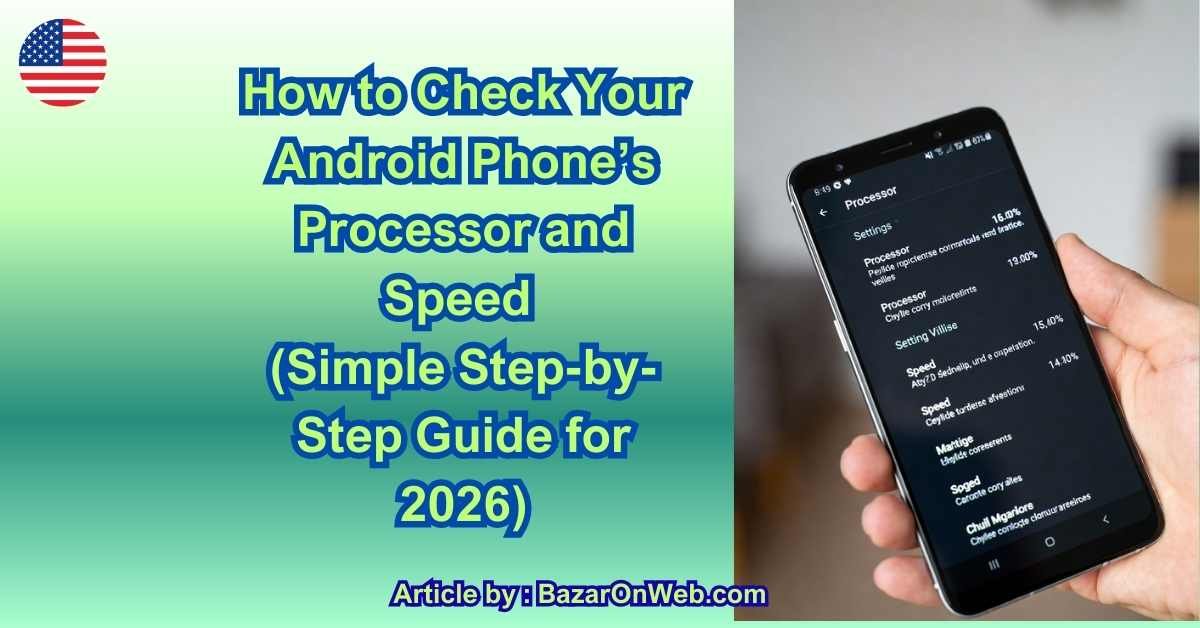
Start by opening the Settings app on your Android phone. Scroll down and look for About phone. On some devices, this may be nested under System, but the wording is usually similar across brands.
Once inside the About phone section, you’ll see general information such as your device name, Android version, storage, and model number. Look carefully for entries labeled Processor, Chipset, CPU, or sometimes Hardware. Depending on your phone brand, Android may display the processor name directly—such as Snapdragon, MediaTek, Exynos, or Tensor—or it may show a model code that represents the chipset.
Some phones also display processor speed here, usually measured in GHz. If you see numbers like 2.2 GHz or 3.0 GHz, that indicates how fast the processor cores can run at peak performance. If you don’t see speed information, that’s completely normal. Many manufacturers keep the settings page simplified for everyday users.
Even with limited details, this section gives you a solid starting point. You can usually determine whether your phone uses a budget, mid-range, or flagship processor just by the chipset name. That alone explains a lot about your phone’s performance behavior.
Understanding What the Processor Name Tells You
When you see your processor name, you’re not just looking at a technical label—you’re looking at a performance category.
High-end processors are designed for heavy multitasking, gaming, and advanced camera processing. Mid-range processors focus on balanced performance and battery efficiency, while entry-level processors prioritize basic functionality and lower power consumption.
If your phone uses a mid-range or entry-level processor, occasional lag or slower app loading isn’t necessarily a problem—it’s simply a design limitation. Knowing this helps you avoid unnecessary frustration or unrealistic expectations.
How to See Processor Speed Using Developer Options
If your phone settings don’t show processor speed clearly, Android offers a built-in advanced section called Developer Options. Despite the name, this section is safe to access as long as you don’t randomly change settings.
To enable Developer Options, go to Settings → About phone and find Build number. Tap it repeatedly (usually seven times) until you see a message confirming that Developer Options have been enabled.
Now go back to Settings → System → Developer Options. Scroll through the list and look for CPU-related entries. While Android doesn’t always show speed in plain numbers here, you may see options related to running services, CPU usage, or hardware acceleration.
This section is useful for understanding how your processor behaves during real usage rather than just reading specifications.
Why Processor Speed Matters (Without the Technical Jargon)
Processor speed is measured in GHz, but higher numbers don’t automatically mean better performance. Speed represents how quickly each core can process instructions, but modern processors rely on multiple cores working together efficiently.
For example, a processor with eight well-optimized cores at moderate speed may outperform a processor with fewer high-speed cores. This is why two phones with similar GHz numbers can still feel very different in daily use.
What really matters is how your processor balances speed, power efficiency, and heat management. That balance determines whether your phone feels smooth during long usage sessions or slows down after a few minutes.
Using Built-In Performance Information to Diagnose Issues
Once you know your processor and its general speed category, you can use that information to understand common problems:
-
If your phone lags during heavy apps, the processor may be reaching its performance limit
-
If your phone heats up quickly, the processor may be throttling speed to protect itself
-
If battery drains fast, the processor may be working harder than intended
This isn’t about blaming the device—it’s about understanding its capabilities.
Why Knowing Your Processor Helps Before Installing Apps
Many modern apps quietly assume a certain level of processing power. Games, video editors, camera apps, and AI tools often perform poorly on lower-tier processors even if they technically install.
By checking your processor first, you can avoid installing apps that will never run smoothly on your device. This saves storage, battery life, and frustration.
When Built-In Settings Aren’t Enough
Some Android phones intentionally limit how much processor detail is shown in system settings. If you don’t see speed, core count, or real-time performance information, that doesn’t mean it’s unavailable—it just means Android is keeping things simple at the surface level.
That’s where deeper system tools and trusted apps come in, which allow you to see real-time processor speed, core usage, and performance behavior during actual use. These tools don’t replace built-in settings; they complement them by showing what’s happening behind the scenes.
A Practical Mindset Going Forward
Checking your Android phone’s processor isn’t about obsessing over specs. It’s about understanding your device well enough to use it comfortably and efficiently. Once you know what processor you’re working with, you can adjust expectations, choose apps wisely, and make smarter upgrade decisions.
Your phone doesn’t need to be the fastest to be useful—but knowing its limits puts you in control.
Beyond basic settings and developer options, there are times when Android’s built-in information simply doesn’t tell the full story. This is especially true if you want to know real-time processor speed, core usage, or how your phone behaves under actual workload. Android processors are dynamic by design—they constantly change speed depending on what you’re doing. That means the “maximum GHz” listed on paper doesn’t always reflect real performance. To truly understand your phone’s processor, you need to see it in action.
One of the most reliable ways to do this is by using trusted system information apps available on the Play Store. These apps don’t modify your phone or overclock anything; they simply read system data that Android already tracks in the background.
When you install a reputable CPU information app, you’ll usually see details such as:
-
Processor name and manufacturer
-
Number of cores
-
Architecture (32-bit or 64-bit)
-
Current speed of each core
-
Maximum and minimum speed ranges
-
Real-time CPU load
This information helps you understand not just what processor you have, but how it behaves during everyday tasks like scrolling, streaming, gaming, or multitasking.
What surprises many users is how often processor speed changes. Your phone may drop to very low speeds when idle to save battery, then spike briefly when you open an app, and settle somewhere in between during sustained use. This behavior is intentional and healthy. It means your processor is balancing performance and power efficiency correctly.
Another important detail these tools reveal is core behavior. Modern Android processors use different types of cores—some optimized for performance, others for efficiency. Light tasks like messaging or reading usually run on low-power cores, while heavy tasks like gaming or video editing activate the faster cores. Seeing this in real time explains why your phone may feel smooth for basic tasks but struggle during demanding ones.
Understanding this distinction can change how you judge your device. A phone that feels slow in games but excellent for daily use isn’t “bad”—it’s simply optimized for efficiency rather than raw power.
Processor information also becomes especially valuable when diagnosing overheating or throttling issues. If your phone slows down after a few minutes of heavy use, it’s often because the processor is intentionally reducing speed to control temperature. This is known as thermal throttling. CPU monitoring apps make this visible by showing speed drops as temperature rises. Knowing this helps you distinguish between a software bug and a normal hardware safety feature.
Another practical use of processor details is comparing devices realistically. Marketing terms can be misleading, and RAM or storage numbers alone don’t tell the whole story. Two phones with the same RAM can perform very differently depending on processor efficiency. By checking chipset generation, core design, and speed behavior, you can make much smarter comparisons—especially when choosing between mid-range phones.
Processor speed also affects camera performance more than most people realize. Features like night mode, HDR, portrait effects, and video stabilization rely heavily on processing power. If your phone struggles with camera lag or slow photo processing, the processor is often the limiting factor—not the camera sensor itself. Knowing this can help you adjust expectations or camera settings for better results.
Gaming performance is another area where processor knowledge matters. Many games scale graphics quality automatically based on detected hardware. If your processor is entry-level or older, games may reduce frame rates or visual effects. Understanding this prevents confusion when graphics don’t look as advertised. It also helps you tweak in-game settings for smoother gameplay rather than pushing the processor beyond its comfort zone.
Battery life is closely tied to processor behavior as well. Efficient processors can deliver good performance without draining the battery quickly. If your phone uses an older or less efficient chipset, heavy multitasking may result in faster battery drain. Monitoring CPU usage helps identify apps that keep the processor active unnecessarily, allowing you to adjust usage habits or app permissions.
For users considering upgrades, checking processor details on your current phone gives you a solid baseline. Instead of upgrading blindly, you can compare your existing processor with newer ones and decide whether the performance jump is truly worth it. Sometimes, a phone feels slow due to software clutter rather than hardware limitations—and knowing your processor helps you make that call confidently.
It’s also worth noting that processor speed alone doesn’t define user experience. Software optimization plays a massive role. Some phones feel smoother than others with similar hardware simply because the operating system and apps are better optimized. Processor information should be viewed as one piece of a bigger puzzle, not the only metric that matters.
As Android continues evolving, processors are becoming more specialized, handling AI tasks, image processing, and security features directly on the device. Knowing what processor you have helps you understand which of these modern features your phone supports—and which ones it may struggle with or lack entirely.
Ultimately, checking your Android phone’s processor and speed isn’t about chasing numbers or comparing benchmarks endlessly. It’s about understanding your device well enough to use it effectively. Once you know what your processor can and can’t do, you can adjust how you use your phone, which apps you install, and when it truly makes sense to upgrade.
Final Thoughts
Your Android phone’s processor is the silent workhorse behind every tap, swipe, and scroll. Taking a few minutes to check what processor your device uses—and how it behaves in real-world conditions—can completely change how you view its performance. Instead of guessing why your phone feels fast or slow, you gain clarity. And with clarity comes smarter decisions, fewer frustrations, and a much better overall experience. You don’t need the most powerful processor to enjoy your phone—but understanding the one you have puts you firmly in control.
Disclaimer
This article is for informational purposes only. Processor details, speed readings, and performance behavior may vary depending on device model, manufacturer customizations, Android version, and installed apps. The methods described do not modify system performance and are safe when followed correctly. Always avoid changing advanced system settings unless you fully understand their function.

- How to Fix PNP DETECTED FATAL ERROR on Windows (Complete BSOD Troubleshooting Guide)

- How to Reset Network Settings on Android and Fix WiFi, Bluetooth, and Mobile Data Issues

- How to Fix PDF Thumbnails Not Showing in Windows 11 (Complete Guide)

- How to Change BitLocker Password on Windows 11 to Keep Your Drive Secure

- How to Download & Install Wispr Flow AI on Android (Step-by-Step Guide)

Products
-
![Apple Watch Ultra 3 [GPS + Cellular 49mm] Running & Multisport Smartwatch w/Rugged Titanium Case w/Black Titanium Milanese Loop - M. Satellite Communications, Advanced Health & Fitness Tracking](https://bazaronweb.com/retailstores/wp-content/uploads/2025/09/apple-watch-320x320.jpg) Apple Watch Ultra 3 [GPS + Cellular 49mm] Running & Multisport Smartwatch w/Rugged Titanium Case w/Black Titanium Milanese Loop - M. Satellite Communications, Advanced Health & Fitness Tracking
Apple Watch Ultra 3 [GPS + Cellular 49mm] Running & Multisport Smartwatch w/Rugged Titanium Case w/Black Titanium Milanese Loop - M. Satellite Communications, Advanced Health & Fitness Tracking
-
 Apple iPad mini (A17 Pro): Apple Intelligence, 8.3-inch Liquid Retina Display, 256GB, Wi-Fi 6E, 12MP Front/12MP Back Camera, Touch ID, All-Day Battery Life — Purple
-
 Apple AirPods Max Wireless Over-Ear Headphones, Active Noise Cancelling, Transparency Mode, Personalized Spatial Audio, Dolby Atmos, Bluetooth Headphones for iPhone – Space Gray
-
 Apple AirPods Pro 2 Wireless Earbuds, Active Noise Cancellation, Hearing Aid Feature, Bluetooth Headphones, Transparency, Personalized Spatial Audio, High-Fidelity Sound, H2 Chip, USB-C Charging
-
Leo Creation 144 TC Cotton Double Jaipuri Prints Flat Bedsheet(Pack of 1, Blue, Gree, Red, Grey, Light Grey)
Original price was: ₹2,999.00.₹329.00Current price is: ₹329.00.
Leave a Reply