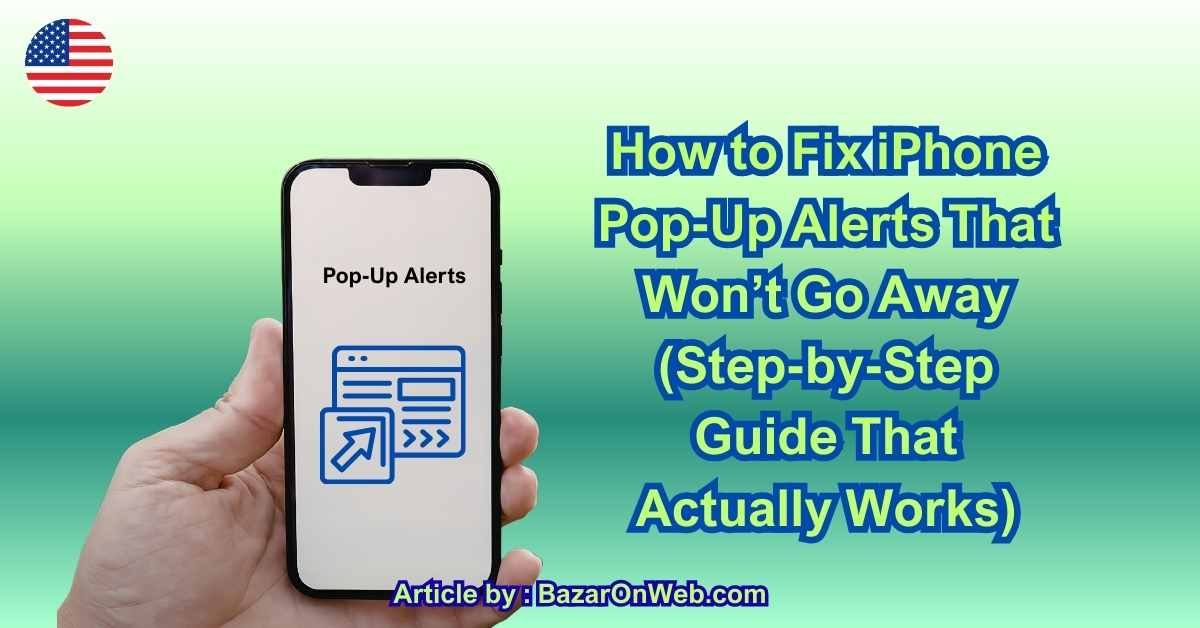
How to Fix iPhone Pop-Up Alerts That Won’t Go Away (Step-by-Step Guide That Actually Works)

How to Fix iPhone Pop-Up Alerts That Won’t Go Away (Step-by-Step Guide That Actually Works)

Hey, it’s Jessica.

You know that moment when a pop-up alert just refuses to disappear from your iPhone? Maybe it keeps reappearing every few minutes. Maybe it’s blocking your screen. Maybe it says something about iCloud, a calendar invite, Apple ID verification, storage full, or even a suspicious website alert — and no matter how many times you tap “OK,” it comes right back.

It’s frustrating. And when you rely on your phone all day — for work emails, school apps, grocery lists, banking, maps — a stuck pop-up isn’t just annoying. It disrupts everything.

The good news? In most cases, pop-up alerts that won’t go away on iPhone are completely fixable. You don’t need to reset your phone. You don’t need to panic. And you definitely don’t need to click anything suspicious.

In this guide, I’ll walk you step by step through why iPhone pop-ups get stuck, how to identify what type of alert you’re dealing with, and exactly how to fix it safely.

Let’s break this down calmly and clearly.


First: Identify What Type of Pop-Up You’re Seeing

Not all pop-ups are the same. The solution depends entirely on the source.

Here are the most common types:

  1. System alerts (iCloud sign-in, Apple ID verification, storage full)

  2. App notification alerts

  3. Calendar spam pop-ups

  4. Safari website pop-ups

  5. Configuration profile alerts

  6. Software update loops

  7. Notification banner glitches

Before fixing anything, ask yourself:

  • Does it appear inside Safari?

  • Does it mention iCloud or Apple ID?

  • Does it come from a specific app?

  • Is it a calendar event reminder?

  • Does it reappear after restarting?

This small moment of observation saves time later.


Fix 1: Force Close the App (If It’s App-Specific)

If the pop-up appears while using a specific app — like a game, shopping app, or social media app — it could be an app glitch.

Here’s what to do:

  1. Swipe up from the bottom of your screen (or double-click Home button on older models).

  2. Find the app.

  3. Swipe it up to close it completely.

  4. Wait 10–15 seconds.

  5. Reopen it.

If the pop-up does not return, it was likely a temporary app crash or script issue.

If it does return, move to the next step.


Fix 2: Restart Your iPhone Properly

Yes, it sounds basic — but a proper restart clears temporary memory conflicts.

To restart:

  • Press and hold the Side button + Volume button.

  • Slide to power off.

  • Wait 30 seconds.

  • Turn it back on.

This clears:

  • Temporary software bugs

  • Stuck UI elements

  • Minor background process errors

If the alert still appears after reboot, it’s likely tied to settings or a specific service.


Fix 3: If It’s an iCloud or Apple ID Verification Pop-Up

One of the most common repeating alerts says something like:

“Sign in to iCloud”
“Apple ID Verification Required”
“Enter password for…”

This usually happens because:

  • Your password changed

  • Your session expired

  • iCloud didn’t sync properly

  • There’s a billing or payment issue

Here’s how to fix it:

  1. Go to Settings.

  2. Tap your name at the top.

  3. See if there’s a red alert banner.

  4. Tap it and follow the instructions.

If prompted, re-enter your Apple ID password.

If it keeps looping:

  • Go to Settings → Tap your name → Sign Out

  • Restart your phone

  • Sign back in

This refreshes your iCloud authentication session completely.


Fix 4: If It’s a Calendar Spam Pop-Up

This one is sneaky.

You may see constant alerts about:

  • “Virus detected”

  • “Your iPhone is infected”

  • “Claim your prize”

  • Random events with suspicious links

This is NOT a virus.

It’s usually a spam calendar subscription.

To fix:

  1. Go to Settings.

  2. Tap Calendar.

  3. Tap Accounts.

  4. Look for any suspicious or unknown subscribed calendars.

  5. Tap it.

  6. Tap Delete Account.

That’s it.

Once removed, the pop-ups disappear permanently.

Never tap links inside those fake calendar alerts.


Fix 5: If It’s a Safari Website Pop-Up That Keeps Returning

If the alert appears inside Safari and says something like:

“Your iPhone has been hacked!”
“Click OK to remove virus”
“Storage almost full – tap to clean”

This is a malicious website script.

Do NOT tap anything inside the pop-up.

Instead:

  1. Close Safari completely (force close it).

  2. Go to Settings.

  3. Tap Safari.

  4. Tap Clear History and Website Data.

  5. Confirm.

Then:

  1. Turn on Block Pop-ups.

  2. Turn on Fraudulent Website Warning.

This prevents the script from reloading.

Safari pop-ups are browser-based — clearing website data removes the trigger.


Fix 6: Check Notification Settings

Sometimes a “pop-up” is actually repeated notifications appearing as banners.

Go to:

Settings → Notifications

Scroll to the app sending repeated alerts.

Tap it and adjust:

  • Turn off Allow Notifications

  • Disable Lock Screen alerts

  • Change Banner style to Temporary

Some apps set banners to Persistent, which means they stay on screen until manually dismissed.

Switching to Temporary fixes this immediately.


Fix 7: Check for iOS Software Update Issues

If you’re seeing repeated update reminders or software alerts, it may be a failed update attempt.

Go to:

Settings → General → iPhone Storage

Scroll and see if an iOS update file is downloaded but not installed.

If yes:

  • Tap it.

  • Delete Update.

  • Restart your phone.

  • Then go to Settings → General → Software Update and reinstall properly.

Corrupted update files can cause looping alerts.


Fix 8: Remove Suspicious Profiles (Important)

If pop-ups started after clicking something online, check for configuration profiles.

Go to:

Settings → General → VPN & Device Management

If you see:

  • Unknown profiles

  • Management profiles you didn’t install

Tap and remove them.

Malicious profiles can force pop-ups, ads, and repeated prompts.

If nothing appears there, you’re safe on that front.


Fix 9: Reset Notification Settings (If Glitchy)

If alerts visually glitch and won’t disappear, you can reset all settings.

Go to:

Settings → General → Transfer or Reset iPhone → Reset → Reset All Settings

This does NOT delete photos or apps.

It resets:

  • Wi-Fi passwords

  • Notification settings

  • Display settings

  • Privacy permissions

This often fixes UI bugs causing stuck alerts.


When It Might Be Storage Related

If you constantly see:

“iPhone Storage Almost Full”

Go to:

Settings → General → iPhone Storage

Delete:

  • Large videos

  • Unused apps

  • Old downloads

Low storage can trigger repeated system alerts.

Try to keep at least 10–15% storage free for smooth performance.


When It’s Actually a Bug in a Specific App

Sometimes one app keeps generating a system permission pop-up repeatedly (like camera or microphone access).

Go to:

Settings → Privacy & Security

Check:

  • Camera

  • Microphone

  • Photos

  • Location

Make sure permissions are correctly set.

If the app keeps asking:

  • Delete the app

  • Restart phone

  • Reinstall it

That usually resets corrupted permissions.


A Calm Way to Approach Stubborn Pop-Ups

Whenever you see a pop-up that won’t go away, ask:

  1. Is it from Safari?

  2. Is it from Calendar?

  3. Is it from Apple ID?

  4. Is it from a specific app?

  5. Did this start after clicking something?

Once you identify the category, the fix becomes simple.

Most iPhone pop-up issues are software-based — not hardware failures.


Why This Happens in the First Place

Pop-ups that won’t go away usually happen because:

  • Session authentication expired

  • Corrupted cached website data

  • App update bugs

  • Spam calendar subscriptions

  • Failed system update files

  • Notification misconfiguration

  • Low storage warnings

Notice something?

None of those mean your phone is “broken.”

They’re fixable configuration issues.

Pop-up alerts that won’t go away on iPhone feel overwhelming — especially when they block your screen repeatedly. But once you understand the source, the solution is usually straightforward.

In most cases, you’re dealing with:

  • A Safari script

  • A spam calendar

  • A notification setting

  • An Apple ID session issue

  • A stuck update file

And each of those has a clear fix.

In the next part, we’ll go deeper into advanced troubleshooting, security protection steps, how to prevent pop-ups permanently, and what to do if none of the standard fixes work.

Stay with me — we’re going to solve this completely.

Hey, it’s Jessica again. If you’ve already tried the basic fixes and that pop-up alert still refuses to disappear from your iPhone, don’t worry. Now we’re moving into deeper troubleshooting — the kind that solves the stubborn, persistent, “why is this still here?!” type of alerts.

Let’s finish this properly.


Step 10: Check for Stuck System Permissions

Sometimes the repeating pop-up isn’t malicious — it’s a permission conflict.

For example:

  • “Allow Camera Access?”

  • “Allow Microphone Access?”

  • “Allow Location Access?”

If you tap “Don’t Allow” repeatedly, some apps will continue asking every time they launch.

To fix this:

  1. Go to Settings → Privacy & Security.

  2. Tap the permission category (Camera, Microphone, Photos, Location).

  3. Find the app.

  4. Adjust the setting intentionally — either allow it or turn it off permanently.

Then:

  • Close the app.

  • Restart your phone.

  • Reopen it.

This resets the permission loop.


Step 11: Check Screen Time Restrictions

This one surprises a lot of people.

If Screen Time restrictions are enabled, certain apps may trigger repeated alerts because permissions are blocked.

Go to:

Settings → Screen Time

Check:

  • App Limits

  • Content & Privacy Restrictions

  • Communication Limits

If an app is restricted, it may keep prompting for access.

Temporarily disable Screen Time (if appropriate), restart your phone, and test again.

If the pop-up disappears, you’ve found the conflict.


Step 12: Disable “Persistent” Notification Style

Sometimes the issue isn’t that the alert keeps reappearing — it’s that it doesn’t auto-dismiss.

Go to:

Settings → Notifications → Select the App

Look at the Banner Style.

If it’s set to Persistent, change it to Temporary.

Persistent notifications stay on the screen until you manually dismiss them. Temporary ones disappear automatically.

That one setting can instantly “fix” what feels like a stuck alert.


Step 13: Clear Safari Advanced Data (If Standard Clear Didn’t Work)

If Safari pop-ups continue even after clearing history:

  1. Go to Settings → Safari.

  2. Scroll down and tap Advanced.

  3. Tap Website Data.

  4. Tap Remove All Website Data.

Then:

  • Turn on Block Pop-ups

  • Turn on Fraudulent Website Warning

Safari-based pop-ups are almost always website scripts stored in cached data. Removing that data breaks the loop.


Step 14: Check VPN or Ad Blocker Conflicts

If you use:

  • A VPN app

  • Third-party ad blockers

  • DNS filtering apps

They can sometimes interfere with page loading and trigger repeating alerts.

Go to:

Settings → VPN

Turn it off temporarily and see if the pop-up stops.

Also check:

Settings → Safari → Extensions

Disable extensions one by one and test.

If the pop-up disappears, you’ve identified the conflict.


Step 15: Update iOS Immediately

Outdated iOS versions can cause:

  • Notification glitches

  • Repeating system prompts

  • App compatibility issues

Go to:

Settings → General → Software Update

If an update is available, install it.

Apple regularly patches:

  • UI bugs

  • Security vulnerabilities

  • Alert loops

Updating fixes more issues than people realize.


Step 16: Delete and Reinstall the Problem App

If the pop-up clearly comes from one specific app and nothing else works:

  1. Press and hold the app icon.

  2. Tap Remove App.

  3. Tap Delete App.

  4. Restart your phone.

  5. Reinstall it from the App Store.

This removes:

  • Corrupted app files

  • Broken notification tokens

  • Glitched background processes

It’s often the cleanest solution.


Step 17: Check iCloud Storage & Payment Issues

If you’re getting repeated Apple ID or iCloud alerts, it might be related to:

  • Expired payment method

  • Failed subscription renewal

  • iCloud storage full

Go to:

Settings → Tap your name → Payment & Shipping

Make sure your payment method is valid.

Then check:

Settings → Tap your name → iCloud → Manage Storage

If iCloud is full, upgrade or delete files.

Sometimes repeated “Sign in to iCloud” pop-ups are triggered by storage or billing errors.


Step 18: Perform a Settings Reset (Advanced but Safe)

If nothing else works:

Go to:

Settings → General → Transfer or Reset iPhone → Reset → Reset All Settings

Important:
This does NOT delete your data.

It resets:

  • Wi-Fi

  • Notifications

  • Privacy settings

  • Display settings

  • Network settings

Many persistent alert bugs disappear after this reset because system configuration conflicts are cleared.


How to Prevent Pop-Ups From Coming Back

Now let’s talk prevention.

Because fixing it once is good.
Preventing it forever is better.


1. Never Allow Random Calendar Subscriptions

If a website asks:
“Subscribe to calendar to continue”

Do not allow it.

That’s how spam alerts begin.


2. Avoid Tapping “Allow” on Suspicious Websites

If Safari shows:
“Allow notifications?”

Only allow it for trusted sites.

Never allow unknown websites to send notifications.


3. Keep iOS Updated

This is non-negotiable.

Outdated systems are more vulnerable to:

  • Script loops

  • Notification bugs

  • Security exploits


4. Review Notification Permissions Every Few Months

Go to:
Settings → Notifications

Turn off:

  • Apps you rarely use

  • Apps that send excessive alerts

This keeps your phone calm — and your battery healthier too.


5. Be Careful With Configuration Profiles

Never install profiles from unknown websites.

Always check:
Settings → General → VPN & Device Management

If you see something you don’t recognize, remove it.


When Should You Worry?

You should only worry if:

  • The phone restarts randomly.

  • Pop-ups appear even in Airplane Mode.

  • Settings are locked or inaccessible.

  • Apps install themselves automatically.

Those are extremely rare cases and may require:

  • Full device restore via computer

  • Apple Support assistance

But in 95% of cases, the issue is simple:
Safari data, calendar spam, notification style, or Apple ID loop.


Conclusion

Pop-up alerts that won’t go away on iPhone can feel overwhelming — especially when they interrupt your workflow, block your screen, or repeat endlessly.

But once you categorize the alert properly, the solution becomes clear.

Most persistent pop-ups come from:

  • Safari cached website scripts

  • Spam calendar subscriptions

  • Apple ID authentication loops

  • Notification style set to Persistent

  • Corrupted app files

  • iOS update glitches

The key isn’t tapping “OK” repeatedly.

The key is identifying the source and applying the right fix.

Take it step by step:
Restart.
Clear Safari data.
Check calendar accounts.
Review notifications.
Update iOS.
Remove suspicious profiles.

Your iPhone is designed to be secure and stable. When pop-ups misbehave, it’s almost always a configuration issue — not a virus and not hardware failure.

And now, you know exactly how to handle it calmly and confidently.

Disclaimer

This guide is for informational purposes only. Menu paths may vary slightly depending on your iPhone model and iOS version. Always back up your device before performing advanced resets or system changes.

Leave a Reply

Your email address will not be published. Required fields are marked *

Select the fields to be shown. Others will be hidden. Drag and drop to rearrange the order.
  • Image
  • SKU
  • Rating
  • Price
  • Stock
  • Availability
  • Add to cart
  • Description
  • Content
  • Weight
  • Dimensions
  • Additional information
Click outside to hide the comparison bar
Compare