Discounted Products
-
 Leo Creation 144 TC Cotton Double Jaipuri Prints Flat Bedsheet(Pack of 1, Blue, Gree, Red, Grey, Light Grey)
Original price was: ₹2,999.00.₹329.00Current price is: ₹329.00.
Leo Creation 144 TC Cotton Double Jaipuri Prints Flat Bedsheet(Pack of 1, Blue, Gree, Red, Grey, Light Grey)
Original price was: ₹2,999.00.₹329.00Current price is: ₹329.00.
-
 Home Garage 210 TC Cotton King Floral Fitted (Elastic) Bedsheet(Pack of 1, Grey)
Original price was: ₹999.00.₹299.00Current price is: ₹299.00.
Home Garage 210 TC Cotton King Floral Fitted (Elastic) Bedsheet(Pack of 1, Grey)
Original price was: ₹999.00.₹299.00Current price is: ₹299.00.
-
 Goodrik 140 TC Cotton Double 3D Printed Flat Bedsheet(Pack of 1, Brown)
Original price was: ₹499.00.₹229.00Current price is: ₹229.00.
Goodrik 140 TC Cotton Double 3D Printed Flat Bedsheet(Pack of 1, Brown)
Original price was: ₹499.00.₹229.00Current price is: ₹229.00.
-
 GLOBALSHOP 350 TC Microfiber Double Floral Flat Bedsheet(Pack of 1, Multicolor)
Original price was: ₹1,250.00.₹263.00Current price is: ₹263.00.
GLOBALSHOP 350 TC Microfiber Double Floral Flat Bedsheet(Pack of 1, Multicolor)
Original price was: ₹1,250.00.₹263.00Current price is: ₹263.00.
-
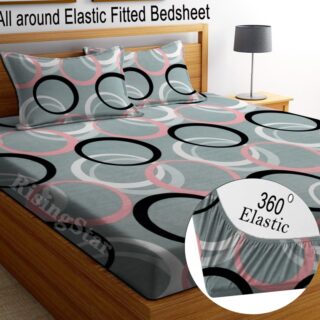 RisingStar 250 TC Microfiber King Printed Fitted (Elastic) Bedsheet(Pack of 1, FITTED-ROUND-CIRCLES-PREMIUM)
Original price was: ₹2,299.00.₹299.00Current price is: ₹299.00.
RisingStar 250 TC Microfiber King Printed Fitted (Elastic) Bedsheet(Pack of 1, FITTED-ROUND-CIRCLES-PREMIUM)
Original price was: ₹2,299.00.₹299.00Current price is: ₹299.00.
-
 Home Garage 210 TC Cotton King Floral Fitted (Elastic) Bedsheet(Pack of 1, Fitted Black Green)
Original price was: ₹1,299.00.₹299.00Current price is: ₹299.00.
Home Garage 210 TC Cotton King Floral Fitted (Elastic) Bedsheet(Pack of 1, Fitted Black Green)
Original price was: ₹1,299.00.₹299.00Current price is: ₹299.00.
-
 Home Garage 180 TC Cotton King 3D Printed Flat Bedsheet(Pack of 1, White)
Original price was: ₹999.00.₹229.00Current price is: ₹229.00.
Home Garage 180 TC Cotton King 3D Printed Flat Bedsheet(Pack of 1, White)
Original price was: ₹999.00.₹229.00Current price is: ₹229.00.
-
 Home Sizzler 153 cm (5 ft) Polyester Room Darkening Window Curtain (Pack Of 2)(Floral, Maroon)
Original price was: ₹799.00.₹299.00Current price is: ₹299.00.
Home Sizzler 153 cm (5 ft) Polyester Room Darkening Window Curtain (Pack Of 2)(Floral, Maroon)
Original price was: ₹799.00.₹299.00Current price is: ₹299.00.
-
 Panipat Textile Hub 152.4 cm (5 ft) Polyester Window Curtain (Pack Of 2)(Solid, Aqua)
Original price was: ₹1,899.00.₹299.00Current price is: ₹299.00.
Panipat Textile Hub 152.4 cm (5 ft) Polyester Window Curtain (Pack Of 2)(Solid, Aqua)
Original price was: ₹1,899.00.₹299.00Current price is: ₹299.00.
-
 Home Sizzler 214 cm (7 ft) Polyester Semi Transparent Door Curtain (Pack Of 2)(Floral, Maroon)
Original price was: ₹1,199.00.₹399.00Current price is: ₹399.00.
Home Sizzler 214 cm (7 ft) Polyester Semi Transparent Door Curtain (Pack Of 2)(Floral, Maroon)
Original price was: ₹1,199.00.₹399.00Current price is: ₹399.00.
-
 Home Sizzler 153 cm (5 ft) Polyester Room Darkening Window Curtain (Pack Of 2)(Floral, Brown)
Original price was: ₹799.00.₹299.00Current price is: ₹299.00.
Home Sizzler 153 cm (5 ft) Polyester Room Darkening Window Curtain (Pack Of 2)(Floral, Brown)
Original price was: ₹799.00.₹299.00Current price is: ₹299.00.
-
 Stella Creations 214 cm (7 ft) Polyester Room Darkening Door Curtain (Pack Of 2)(Abstract, Brown)
Original price was: ₹1,299.00.₹449.00Current price is: ₹449.00.
Stella Creations 214 cm (7 ft) Polyester Room Darkening Door Curtain (Pack Of 2)(Abstract, Brown)
Original price was: ₹1,299.00.₹449.00Current price is: ₹449.00.
-
 Homefab India 152.5 cm (5 ft) Polyester Room Darkening Window Curtain (Pack Of 2)(Floral, Light Blue)
Original price was: ₹1,199.00.₹319.00Current price is: ₹319.00.
Homefab India 152.5 cm (5 ft) Polyester Room Darkening Window Curtain (Pack Of 2)(Floral, Light Blue)
Original price was: ₹1,199.00.₹319.00Current price is: ₹319.00.
-
 Urban Home 214 cm (7 ft) PVC Transparent Door Curtain Single Curtain(Solid, Off White)
Original price was: ₹699.00.₹203.00Current price is: ₹203.00.
Urban Home 214 cm (7 ft) PVC Transparent Door Curtain Single Curtain(Solid, Off White)
Original price was: ₹699.00.₹203.00Current price is: ₹203.00.
-
 Panipat Textile Hub 213 cm (7 ft) Polyester Door Curtain (Pack Of 2)(Solid, Brown)
Original price was: ₹1,199.00.₹349.00Current price is: ₹349.00.
Panipat Textile Hub 213 cm (7 ft) Polyester Door Curtain (Pack Of 2)(Solid, Brown)
Original price was: ₹1,199.00.₹349.00Current price is: ₹349.00.
Hey, it’s Jessica.
You turn on your Windows 11 laptop expecting to get some work done… and instead of your normal login screen, you see:
“Preparing Automatic Repair”
Then maybe:
“Diagnosing your PC”
And then… nothing.
Or worse — it loops. Again and again.
If you’re stuck in the Windows 11 Automatic Repair loop, I know how stressful it feels. Your files are on that device. Your work is there. Your photos. Your projects. And suddenly it won’t even boot.
Take a breath.
In most cases, this problem is fixable. And you don’t need to immediately wipe your computer.
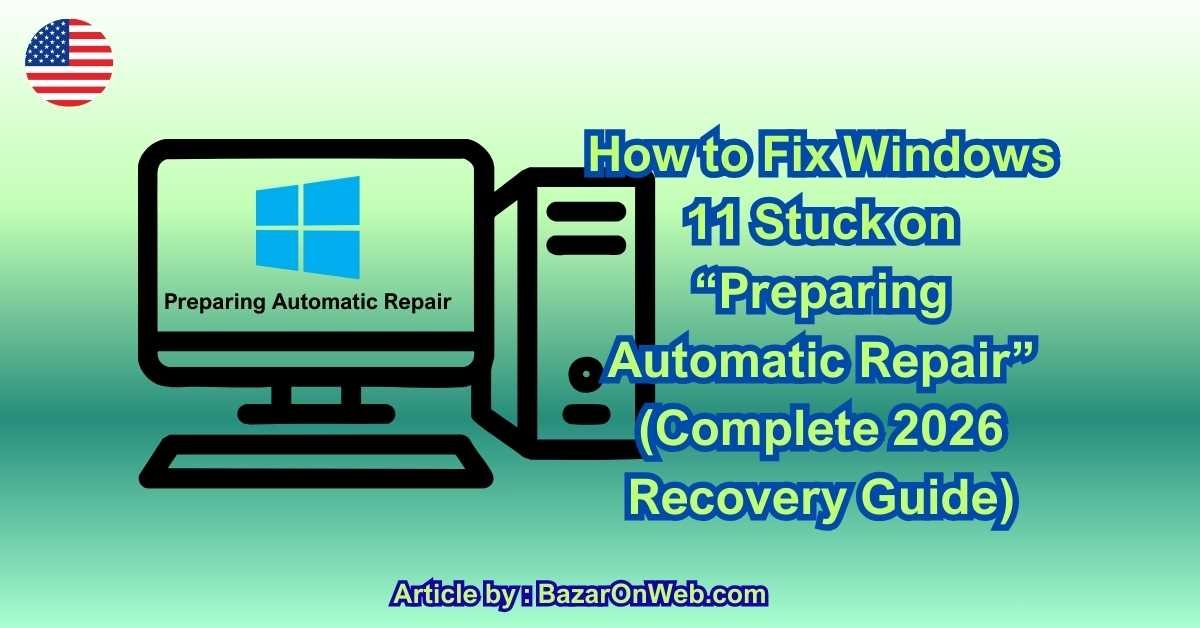
In this guide, I’ll walk you step-by-step through why Windows 11 gets stuck on “Preparing Automatic Repair” and exactly how to fix it safely — starting from the simplest solutions and moving toward advanced recovery.
Let’s solve this properly.
Why Windows 11 Gets Stuck on Automatic Repair
Windows triggers Automatic Repair when it detects boot problems.
Common causes include:
-
Corrupted system files
-
Failed Windows updates
-
Sudden power shutdown
-
Hard drive errors
-
Driver conflicts
-
Malware infection
-
Corrupted Boot Configuration Data (BCD)
-
Hardware changes
Sometimes Windows genuinely needs repair.
Other times, it just fails to complete the repair process and gets stuck in a loop.
The key is figuring out whether it’s a software issue or something deeper.
First: Force a Clean Restart
Before jumping into recovery tools, try this:
-
Hold the Power button for 10 seconds.
-
Wait 30 seconds.
-
Turn it back on.
If it boots normally — great.
If it returns to Automatic Repair, we move forward.
Step 1: Enter Advanced Startup Manually
If Windows is stuck in a loop, you need access to Advanced Startup options.
If it doesn’t appear automatically, you can force it:
-
Turn on the PC.
-
As soon as Windows logo appears, hold Power button to shut it down.
-
Repeat this 2–3 times.
Windows should automatically load:
“Preparing Automatic Repair” → Advanced Options
If you see “Choose an option,” you’re in the right place.
Step 2: Try Startup Repair (First Official Fix)
Inside Advanced Options:
-
Click Troubleshoot
-
Click Advanced Options
-
Select Startup Repair
Windows will attempt to detect and fix boot problems.
This may take several minutes.
If it says:
“Startup Repair couldn’t repair your PC,”
don’t panic — that’s common.
We move to the next fix.
Step 3: Uninstall Recent Windows Updates
Failed updates are one of the biggest causes of repair loops.
Go to:
Troubleshoot → Advanced Options → Uninstall Updates
You’ll see two options:
-
Uninstall latest quality update
-
Uninstall latest feature update
Start with:
Uninstall latest quality update
If that doesn’t work, try removing the feature update.
After uninstalling, restart and check if Windows boots normally.
Step 4: Use System Restore (If Enabled)
If you previously had System Restore turned on:
-
Go to Advanced Options.
-
Click System Restore.
-
Choose a restore point before the issue began.
-
Follow the prompts.
This rolls back:
-
System files
-
Drivers
-
Updates
It does NOT delete personal files.
If restore completes successfully, the loop usually stops.
Step 5: Run System File Checker (SFC Scan)
If system files are corrupted, SFC can repair them.
Go to:
Advanced Options → Command Prompt
Type:
Press Enter.
Wait until it completes (can take 10–20 minutes).
If it says corrupted files were repaired, restart your PC.
If it says it couldn’t fix them, we move deeper.
Step 6: Run DISM Command
Still in Command Prompt, type:
This command repairs the Windows image itself.
Wait until it completes.
Then restart and test again.
Step 7: Check Disk for Errors (Very Important)
Hard drive errors often cause repair loops.
In Command Prompt, type:
Press Enter.
If prompted to schedule at next restart, type Y and press Enter.
Restart.
This scans for:
-
Bad sectors
-
File system errors
-
Disk corruption
If errors are fixed, Windows may boot normally afterward.
Step 8: Disable Automatic Repair Loop
Sometimes Automatic Repair itself causes the loop.
In Command Prompt, type:
Press Enter.
Restart.
This disables automatic repair temporarily and allows normal boot attempt.
If Windows boots, you’ve bypassed the loop.
Step 9: Rebuild Boot Configuration Data (BCD)
Corrupted BCD is a major cause of boot failures.
In Command Prompt, type:
bootrec /fixboot
bootrec /scanos
bootrec /rebuildbcd
Press Enter after each.
If “Access is denied” appears for fixboot, additional disk formatting steps may be required — but often the other commands are enough.
Restart after completing.
If You Suspect a Hardware Issue
Watch for these warning signs:
-
Clicking sounds from hard drive
-
Extremely slow loading
-
Blue screen before repair
-
Disk errors during CHKDSK
If your drive is failing, you should:
-
Back up data immediately using recovery environment
-
Consider replacing the drive
You can access files via Command Prompt or connect the drive to another computer.
Step 10: Reset Windows 11 (Keep Your Files)
If none of the above works, this is the safest major fix.
Go to:
Troubleshoot → Reset this PC
Choose:
Keep my files
This:
-
Reinstalls Windows
-
Removes apps
-
Keeps personal files
This fixes most software-related repair loops.
It’s much safer than full wipe.
When You Should NOT Keep Trying
Stop repeated reboot attempts if:
-
Device overheats
-
You hear mechanical drive noise
-
Repair process freezes permanently
-
Blue screen errors appear
In those cases, hardware diagnostics may be required.
Why This Happens After Windows Updates
Major Windows 11 updates modify:
-
Boot files
-
Drivers
-
Registry entries
-
Security policies
If installation is interrupted (power loss, battery drain), boot files may become corrupted.
That’s why keeping your device plugged in during updates is critical.
Prevent Future Repair Loops
Once fixed:
-
Enable System Restore
-
Keep at least 20% storage free
-
Avoid forced shutdowns
-
Update drivers carefully
-
Create a recovery USB drive
To create recovery USB:
Settings → System → Recovery → Create recovery drive
This can save you in future emergencies.
Final Thoughts Before We Continue
Windows 11 stuck on “Preparing Automatic Repair” feels serious — but in most cases, it’s fixable without losing your data.
Start simple:
Startup Repair
Uninstall updates
System Restore
Move deeper only if needed:
SFC
DISM
CHKDSK
Rebuild BCD
And if all else fails:
Reset Windows while keeping files.
Most repair loops are caused by software corruption — not total system failure.
In the next section, we’ll go deeper into advanced recovery scenarios, including how to recover files before reset, how to use bootable USB repair tools, and what to do if BitLocker appears during the process.
Stay with me — we’ll cover every angle.
Now let’s go deeper into the more advanced recovery options — especially if Windows 11 is still stuck on “Preparing Automatic Repair” even after Startup Repair, SFC, DISM, and CHKDSK.
If you’re here, this likely means:
-
The system won’t boot at all
-
Repair tools failed
-
You’re worried about losing files
-
Or BitLocker suddenly appeared
Don’t panic. You still have solid recovery paths.
Recover Your Files Before Doing Anything Major
Before attempting a full reset or reinstall, it’s smart to secure your files.
Even if Windows won’t boot normally, you can still access your data.
Method 1: Use Command Prompt to Back Up Files
From Advanced Startup:
-
Go to Troubleshoot → Advanced Options → Command Prompt
-
Plug in an external USB drive.
-
Type:
Press Enter.
When Notepad opens:
-
Click File → Open
-
Browse “This PC”
-
Locate your internal drive (usually C:)
-
Navigate to:
C:\Users\YourUsername
From here, you can:
-
Right-click files
-
Copy them
-
Paste into your USB drive
It’s a simple trick, but incredibly powerful.
This method allows you to back up photos, documents, and critical files even if Windows won’t boot.
If BitLocker Appears During Repair
Sometimes during reset or repair, Windows asks for a BitLocker recovery key.
This happens if:
-
Device encryption was enabled
-
Hardware settings changed
-
Boot process was interrupted
To retrieve your key:
-
On another device, go to:
https://account.microsoft.com/devices/recoverykey -
Sign in with your Microsoft account.
-
Locate your device name.
-
Copy the 48-digit recovery key.
-
Enter it on the locked PC.
If this is a work device, contact IT immediately.
Without the BitLocker key, encrypted data cannot be accessed.
Use a Windows 11 Installation USB (Advanced but Powerful)
If built-in repair tools fail, using a bootable Windows USB gives you more control.
Create Installation Media
On another working computer:
-
Go to Microsoft’s official website.
-
Download the Windows 11 Media Creation Tool.
-
Insert a USB drive (8GB or larger).
-
Create installation media.
Boot From USB
-
Insert USB into the broken PC.
-
Turn it on.
-
Press Boot Menu key (F12, F9, Esc — varies by manufacturer).
-
Select USB device.
When setup loads:
Click Repair your computer (bottom-left corner).
Now you’ll see the same Advanced Options — but sometimes USB-based repair works better than internal recovery.
Perform an In-Place Repair (Keeps Everything)
If Windows partially boots but crashes later, an in-place repair may work.
From inside Windows (if accessible):
-
Run Windows 11 setup from USB.
-
Choose Upgrade this PC now.
-
Select Keep personal files and apps.
This reinstalls system files without deleting data or apps.
It’s one of the most effective ways to fix deep corruption.
When Reset This PC Is the Best Option
If:
-
BCD rebuild fails
-
System files remain corrupted
-
Repair tools don’t work
-
Boot loops persist
Go to:
Troubleshoot → Reset this PC → Keep my files
This:
-
Reinstalls Windows 11
-
Removes programs
-
Preserves personal files
It resolves most software-level boot loops.
After reset, reinstall apps and restore settings.
When to Choose Full Clean Install
Only choose this if:
-
Hard drive is stable
-
You backed up files
-
Reset with “Keep my files” fails
Choose:
Troubleshoot → Reset this PC → Remove everything
Or use USB installer and format drive.
This completely wipes Windows and installs fresh copy.
It guarantees removal of:
-
Corrupted registry entries
-
Malware
-
Boot configuration issues
But it deletes all data.
Only do this after backup.
How to Check If Hard Drive Is Failing
If Automatic Repair keeps returning even after reset attempts, check for hardware issues.
Warning signs:
-
Clicking or grinding noise
-
Extremely slow disk scans
-
Frequent disk errors
-
SMART failure warnings
If possible:
-
Enter BIOS.
-
Run built-in hardware diagnostics.
-
Check drive health.
If drive is failing, replacement is required.
Once replaced, reinstall Windows via USB.
What If You Get Blue Screen Before Repair?
If you see Blue Screen of Death (BSOD) before repair:
Common codes include:
-
CRITICAL_PROCESS_DIED
-
INACCESSIBLE_BOOT_DEVICE
-
UNMOUNTABLE_BOOT_VOLUME
These usually indicate:
-
Disk corruption
-
Driver failure
-
Update conflicts
Booting into Safe Mode (from Advanced Options → Startup Settings) may allow driver removal.
If Safe Mode works:
-
Uninstall recent drivers
-
Remove third-party antivirus
-
Roll back GPU drivers
After You Fix It: Prevent It From Happening Again
Once your PC boots normally:
-
Enable System Restore.
-
Create a recovery drive.
-
Keep at least 20% storage free.
-
Avoid forced shutdowns.
-
Keep device plugged in during updates.
-
Update drivers only from official sources.
-
Back up regularly using OneDrive or external drive.
Most Automatic Repair loops start from interrupted updates or storage overload.
Good system hygiene prevents recurrence.
The Calm Reality About Automatic Repair Loops
When Windows 11 gets stuck on “Preparing Automatic Repair,” it feels catastrophic.
But statistically, most cases are:
-
Update corruption
-
Boot file damage
-
Minor disk errors
-
Interrupted shutdown
And most are fixable without permanent data loss.
The key is not repeatedly rebooting randomly.
Instead:
Follow structured recovery steps.
Back up files early.
Escalate gradually.
Only wipe as last resort.
Conclusion
Windows 11 stuck on “Preparing Automatic Repair” can feel like the system is completely broken — but in most cases, it’s a recoverable boot issue.
Start with:
Startup Repair
Uninstall Updates
System Restore
Move deeper:
SFC
DISM
CHKDSK
Rebuild BCD
If needed:
Back up files
Reset while keeping files
Use installation USB
And only consider full wipe if all else fails.
Automatic Repair is Windows trying to protect itself — not destroy your system.
With careful steps, calm troubleshooting, and proper recovery tools, you can restore your PC safely and get back to normal operation.
Disclaimer
This guide is for informational purposes only. Advanced commands and system resets should be performed carefully. Always back up important files before reinstalling or resetting Windows.

- How to Download & Install Wispr Flow AI on Android (Step-by-Step Guide)

- How to Fix Memory Management Error 0x0000001A on Windows 11 (Complete Troubleshooting Guide)

- Fix “The Recycle Bin on C:\ is Corrupted” Error on Windows 11 (Step-by-Step Guide)

- How to Reset Graphics Driver on Windows 11: Easy Fix for Screen Freezes, Lag, and Display Glitches

- What Is Killer Network Service in Windows Complete Guide for Gamers and Laptop Users

Products
-
![Apple Watch Ultra 3 [GPS + Cellular 49mm] Running & Multisport Smartwatch w/Rugged Titanium Case w/Black Titanium Milanese Loop - M. Satellite Communications, Advanced Health & Fitness Tracking](https://bazaronweb.com/retailstores/wp-content/uploads/2025/09/apple-watch-320x320.jpg) Apple Watch Ultra 3 [GPS + Cellular 49mm] Running & Multisport Smartwatch w/Rugged Titanium Case w/Black Titanium Milanese Loop - M. Satellite Communications, Advanced Health & Fitness Tracking
Apple Watch Ultra 3 [GPS + Cellular 49mm] Running & Multisport Smartwatch w/Rugged Titanium Case w/Black Titanium Milanese Loop - M. Satellite Communications, Advanced Health & Fitness Tracking
-
 Apple iPad mini (A17 Pro): Apple Intelligence, 8.3-inch Liquid Retina Display, 256GB, Wi-Fi 6E, 12MP Front/12MP Back Camera, Touch ID, All-Day Battery Life — Purple
-
 Apple AirPods Max Wireless Over-Ear Headphones, Active Noise Cancelling, Transparency Mode, Personalized Spatial Audio, Dolby Atmos, Bluetooth Headphones for iPhone – Space Gray
-
 Apple AirPods Pro 2 Wireless Earbuds, Active Noise Cancellation, Hearing Aid Feature, Bluetooth Headphones, Transparency, Personalized Spatial Audio, High-Fidelity Sound, H2 Chip, USB-C Charging
-
Leo Creation 144 TC Cotton Double Jaipuri Prints Flat Bedsheet(Pack of 1, Blue, Gree, Red, Grey, Light Grey)
Original price was: ₹2,999.00.₹329.00Current price is: ₹329.00.
Leave a Reply