Discounted Products
-
 Leo Creation 144 TC Cotton Double Jaipuri Prints Flat Bedsheet(Pack of 1, Blue, Gree, Red, Grey, Light Grey)
Original price was: ₹2,999.00.₹329.00Current price is: ₹329.00.
Leo Creation 144 TC Cotton Double Jaipuri Prints Flat Bedsheet(Pack of 1, Blue, Gree, Red, Grey, Light Grey)
Original price was: ₹2,999.00.₹329.00Current price is: ₹329.00.
-
 Home Garage 210 TC Cotton King Floral Fitted (Elastic) Bedsheet(Pack of 1, Grey)
Original price was: ₹999.00.₹299.00Current price is: ₹299.00.
Home Garage 210 TC Cotton King Floral Fitted (Elastic) Bedsheet(Pack of 1, Grey)
Original price was: ₹999.00.₹299.00Current price is: ₹299.00.
-
 Goodrik 140 TC Cotton Double 3D Printed Flat Bedsheet(Pack of 1, Brown)
Original price was: ₹499.00.₹229.00Current price is: ₹229.00.
Goodrik 140 TC Cotton Double 3D Printed Flat Bedsheet(Pack of 1, Brown)
Original price was: ₹499.00.₹229.00Current price is: ₹229.00.
-
 GLOBALSHOP 350 TC Microfiber Double Floral Flat Bedsheet(Pack of 1, Multicolor)
Original price was: ₹1,250.00.₹263.00Current price is: ₹263.00.
GLOBALSHOP 350 TC Microfiber Double Floral Flat Bedsheet(Pack of 1, Multicolor)
Original price was: ₹1,250.00.₹263.00Current price is: ₹263.00.
-
 RisingStar 250 TC Microfiber King Printed Fitted (Elastic) Bedsheet(Pack of 1, FITTED-ROUND-CIRCLES-PREMIUM)
Original price was: ₹2,299.00.₹299.00Current price is: ₹299.00.
RisingStar 250 TC Microfiber King Printed Fitted (Elastic) Bedsheet(Pack of 1, FITTED-ROUND-CIRCLES-PREMIUM)
Original price was: ₹2,299.00.₹299.00Current price is: ₹299.00.
-
 Home Garage 210 TC Cotton King Floral Fitted (Elastic) Bedsheet(Pack of 1, Fitted Black Green)
Original price was: ₹1,299.00.₹299.00Current price is: ₹299.00.
Home Garage 210 TC Cotton King Floral Fitted (Elastic) Bedsheet(Pack of 1, Fitted Black Green)
Original price was: ₹1,299.00.₹299.00Current price is: ₹299.00.
-
 Home Garage 180 TC Cotton King 3D Printed Flat Bedsheet(Pack of 1, White)
Original price was: ₹999.00.₹229.00Current price is: ₹229.00.
Home Garage 180 TC Cotton King 3D Printed Flat Bedsheet(Pack of 1, White)
Original price was: ₹999.00.₹229.00Current price is: ₹229.00.
-
 Home Sizzler 153 cm (5 ft) Polyester Room Darkening Window Curtain (Pack Of 2)(Floral, Maroon)
Original price was: ₹799.00.₹299.00Current price is: ₹299.00.
Home Sizzler 153 cm (5 ft) Polyester Room Darkening Window Curtain (Pack Of 2)(Floral, Maroon)
Original price was: ₹799.00.₹299.00Current price is: ₹299.00.
-
 Panipat Textile Hub 152.4 cm (5 ft) Polyester Window Curtain (Pack Of 2)(Solid, Aqua)
Original price was: ₹1,899.00.₹299.00Current price is: ₹299.00.
Panipat Textile Hub 152.4 cm (5 ft) Polyester Window Curtain (Pack Of 2)(Solid, Aqua)
Original price was: ₹1,899.00.₹299.00Current price is: ₹299.00.
-
 Home Sizzler 214 cm (7 ft) Polyester Semi Transparent Door Curtain (Pack Of 2)(Floral, Maroon)
Original price was: ₹1,199.00.₹399.00Current price is: ₹399.00.
Home Sizzler 214 cm (7 ft) Polyester Semi Transparent Door Curtain (Pack Of 2)(Floral, Maroon)
Original price was: ₹1,199.00.₹399.00Current price is: ₹399.00.
-
 Home Sizzler 153 cm (5 ft) Polyester Room Darkening Window Curtain (Pack Of 2)(Floral, Brown)
Original price was: ₹799.00.₹299.00Current price is: ₹299.00.
Home Sizzler 153 cm (5 ft) Polyester Room Darkening Window Curtain (Pack Of 2)(Floral, Brown)
Original price was: ₹799.00.₹299.00Current price is: ₹299.00.
-
 Stella Creations 214 cm (7 ft) Polyester Room Darkening Door Curtain (Pack Of 2)(Abstract, Brown)
Original price was: ₹1,299.00.₹449.00Current price is: ₹449.00.
Stella Creations 214 cm (7 ft) Polyester Room Darkening Door Curtain (Pack Of 2)(Abstract, Brown)
Original price was: ₹1,299.00.₹449.00Current price is: ₹449.00.
-
 Homefab India 152.5 cm (5 ft) Polyester Room Darkening Window Curtain (Pack Of 2)(Floral, Light Blue)
Original price was: ₹1,199.00.₹319.00Current price is: ₹319.00.
Homefab India 152.5 cm (5 ft) Polyester Room Darkening Window Curtain (Pack Of 2)(Floral, Light Blue)
Original price was: ₹1,199.00.₹319.00Current price is: ₹319.00.
-
 Urban Home 214 cm (7 ft) PVC Transparent Door Curtain Single Curtain(Solid, Off White)
Original price was: ₹699.00.₹203.00Current price is: ₹203.00.
Urban Home 214 cm (7 ft) PVC Transparent Door Curtain Single Curtain(Solid, Off White)
Original price was: ₹699.00.₹203.00Current price is: ₹203.00.
-
 Panipat Textile Hub 213 cm (7 ft) Polyester Door Curtain (Pack Of 2)(Solid, Brown)
Original price was: ₹1,199.00.₹349.00Current price is: ₹349.00.
Panipat Textile Hub 213 cm (7 ft) Polyester Door Curtain (Pack Of 2)(Solid, Brown)
Original price was: ₹1,199.00.₹349.00Current price is: ₹349.00.
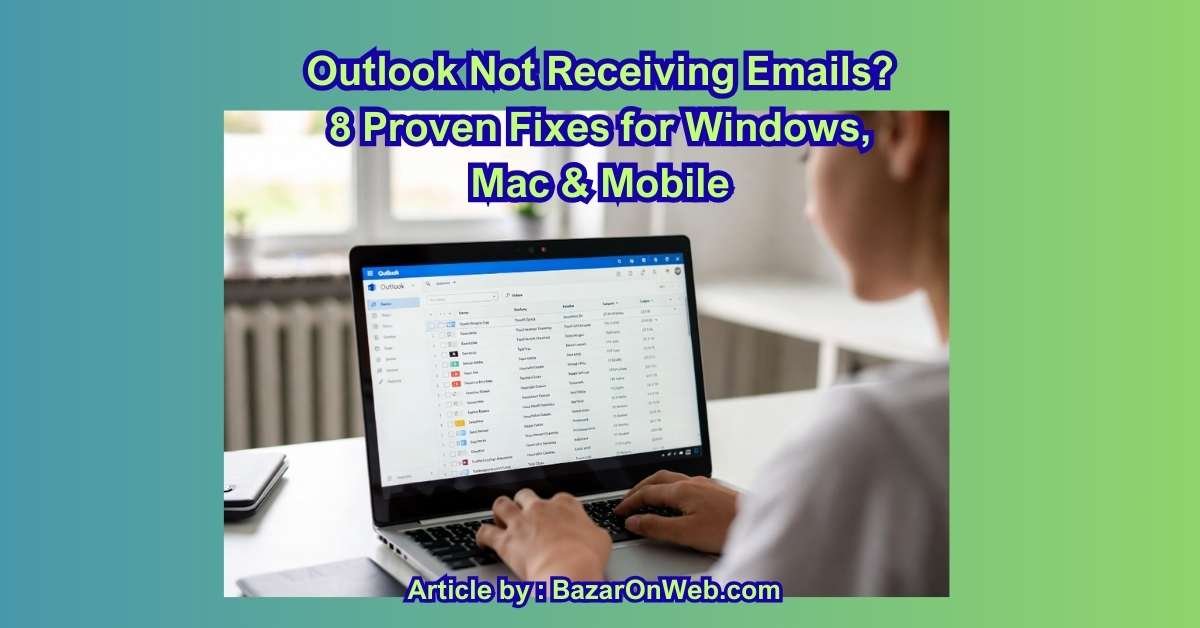
Introduction
Microsoft Outlook is a core productivity tool for professionals, businesses, remote teams, and enterprise environments. When it works properly, emails arrive instantly, messages sync across devices, attachments load without delay, and communication flows efficiently. But when Outlook suddenly stops receiving emails, the disruption can be immediate and stressful. Important messages from colleagues may never arrive, project deadlines may be missed, notifications disappear, and ongoing conversations pause unexpectedly.
This issue is more common than most users realize. Outlook depends on multiple moving parts: account authentication, server connection, mailbox file integrity, email rule structure, storage limits, mobile sync, security permissions, and network conditions. If even one component fails, new emails may stop flowing. Sometimes emails arrive on mobile devices but not on desktop. Other times, Outlook may display sync errors, connection warnings, or missing inbox items. For some users, the problem appears silently — Outlook simply stops updating without any visible alert.
The good news is that most Outlook email delivery problems can be resolved quickly once the underlying cause is identified. Whether the issue stems from server authentication, software bugs, corrupted data files, outdated settings, or mailbox rules, Outlook provides multiple tools for diagnosis and repair.
This guide covers eight proven fixes that work on Windows, macOS, and mobile devices. Below are the first three foundational solutions — designed to address the most common reasons Outlook stops receiving new emails.
Fix 1: Check Internet Connection and Server Status
Before making advanced changes inside Outlook, the first step is to confirm that your device is connected to the internet and that Outlook servers are operational. Outlook supports online and offline modes. If the app is running offline, or if your internet connection is unstable, emails will not sync or update.
Start by testing your internet connection. Open a browser and load several webpages. If sites load slowly or not at all, troubleshoot your Wi-Fi, modem, router, or mobile data before modifying Outlook settings. Even if the connection appears functional, low bandwidth or inconsistent signal strength can prevent Outlook from reaching mail servers.
Next, confirm that Outlook is online. In the Outlook status bar, look for “Working Offline” or a disconnected cloud icon. If so, select the “Send/Receive” tab and click “Work Offline” to toggle back to online mode.
If the desktop app appears connected but still won’t receive emails, verify whether the issue is server related. Microsoft 365 and Outlook.com occasionally experience partial outages that affect mailbox synchronization. Visit the Microsoft Service Health page or search online for recent Outlook outages. If servers are down, emails will resume automatically once service is restored.
You may also want to test message delivery in Outlook Web Access (OWA). If emails appear in the browser version but not in the desktop app, the issue is local to the device rather than the server.
This fix is important because many Outlook email failures originate from connection interruptions rather than software corruption. Before modifying accounts, deleting files, or reinstalling Outlook, always confirm connectivity.
Fix 2: Refresh Outlook Account Authentication and Password Access
If internet connectivity is confirmed but Outlook still isn’t receiving new mail, the next likely cause is account authentication failure. When Outlook loses permission to access a mailbox — often due to password changes, expired tokens, multi-factor authentication resets, organizational policy updates, or login mismatches — email delivery stops immediately.
Start by confirming that your Outlook credentials are valid. If you recently updated your password in another Microsoft app or on another device, you must enter the same updated password inside Outlook. If Outlook continues trying to authenticate using an outdated password, new messages will fail to download.
Open Account Settings and select “Repair” to refresh the login session. On Microsoft 365 accounts, this process re-establishes secure token access between Outlook and the mail server. If the repair function returns an error, remove the account and re-add it using the updated credentials.
Multi-factor authentication (MFA) is another frequent source of sync failure. If Outlook cannot complete MFA validation using email, SMS, authentication apps, biometrics, or security keys, access is denied in the background. Open your Microsoft account portal and confirm that MFA settings are current. Updating verification methods, adding backup authentication options, or approving recent sign-in attempts can correct the problem.
Corporate accounts using Azure Active Directory may also experience login locks due to expired passwords, device compliance rules, or conditional access policies. In that case, you may need to reset your password or request account reauthorization from IT support.
For IMAP or POP accounts, incorrect server credentials or outdated authorization settings can block incoming mail entirely. Verifying server addresses, username format, and security type settings may be necessary.
Refreshing Outlook login permissions solves a common problem: mailbox access was never lost — Outlook simply does not have the correct authority to retrieve mail. Once authentication is restored, inbox updates normally resume.
Fix 3: Verify Mailbox Storage Capacity and Outlook Data File Health
If connectivity and authentication are working, but new messages still don’t appear, the next area to check is mailbox storage capacity and data file integrity. Outlook cannot receive new mail if the mailbox is full, if local data storage is saturated, or if the PST/OST file is damaged. These issues occur more often in large corporate inboxes, long-term archives, and accounts containing thousands of emails and attachments.
Start by checking mailbox quota. For Microsoft 365 and Exchange accounts, go to File → Tools → Mailbox Cleanup → View Mailbox Size. If storage is near the limit, delete unneeded items or move older emails to archive folders. Empty the Deleted Items and Junk folders as they count toward storage quotas. Once space is freed, Outlook will download new messages normally.
For POP or IMAP accounts, check server storage settings provided by the email host. Some providers allocate small mailbox quotas that fill quickly. Logging into the webmail interface can provide more detailed storage metrics.
If storage is not the problem, examine Outlook data file integrity. PST and OST files can become fragmented or corrupted for many reasons: abrupt shutdowns, forced program closures, system crashes, or large-volume mailbox activity. When corruption occurs, Outlook may stop updating, display sync errors, or show incomplete folder structure.
On Windows, run the Microsoft Inbox Repair Tool (scanpst.exe). This utility scans and repairs PST/OST files to restore data health. After repair, restart Outlook and allow it to resync. For Exchange and Microsoft 365 accounts, Outlook may automatically rebuild OST files if corruption is detected.
If data file recovery is not possible, creating a new Outlook profile can solve the issue. Adding the mailbox to a fresh profile forces Outlook to regenerate database files — eliminating hidden corruption.
This fix addresses a problem many users overlook: Outlook might not be malfunctioning — the storage structure holding email data may be damaged. Ensuring a healthy mailbox and data file foundation is essential for continued mail delivery.
Fix 4: Check Email Rules, Filters, and Focused Inbox Sorting
If Outlook is connected, authenticated, and mailbox storage is healthy, but emails are still not showing up, the next place to investigate is message routing. Many users accidentally hide new messages without realizing it. Rules, filters, folders, and Outlook’s Focused Inbox can redirect mail away from the main inbox. When this happens, it appears as if messages aren’t arriving — even though they are stored elsewhere.
Start with message rules. Navigate to Home → Rules → Manage Rules & Alerts, and look for active rules that automatically move, delete, forward, categorize, or mark emails as read. Perhaps an older rule created for a project or client is now catching unrelated mail or moving messages into archived folders. Disable any rule you do not actively need, then send a test email to yourself.
Next, check mailbox folders. Expand and scroll through folder lists, including Junk Email, Archive, Clutter, Conversation History, RSS Feeds, and custom folders. Many users discover that emails flagged by a rule or antivirus filter are simply sitting in another location.
If you have enabled Focused Inbox, messages may appear under the Other tab instead of Focused. Switch between Focused and Other at the top of your inbox. If hidden sorting is the problem, disable Focused Inbox under View → Show Focused Inbox.
Search filters are another common issue. If the search bar or filtering options are set to unread-only, flagged messages, or date restrictions, your inbox may hide recent mail. Clear all filters using View → Reset View or by selecting Clear All in the filter dropdown.
It’s also helpful to verify that blocked senders and spam filters aren’t misclassifying legitimate mail. Outlook’s junk filtering engine updates regularly, and false positives happen. Check the Junk folder, then mark any valid sender as “Not Junk” to avoid repeat filtering.
Adjusting rules and filtering tools resolves many Outlook “missing email” problems. The inbox may not be broken — mail is simply being sorted away from view. Once routing logic is corrected, new messages return to the main inbox.
Fix 5: Repair Outlook Sync Settings and Ensure Send/Receive Functionality
If emails are appearing on webmail but not in the Outlook desktop app, Outlook may not be synchronizing properly. Sync interruptions can happen when background services freeze, Send/Receive settings are disabled, or mail server paths are misconfigured.
Begin by clicking Send/Receive → Send/Receive All Folders. If the inbox updates successfully, the sync error may have been temporary. If not, examine the Send/Receive Groups settings: go to Send/Receive → Send/Receive Groups → Define Send/Receive Groups. Ensure that the main group is enabled, that scheduled sync is turned on, and that the inbox is selected for download. Some users disable scheduled syncing without realizing that new messages will no longer refresh automatically.
Next, examine the bottom status bar for sync-related warnings. Messages like “Disconnected,” “Trying to connect,” or “Updating inbox” may appear. These indicate server connection difficulty. Right-click the email account in the folder pane and select “Update Folder” to force Outlook to reconnect manually. If Outlook displays authentication prompts, re-enter login credentials.
It’s also helpful to check Exchange mode configuration. If Cached Exchange Mode is disabled, Outlook may attempt continuous live sync over unstable networks, leading to frequent delays. Enable Cached Exchange Mode under File → Account Settings → Account Settings → Email tab → Change. This stores messages locally, speeding up retrieval and reducing load on the server.
If sync settings are correct but Outlook still will not update, use the built-in Repair tool: File → Account Settings → Account Settings → select account → Repair. This refreshes server paths, corrects protocol misalignment, and resolves sync token mismatches.
Mobile users should confirm that background refresh, push notifications, and mail sync permissions are activated. iOS and Android both allow sync restrictions that prevent incoming messages. For iPhone users, ensure that Fetch/Push is enabled in Mail settings. For Android, remove battery optimization limits that may suspend the Outlook app.
Once sync settings are restored, Outlook should begin downloading new mail immediately.
Fix 6: Remove and Re-add the Email Account to Rebuild Server Connection
If Outlook still refuses to receive emails after network, authentication, routing, and sync-setting fixes, the next step is to recreate the account connection entirely. Sometimes the account profile becomes corrupted or misconfigured, and Outlook cannot repair it internally. Removing the account and re-adding it resets server communication and authentication flows.
Start by backing up any unsent drafts or local-only folders. Although removing and re-adding an account does not delete messages stored on the server, local folders not synced to the cloud may be lost.
Open File → Account Settings → Account Settings, select the affected account, and click Remove. If the account is part of a linked profile, remove only that mailbox rather than deleting the profile itself.
After removal, restart Outlook to clear residual session data. Then return to Account Settings and select New to add the account again. Enter your email address, authenticate through Microsoft 365 login, IMAP/POP credentials, or Exchange credentials, and allow Outlook to rebuild the profile. This process re-establishes encryption keys, folder mapping, mailbox hierarchy, and sync permissions.
In some cases, users may benefit from creating a completely new Outlook profile instead of modifying the existing one. Go to Control Panel → Mail → Show Profiles → Add. Set the new profile as the default and add your account to it. Creating a fresh profile bypasses old registry entries, corrupted identity tokens, and damaged OST/PST linking structures.
For IMAP or POP accounts, ensure that incoming and outgoing server addresses are correct. An outdated hostname or SSL port number will block email delivery even if the password is correct. Email providers often update server settings over time.
Once the account is added and synced, inbox messages should begin downloading normally. Removing and re-adding the account resolves deeper Outlook issues by clearing internal configuration corruption that cannot be repaired through standard tools.
Fix 7: Repair or Rebuild Outlook Data Files (OST/PST) to Fix Corruption Issues
When Outlook continues to fail at receiving emails, even after account repair, authentication refresh, and sync verification, there may be a deeper underlying issue: corrupted data files. Outlook stores mailbox data in OST (Offline Storage Table) and PST (Personal Storage Table) files. These files can degrade over time due to forced shutdowns, program crashes, power failures, large mailbox sizes, antivirus interference, or disk-level errors.
When corruption occurs, Outlook may:
-
stop syncing
-
freeze during send/receive
-
show incomplete folder content
-
lose recent messages
-
fail to download new mail entirely
Repairing or rebuilding mailbox data files is often the breakthrough solution when nothing else works.
Start by identifying which type of file you are using. Microsoft 365, Exchange, and IMAP accounts typically use OST files, while POP accounts rely on PST files.
On Windows, run Microsoft’s built-in Inbox Repair Tool (scanpst.exe). It is installed automatically with Outlook but not always easy to locate. To find it, search your Outlook installation folder under Program Files or Program Files (x86). Once launched, browse to your PST or OST file path and run the scan. The tool will detect structural errors, indexing corruption, and data fragmentation issues — then attempt automated repair. After repairs complete, restart Outlook and allow it to reindex.
For OST files linked to Microsoft 365 or Exchange, rebuilding the data file can be more effective than repairing it. Close Outlook, locate the OST file in the AppData directory, and rename it. Outlook will generate a new file on next launch and re-sync mailbox data from the server. This eliminates corruption without risking data loss.
On macOS, Outlook stores local database content inside the Microsoft User Data folder. Use Outlook’s built-in Rebuild utility found under Tools → Accounts or by accessing the Outlook Profile Manager. Rebuilding reindexes local cache files and restores clean mailbox structure.
Corruption is particularly common on devices that run low on storage or those that host extremely large inboxes with thousands of messages. Repairing or rebuilding data files resolves these integrity issues and allows Outlook to resume normal mail reception once the damaged file no longer blocks the sync pipeline.
If Outlook still fails to retrieve messages after repair or rebuild, proceed to Fix 8 — involving advanced server, protocol, and security settings.
Fix 8: Verify Advanced Server Settings, Protocol Configurations, and Security Requirements
When Outlook cannot receive emails, despite correct login credentials and a clean mailbox profile, the last major troubleshooting area is advanced server configuration. Every Outlook account type — Microsoft 365, Exchange, IMAP, and POP — requires specific routing, encryption, and authentication configurations. If these settings are incorrect or outdated, Outlook may appear to function normally while silently failing to retrieve messages.
Begin by confirming the protocol in use. Microsoft 365 and Exchange accounts rely on MAPI over HTTP, while IMAP and POP accounts depend on manual server configuration. Mismatched ports or security settings can break communication channels.
For Exchange and Microsoft 365 users, open File → Account Settings → Account Settings → Email tab → Change. Confirm that “Use Cached Exchange Mode” is enabled and that the server name matches Microsoft’s current service endpoints. Outdated or third-party hosted servers must be updated to reflect new Microsoft routing paths. If you are using older protocols such as RPC over HTTP, upgrading to modern authentication may be required.
For IMAP and POP accounts, verify incoming and outgoing server details. Many users experience email interruptions because their provider updated SSL/TLS requirements or changed port assignments. Ensure that IMAP accounts use SSL-enabled ports such as 993 for incoming mail and 587 for SMTP outgoing mail. POP users may need to update to port 995. Incorrect encryption level settings — such as selecting STARTTLS when SSL/TLS is required — will also block inbox updates.
Security requirements may also prevent mail from syncing. Many providers now require app-specific passwords for third-party email clients. If you enabled two-factor authentication for Gmail, Yahoo, or iCloud, Outlook may reject normal passwords and require a generated app password. Failing to use one will cause repeated “send/receive” failures.
On macOS, verify that Outlook has system-level security permissions for Internet Accounts, iCloud access, Keychain access, and application data. Revoked or expired permission flags can block incoming mail silently.
Firewall or security appliances may also block connection to mail servers. If Outlook works on another network, your primary network may be filtering mail ports. Advanced filtering solutions like DNS filtering, SSL inspection, or corporate proxy routing may require whitelisting mail servers.
Finally, confirm whether your organization uses mailbox restrictions, retention policies, quarantine rules, or email compliance filters. In corporate environments, new mail may be blocked before delivery due to policy violations. IT departments can release quarantined emails and provide event logs.
Advanced server checks resolve a common misconception: Outlook may be functioning normally — it is the mail path behind Outlook that is broken. Once server configurations are aligned with current protocols and security requirements, inbox flow typically resumes.
Conclusion
Outlook remains one of the most widely used email platforms in the world — powering communication for businesses, educational institutions, government organizations, and independent professionals. When Outlook stops receiving emails, it can immediately disrupt productivity, delay decision-making, and interrupt workflow. The issue might appear sudden or confusing, but the underlying causes are often manageable and solvable.
The eight fixes in this guide were designed to address the most common failure points from the ground up — starting with basic network checks, moving through account verification, and progressing to deeper technical repairs. The goal is to help users diagnose email flow issues confidently, without unnecessary guesswork or frustration.
First, we began with connectivity and login validation. Internet access, account authentication, and password accuracy form the foundation of incoming mail delivery. If any of these elements break, Outlook cannot retrieve messages, even if everything else is configured correctly.
From there, we progressed to mailbox structure, sorting logic, and storage limitations. Rules, filters, focused view modes, and capacity limits are easy to overlook, yet they frequently redirect or block incoming mail without warning. Sync settings and scheduled send/receive operations were explored next — an especially important step for users who notice messages appearing on mobile or webmail but not the desktop app.
When these surface-level fixes are exhausted, deeper troubleshooting becomes necessary. Outlook data file damage, profile corruption, and server configuration errors can cause partial delivery, missing emails, or complete sync failure. Rebuilding OST/PST files, re-adding accounts, adjusting protocol endpoints, updating ports, and aligning encryption standards are critical steps that resolve persistent delivery breakdowns.
Taken together, these eight approaches provide a structured troubleshooting roadmap — guiding users from simple fixes to advanced diagnostics. Most users will discover that Outlook is not “broken” — it is simply blocked, misrouted, paused, restricted, or corrupted beneath the surface.
Going forward, it helps to establish preventive habits:
-
keep Outlook and Windows/macOS updated
-
avoid oversized inboxes
-
archive emails routinely
-
maintain password hygiene
-
back up data files
-
monitor mailbox storage
-
clear rules that are no longer useful
By taking proactive steps, Outlook performance remains fast, secure, and reliable. And if email delivery stops again, this guide provides a clear path back to functionality — ensuring inbox activity resumes without unnecessary downtime.
Disclaimer (Bazaronweb.com)
The information in this article is provided for educational and troubleshooting purposes only. Results may vary depending on operating system version, email provider configuration, authentication method, mailbox size, device hardware, and network environment. Bazaronweb.com is not responsible for data loss, configuration changes, software issues, or operational interruptions that may occur while following this guide.
Microsoft Outlook, Office 365, Exchange, Windows, macOS, and related product names are trademarks of their respective owners. Bazaronweb.com is not affiliated with Microsoft.

- Can’t View Comments on YouTube Shorts? 6 Ways to Fix It (Complete Guide)

- How to Block Users From Installing Programs in Windows 11 Complete Step-by-Step Guide for Better Security

- How to Fix Chrome Automatically Deleting Downloaded Files (Complete Step-by-Step Guide)

- How to View Apps That Windows Security Identifies as PUA (Step-by-Step Guide)

- How to Add Custom DNS Server on iPhone to Fix DNS Errors and Improve Internet Speed

Products
-
![Apple Watch Ultra 3 [GPS + Cellular 49mm] Running & Multisport Smartwatch w/Rugged Titanium Case w/Black Titanium Milanese Loop - M. Satellite Communications, Advanced Health & Fitness Tracking](https://bazaronweb.com/retailstores/wp-content/uploads/2025/09/apple-watch-320x320.jpg) Apple Watch Ultra 3 [GPS + Cellular 49mm] Running & Multisport Smartwatch w/Rugged Titanium Case w/Black Titanium Milanese Loop - M. Satellite Communications, Advanced Health & Fitness Tracking
Apple Watch Ultra 3 [GPS + Cellular 49mm] Running & Multisport Smartwatch w/Rugged Titanium Case w/Black Titanium Milanese Loop - M. Satellite Communications, Advanced Health & Fitness Tracking
-
 Apple iPad mini (A17 Pro): Apple Intelligence, 8.3-inch Liquid Retina Display, 256GB, Wi-Fi 6E, 12MP Front/12MP Back Camera, Touch ID, All-Day Battery Life — Purple
-
 Apple AirPods Max Wireless Over-Ear Headphones, Active Noise Cancelling, Transparency Mode, Personalized Spatial Audio, Dolby Atmos, Bluetooth Headphones for iPhone – Space Gray
-
 Apple AirPods Pro 2 Wireless Earbuds, Active Noise Cancellation, Hearing Aid Feature, Bluetooth Headphones, Transparency, Personalized Spatial Audio, High-Fidelity Sound, H2 Chip, USB-C Charging
-
Leo Creation 144 TC Cotton Double Jaipuri Prints Flat Bedsheet(Pack of 1, Blue, Gree, Red, Grey, Light Grey)
Original price was: ₹2,999.00.₹329.00Current price is: ₹329.00.
Leave a Reply