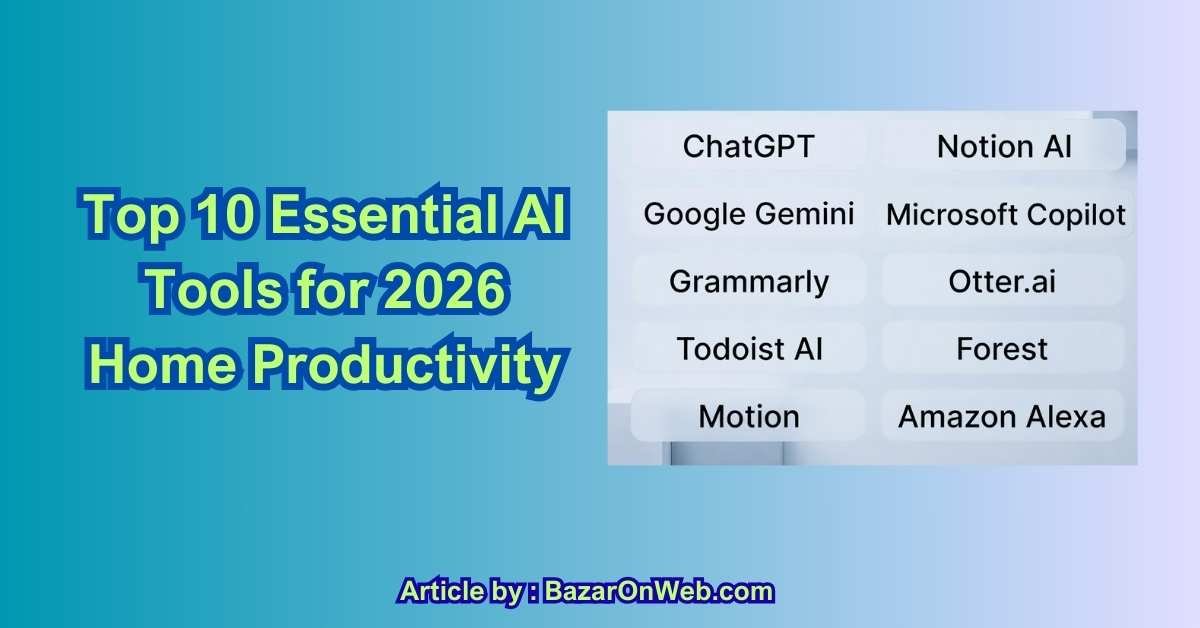
Top 10 Essential AI Tools for 2026 Home Productivity

Top 10 Essential AI Tools for 2026 Home Productivity

Introduction

It’s the very first post of 2026, and if there’s one thing this new year has already made clear, it’s this: home productivity is no longer about doing more—it’s about thinking less. As a working parent, a tech-savvy professional, and someone constantly balancing family life, personal goals, and a fast-moving digital world, I’ve learned that productivity tools only work when they remove friction, not add to it.

Over the last few years, AI quietly moved from being “interesting” to being indispensable at home. What started as simple chatbots and smart speakers has evolved into intelligent systems that plan our days, manage our homes, assist our kids’ learning, organize our finances, and protect our focus. In 2026, AI isn’t something you “try out” anymore—it’s something you build your daily life around.

What makes this moment especially exciting is how home-first AI tools have matured. These tools now understand personal context, family routines, time constraints, and even mental load. They don’t just automate tasks; they anticipate needs, suggest better ways to work, and quietly keep things running in the background. Whether it’s helping your child understand a tough concept, coordinating family schedules, or making sure nothing slips through the cracks, AI has become the invisible productivity partner we didn’t know we needed.

This list of the Top 10 Essential AI Tools for 2026 Home Productivity focuses on tools that genuinely make everyday life smoother—not flashy experiments, but practical, reliable systems people actually use. These are the AI tools shaping how homes function in 2026: smarter planning, clearer communication, better focus, and less stress.

If your goal this year is to reclaim time, reduce mental clutter, and make technology truly work for your household, you’re starting in exactly the right place.

1. ChatGPT

ChatGPT has evolved from a conversational assistant into a full-scale home productivity engine by 2026. It now acts as a centralized AI brain for planning, writing, learning, and decision-making. For home users, ChatGPT is commonly used to manage daily schedules, create grocery lists, draft emails, help kids with homework, plan travel itineraries, and even analyze household budgets. Its biggest strength lies in contextual understanding—it remembers preferences within a session and adapts responses accordingly.

In 2026, ChatGPT’s multimodal capabilities allow users to upload documents, screenshots, voice notes, and images. You can take a photo of a bill or handwritten note, and ChatGPT can extract data, summarize it, or convert it into a task list. Families increasingly rely on it to explain complex topics in simple language, making it especially useful for parents assisting children with studies.

Another key productivity advantage is workflow automation. ChatGPT can integrate with calendars, reminders, cloud documents, and smart home systems, acting as a command center. For example, you can ask it to draft a weekly meal plan, generate a shopping list, and align it with your budget constraints.

Privacy controls and offline-style secure modes introduced in recent versions make it more suitable for home use. Whether you are organizing your personal life, improving learning efficiency, or reducing cognitive load, ChatGPT has become one of the most essential AI tools for home productivity in 2026.


2. Notion AI

Notion AI has transformed home organization by blending notes, tasks, databases, and AI intelligence into a single workspace. In 2026, it is widely used by households to manage personal projects, family schedules, learning plans, and even home finances. Unlike traditional to-do apps, Notion AI can generate content, summarize pages, and convert scattered notes into structured plans automatically.

One of its strongest productivity benefits is intelligent organization. You can dump unstructured thoughts—ideas, reminders, links—and Notion AI will categorize, tag, and turn them into actionable items. Families use shared Notion workspaces to track school activities, doctor appointments, birthdays, and vacation plans in one place.

Notion AI also excels in long-term planning. You can ask it to create a monthly home maintenance checklist, a study timetable for exams, or a fitness plan based on available time. It adapts layouts dynamically, suggesting better templates when your data grows.

In 2026, Notion AI’s offline sync and improved mobile experience make it practical for everyday household use. Its ability to combine documentation, planning, and AI reasoning reduces app overload and mental clutter. For anyone who wants a digital home command center that grows with their needs, Notion AI is an indispensable productivity tool.


3. Google Gemini

Google Gemini has become deeply embedded into home productivity through its seamless integration with Google services. In 2026, it acts as an intelligent layer across Gmail, Google Calendar, Docs, Sheets, and smart home devices. This makes it especially powerful for users already invested in the Google ecosystem.

At home, Gemini helps manage emails by summarizing long threads, drafting replies, and highlighting urgent messages. In Google Calendar, it can automatically suggest schedules, detect conflicts, and optimize routines based on past behavior. For families, this means fewer missed appointments and better time coordination.

Gemini’s strength lies in real-time data access. It can pull information from your files, emails, and cloud storage to answer questions like “When was the last electricity bill paid?” or “Summarize my child’s school notices this week.” This contextual awareness saves significant time.

In 2026, Gemini’s voice-first interaction makes it a natural fit for smart speakers and Android devices. You can manage tasks, set reminders, or get summaries while cooking or commuting. Its strong privacy controls and enterprise-grade security also translate well into home use. For users seeking frictionless productivity tightly integrated with everyday tools, Google Gemini is a top-tier AI assistant.


4. Microsoft Copilot

Microsoft Copilot has emerged as a powerful productivity companion for home users, especially those using Windows and Microsoft 365. By 2026, Copilot is deeply integrated into Word, Excel, Outlook, OneNote, and even Windows itself, turning everyday computing into an AI-assisted experience.

At home, Copilot helps draft documents, manage personal finances in Excel, summarize long emails, and organize notes automatically. Families use it to create budgets, track expenses, and plan events without needing advanced spreadsheet skills. Copilot can explain formulas, generate charts, and highlight spending patterns in plain language.

One of its standout features is contextual assistance across apps. You can ask Copilot to summarize a document and email it, or convert meeting notes into a task list. For parents and students, it acts as a tutor—explaining concepts, rewriting content at different difficulty levels, and creating revision notes.

In 2026, Copilot’s offline and local AI enhancements make it faster and more private for personal use. Its deep integration with Windows reduces friction, making productivity feel native rather than layered. For households already using Microsoft tools, Copilot significantly boosts efficiency and reduces manual effort.


5. Grammarly

Grammarly has evolved far beyond grammar correction to become a full writing productivity assistant for home users. In 2026, it supports emails, messages, documents, and even voice-to-text communication across devices. Its AI now focuses equally on clarity, tone, and intent.

At home, Grammarly helps users write professional emails, school assignments, social media posts, and personal documents with confidence. Parents use it to help children improve writing skills, while professionals rely on it to maintain a polished tone in remote communication.

One of Grammarly’s biggest productivity gains is real-time rewriting. It can shorten long messages, make content more polite or more direct, and adapt tone for different audiences. This reduces time spent editing and rethinking wording.

Grammarly also offers personalized writing insights, helping users gradually improve their communication skills. In 2026, its privacy-first modes ensure sensitive personal writing stays secure. For anyone who writes daily—whether for work, study, or personal communication—Grammarly remains an essential AI productivity tool at home.


6. Otter.ai

Otter.ai has become a key productivity tool for capturing and organizing spoken information at home. In 2026, it offers highly accurate real-time transcription for conversations, lectures, voice notes, and online meetings. This makes it invaluable for households managing learning, planning, and collaboration.

Parents use Otter.ai to record parent-teacher meetings, workshops, or online classes, then quickly review summarized notes. Students rely on it to transcribe lectures and study sessions, freeing them from manual note-taking. Even casual brainstorming or family discussions can be recorded and converted into searchable text.

Otter.ai’s AI-generated summaries highlight key points, action items, and deadlines automatically. This saves time and ensures nothing important is missed. Its integration with calendars and cloud storage makes organization effortless.

In 2026, improved offline recording and multilingual support expand its usability at home. By converting spoken words into structured knowledge, Otter.ai significantly reduces cognitive load and enhances productivity for families, students, and remote workers alike.


7. Todoist AI

Todoist AI has redefined task management for home productivity by adding intelligence to simple to-do lists. In 2026, it not only tracks tasks but also helps users prioritize, schedule, and complete them efficiently.

At home, Todoist AI analyzes deadlines, workload, and habits to suggest the best time to complete tasks. It can break large chores into smaller steps, making overwhelming projects manageable. Families use shared lists to coordinate groceries, cleaning, and events seamlessly.

Natural language input allows users to add tasks effortlessly, such as “Pay electricity bill next Friday evening.” The AI automatically assigns dates, priorities, and reminders. Over time, it learns personal productivity patterns and adapts recommendations.

With strong cross-device syncing and minimalistic design, Todoist AI keeps productivity friction-free. For households juggling multiple responsibilities, it acts as a reliable AI-powered task coordinator.


8. Forest App

Forest uses AI-enhanced focus techniques to help users reduce distractions at home. In 2026, it combines behavioral science with intelligent focus tracking to improve concentration during work, study, or reading.

Users “plant” virtual trees that grow while they stay focused. AI insights analyze focus patterns, suggest optimal focus durations, and identify distraction triggers. Families use Forest to encourage screen discipline for children and adults alike.

Forest’s productivity value lies in habit-building. It transforms focus into a visual and emotional reward system. Over time, users develop healthier digital habits and improved attention spans.

For home environments filled with digital distractions, Forest provides a simple yet effective AI-driven approach to sustained productivity.


9. Motion

Motion is an AI-powered scheduling assistant that automates daily planning. In 2026, it is widely used at home to balance work, personal tasks, and family commitments without manual scheduling.

Motion automatically builds daily schedules based on priorities, deadlines, and available time. If plans change, it instantly reorganizes the day. This reduces stress and decision fatigue significantly.

Home users rely on Motion to maintain realistic routines and avoid overcommitment. Its intelligent rescheduling ensures important tasks always get time.

For individuals seeking structured yet flexible productivity at home, Motion offers a powerful AI-driven solution.


10. Amazon Alexa

Amazon Alexa remains a cornerstone of home productivity in 2026, acting as a voice-controlled AI assistant integrated with smart homes. It helps manage reminders, shopping lists, calendars, and routines hands-free.

Alexa’s productivity strength lies in accessibility. You can add tasks, set timers, control appliances, or get summaries while multitasking. Families use shared reminders and routines to stay coordinated.

With improved conversational AI and privacy controls, Alexa feels more natural and secure. For homes embracing voice-first productivity, Alexa continues to be an essential AI tool.

Conclusion

Looking at these tools together, one thing becomes clear: home productivity in 2026 is no longer fragmented. We’ve moved past juggling dozens of disconnected apps. Instead, AI now works as a coordinated system—planning, writing, listening, scheduling, correcting, reminding, and optimizing quietly in the background.

What makes these AI tools truly essential is not their complexity, but their human-centered design. They adapt to how real people live: interrupted schedules, shared responsibilities, learning curves, and constantly shifting priorities. Whether it’s an AI assistant managing family calendars, a smart task manager reducing decision fatigue, or a focus tool protecting deep work time, each of these solutions solves a very real everyday problem.

Another major shift in 2026 is trust. These tools now offer better privacy controls, clearer data boundaries, and more transparency—making them suitable not just for work, but for personal and family life. AI has stopped feeling intrusive and started feeling supportive.

The biggest productivity upgrade isn’t faster typing, better reminders, or smarter schedules—it’s mental clarity. When AI handles the repetitive, the administrative, and the overwhelming, people regain space for creativity, relationships, and meaningful work. That’s the real value of AI at home.

As this first post of 2026 sets the tone, consider this your reset moment. You don’t need every AI tool out there—but choosing the right ones can fundamentally change how your home runs day to day. Used intentionally, these tools don’t just make you productive—they make life feel lighter, more organized, and more in control.

And honestly, that’s the kind of productivity we all want this year.

Disclaimer

This article is intended for informational and educational purposes only. The AI tools mentioned are based on publicly available features, industry trends, and typical use cases as of 2026. Features, pricing, availability, and privacy policies may change over time. Readers are advised to review official documentation and terms of service of each tool before use. The author does not have any direct affiliation with the tools listed unless explicitly stated.

Leave a Reply

Your email address will not be published. Required fields are marked *

Select the fields to be shown. Others will be hidden. Drag and drop to rearrange the order.
  • Image
  • SKU
  • Rating
  • Price
  • Stock
  • Availability
  • Add to cart
  • Description
  • Content
  • Weight
  • Dimensions
  • Additional information
Click outside to hide the comparison bar
Compare