Category
Popular Articles
- AI (20)
- Air Tag (1)
- Android (53)
- App Suggest (13)
- Apple (42)
- Apple TV (4)
- Bluetooth (3)
- Cars (2)
- ChatGpt (1)
- Chrome (3)
- Did you know? (1)
- E-Commerce News (1)
- Ecommerce Websites business (7)
- Electronics Shopping (5)
- Fashion Tips (3)
- Gaming (7)
- Google Gemini (3)
- Hair Care Tips (2)
- How to (13)
- iCloud (1)
- Infotainment System (1)
- Iphone (159)
- Job Posting (1)
- Lifestyle (3)
- MacBook (34)
- Mobile Games (1)
- Netflix (1)
- Online Shopping Websites (2)
- Personal Finance Management (3)
- Product Reviews (3)
- Roku TV (4)
- Samsung (10)
- Shopping Tips (13)
- Spotify (1)
- Tech (162)
- VPN (2)
- Windows 11 (105)
- Youtube (1)
- Zero Waste (3)
Discounted Products
-
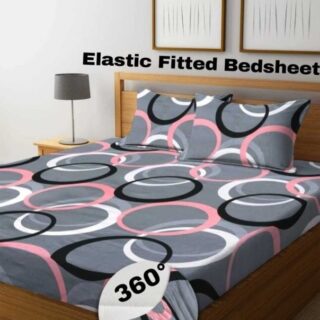
Leo Creation 144 TC Cotton Double Jaipuri Prints Flat Bedsheet(Pack of 1, Blue, Gree, Red, Grey, Light Grey)
₹2,999.00Original price was: ₹2,999.00.₹329.00Current price is: ₹329.00. -
Home Garage 210 TC Cotton King Floral Fitted (Elastic) Bedsheet(Pack of 1, Grey)
₹999.00Original price was: ₹999.00.₹299.00Current price is: ₹299.00. -

Goodrik 140 TC Cotton Double 3D Printed Flat Bedsheet(Pack of 1, Brown)
₹499.00Original price was: ₹499.00.₹229.00Current price is: ₹229.00. -

GLOBALSHOP 350 TC Microfiber Double Floral Flat Bedsheet(Pack of 1, Multicolor)
₹1,250.00Original price was: ₹1,250.00.₹263.00Current price is: ₹263.00. -
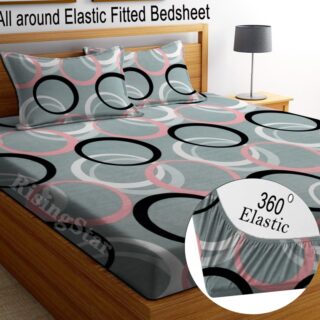
RisingStar 250 TC Microfiber King Printed Fitted (Elastic) Bedsheet(Pack of 1, FITTED-ROUND-CIRCLES-PREMIUM)
₹2,299.00Original price was: ₹2,299.00.₹299.00Current price is: ₹299.00. -
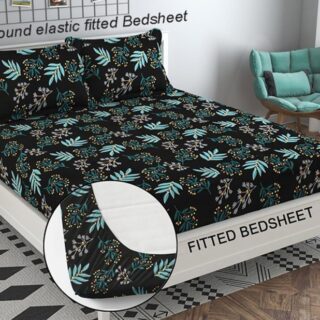
Home Garage 210 TC Cotton King Floral Fitted (Elastic) Bedsheet(Pack of 1, Fitted Black Green)
₹1,299.00Original price was: ₹1,299.00.₹299.00Current price is: ₹299.00. -

Home Garage 180 TC Cotton King 3D Printed Flat Bedsheet(Pack of 1, White)
₹999.00Original price was: ₹999.00.₹229.00Current price is: ₹229.00. -

Home Sizzler 153 cm (5 ft) Polyester Room Darkening Window Curtain (Pack Of 2)(Floral, Maroon)
₹799.00Original price was: ₹799.00.₹299.00Current price is: ₹299.00. -

Panipat Textile Hub 152.4 cm (5 ft) Polyester Window Curtain (Pack Of 2)(Solid, Aqua)
₹1,899.00Original price was: ₹1,899.00.₹299.00Current price is: ₹299.00. -
Home Sizzler 214 cm (7 ft) Polyester Semi Transparent Door Curtain (Pack Of 2)(Floral, Maroon)
₹1,199.00Original price was: ₹1,199.00.₹399.00Current price is: ₹399.00. -

Home Sizzler 153 cm (5 ft) Polyester Room Darkening Window Curtain (Pack Of 2)(Floral, Brown)
₹799.00Original price was: ₹799.00.₹299.00Current price is: ₹299.00. -

Stella Creations 214 cm (7 ft) Polyester Room Darkening Door Curtain (Pack Of 2)(Abstract, Brown)
₹1,299.00Original price was: ₹1,299.00.₹449.00Current price is: ₹449.00. -

Homefab India 152.5 cm (5 ft) Polyester Room Darkening Window Curtain (Pack Of 2)(Floral, Light Blue)
₹1,199.00Original price was: ₹1,199.00.₹319.00Current price is: ₹319.00. -

Urban Home 214 cm (7 ft) PVC Transparent Door Curtain Single Curtain(Solid, Off White)
₹699.00Original price was: ₹699.00.₹203.00Current price is: ₹203.00. -

Panipat Textile Hub 213 cm (7 ft) Polyester Door Curtain (Pack Of 2)(Solid, Brown)
₹1,199.00Original price was: ₹1,199.00.₹349.00Current price is: ₹349.00.
Affiliate Links
Promotion
Mac vs PC in 2026: Which Computer Should You Choose for Work, Gaming, Creativity, and Everyday Life?
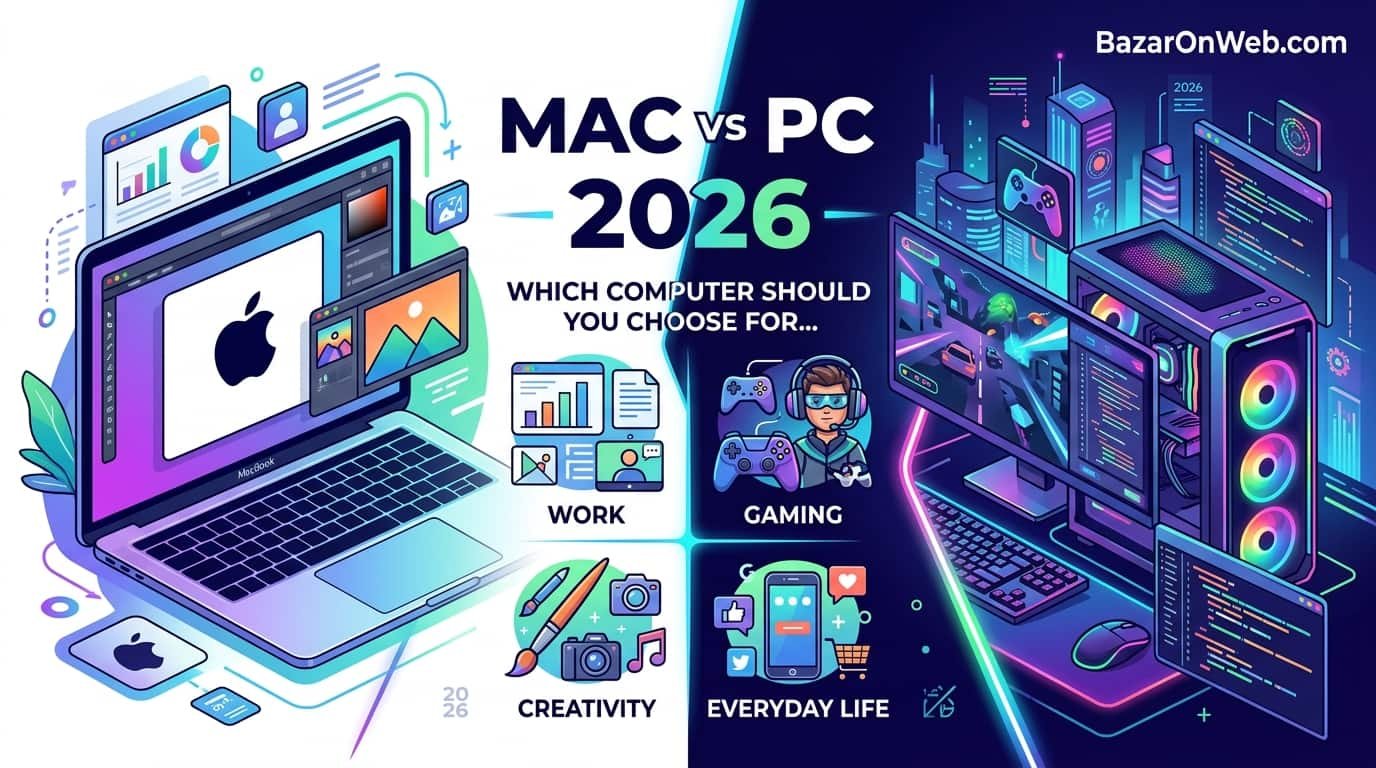
Hi, I’m Jessica, and honestly, this is one of the biggest tech questions people still ask in 2026: should you buy a Mac or a PC? I recently helped my husband replace his aging Windows laptop while I upgraded my own MacBook, and comparing both side by side really reminded me how different these ecosystems feel today. A few years ago, the choice was mostly about brand loyalty or budget, but now it’s more about lifestyle, workflow, compatibility, gaming, battery expectations, and how deeply your devices connect with each other.
If you use an iPhone, AirPods, and iCloud daily, a Mac can feel incredibly seamless and polished. Everything syncs effortlessly, battery life is outstanding, and the overall experience feels refined and stress-free. On the other hand, PCs still dominate when it comes to flexibility, gaming performance, software variety, upgrade options, and price ranges. Whether you need a lightweight budget laptop, a powerful workstation, or a custom gaming setup, the Windows world offers far more choices.
The truth is that neither option is universally better. The best computer in 2026 depends entirely on how you work, create, study, game, travel, and manage your digital life. Understanding the strengths and weaknesses of both platforms can save you money, frustration, and years of regret after a purchase.
H2: Why the Mac vs PC Debate Still Matters in 2026
Even after decades of competition, the Mac versus PC debate remains incredibly relevant because modern computers are now deeply connected to how people live and work every single day. A laptop is no longer just a machine for typing documents or browsing the internet. It has become a communication hub, entertainment center, productivity tool, creative studio, and sometimes even a full business operation. Choosing the wrong platform can affect convenience, compatibility, efficiency, and long-term satisfaction.
In 2026, Macs continue gaining popularity because Apple has refined the experience around its custom silicon chips, macOS optimization, and ecosystem integration. Battery life on MacBooks has become one of the strongest reasons people switch. Many users can now work for an entire day without carrying a charger. Apple also maintains a reputation for premium build quality and consistent software performance that appeals to professionals, students, and content creators.
Meanwhile, PCs continue dominating market share because Windows machines offer enormous variety and customization. Consumers can buy affordable laptops for basic work, ultra-powerful gaming systems, portable business machines, or highly specialized creator workstations. The flexibility of Windows hardware remains unmatched, especially for users who want control over specifications, upgrades, or software compatibility.
Another reason this debate matters is the growing role of AI tools, cloud workflows, and hybrid work environments. Different operating systems now handle AI acceleration, software optimization, and multitasking differently. Buyers must think carefully about what software they use daily and how their future needs may evolve over the next several years.
H2: Battery Life and Portability Differences Between Mac and PC
Battery life has become one of the biggest deciding factors for modern laptop buyers, and this is where Macs currently have a major advantage in 2026. Apple’s efficiency-focused chip architecture allows MacBooks to deliver impressive battery endurance while maintaining strong performance. Many users can comfortably work, stream videos, attend meetings, browse the web, and edit documents throughout an entire day without needing a charger.
This advantage becomes especially noticeable for students, travelers, remote workers, and professionals constantly moving between locations. Carrying fewer chargers and worrying less about battery anxiety creates a genuinely better daily experience. MacBooks also tend to stay cooler and quieter during regular workloads, which further improves comfort during long work sessions.
However, PCs are not weak in portability anymore. Premium Windows ultrabooks from brands like Dell, ASUS, HP, Lenovo, and Samsung have dramatically improved battery optimization and lightweight design. Some Windows laptops now compete closely with MacBooks in terms of portability and battery longevity. Still, consistency varies greatly because Windows devices are built by many manufacturers using different hardware combinations.
Gaming laptops remain a separate category altogether. High-performance gaming PCs often sacrifice battery life in favor of graphics power and cooling performance. These systems may deliver excellent gaming experiences but rarely match the efficiency of a MacBook during unplugged use.
Another important factor is charging flexibility. Many modern PCs support universal USB-C charging standards across multiple brands and accessories. Apple also uses USB-C now, but Windows users often enjoy wider compatibility with docks, adapters, and third-party hardware ecosystems depending on their setup preferences.
H2: Gaming Performance Is Still Stronger on PCs
If gaming is one of your top priorities, PCs remain the clear winner in 2026. While Apple has improved gaming support significantly over recent years, the Windows ecosystem still dominates in terms of game availability, graphics hardware, customization, and performance flexibility. Serious gamers generally continue choosing PCs because they provide access to the largest game libraries and the most advanced graphics technologies.
Modern gaming PCs support powerful dedicated GPUs from NVIDIA and AMD that can handle ultra-high resolutions, ray tracing, VR gaming, competitive esports titles, and demanding AAA games with excellent frame rates. Users can also customize nearly every aspect of the gaming experience, including cooling systems, RGB lighting, refresh rates, monitor setups, and upgrade paths.
Mac gaming has improved compared to previous years, especially with Apple Silicon optimization and developer interest growing slowly. Some major games now run surprisingly well on Macs, and Apple continues encouraging developers to support macOS gaming. However, the library remains smaller, and many popular competitive or niche games still prioritize Windows support first.
Another important consideration is compatibility with gaming accessories and mods. PCs offer broader support for specialized gaming peripherals, custom drivers, emulators, and modification communities. Enthusiasts who enjoy tweaking performance settings or building custom gaming rigs usually prefer the flexibility Windows provides.
Cloud gaming services have also expanded in 2026, allowing Macs to access some gaming experiences remotely. However, for native gaming performance and maximum compatibility, PCs still offer a far superior environment. Anyone planning to spend significant time gaming should carefully evaluate whether macOS limitations could become frustrating over time.
H2: MacBooks Excel at Everyday User Experience
One reason so many people fall in love with Macs is the overall day-to-day experience. Apple focuses heavily on creating a polished, smooth, and consistent environment where hardware and software feel deeply connected. Even people who are not particularly technical often appreciate how intuitive and stable the experience feels compared to managing various Windows systems.
MacBooks are known for excellent trackpads, premium keyboards, sharp displays, quiet operation, and strong build quality. Small details like instant wake-from-sleep, smooth gestures, app consistency, and ecosystem continuity create a refined experience that many users notice immediately. These improvements may seem minor individually, but together they contribute to a laptop that feels reliable and comfortable to use every day.
The Apple ecosystem adds another major advantage. Features like AirDrop, Universal Clipboard, Handoff, iCloud syncing, and seamless AirPods switching create a connected workflow between iPhones, iPads, Apple Watches, and Macs. Users deeply invested in Apple products often find that a Mac naturally integrates into their digital lifestyle with minimal setup or troubleshooting.
Windows PCs can also provide excellent experiences, particularly premium business or creator laptops. However, because Windows exists across countless manufacturers and hardware combinations, consistency varies more dramatically. Some laptops are fantastic, while others may include unnecessary software, weaker optimization, or inconsistent drivers.
Many users choose Macs because they prefer simplicity and stability over customization. The system feels curated and controlled, which reduces technical headaches for people who simply want their devices to work smoothly without constant maintenance or troubleshooting.
H2: PCs Offer More Hardware Choices and Better Pricing Flexibility
One of the biggest strengths of the PC ecosystem is sheer variety. In 2026, Windows users can choose from thousands of devices across every price category imaginable. Whether someone needs a basic budget laptop for school, a touchscreen convertible for business, a portable ultrabook for travel, or a high-end gaming workstation, there is almost always a Windows PC available to match those needs.
This flexibility gives PCs a massive advantage for budget-conscious buyers. Entry-level Windows laptops remain significantly more affordable than MacBooks, making them attractive for students, families, and businesses purchasing multiple systems. Consumers can prioritize features that matter most to them instead of paying for premium design elements they may not need.
The PC market also allows far greater customization. Buyers can choose processors, graphics cards, storage configurations, RAM capacities, display types, cooling systems, and ports according to their specific requirements. Desktop PCs especially offer exceptional upgrade potential. Users can replace components over time instead of purchasing entirely new systems every few years.
Macs, by comparison, follow a more controlled product strategy with fewer models and limited upgrade options after purchase. Apple focuses on delivering optimized experiences rather than modular flexibility. While this simplicity appeals to many users, others feel restricted by Apple’s ecosystem limitations and pricing structures.
Businesses and specialized industries also often prefer PCs because certain enterprise tools, legacy applications, engineering software, or hardware integrations remain optimized primarily for Windows. This broader compatibility makes PCs practical for industries with highly specific technical requirements or operational workflows.
H2: Creative Professionals Now Use Both Platforms Successfully
For many years, Macs were considered the undisputed choice for creative professionals, especially in graphic design, video editing, music production, and photography. While Macs still maintain a strong reputation in creative industries, the situation in 2026 has become much more balanced because Windows PCs have improved dramatically in performance, display quality, and creator-focused hardware.
MacBooks remain extremely popular among video editors, photographers, writers, and music producers because of their stability, color accuracy, efficient rendering performance, and optimized creative applications. Programs like Final Cut Pro and Logic Pro continue attracting creators who prefer Apple-exclusive tools. Many professionals also appreciate the quieter operation and strong battery life during mobile workflows.
However, creator-focused Windows laptops are now incredibly powerful. Devices equipped with advanced GPUs and high-performance processors can outperform Macs in certain rendering tasks, 3D workloads, AI-assisted creative tools, and specialized production environments. Windows systems also support a wider range of hardware accessories and custom workflows for advanced production setups.
Software availability has also expanded significantly across both platforms. Adobe Creative Cloud, Blender, DaVinci Resolve, Figma, and many professional tools now work extremely well on both macOS and Windows. As a result, choosing a platform increasingly depends on personal workflow preferences rather than strict software limitations.
Another growing factor is AI-powered creative tools. Many Windows creator machines now include dedicated AI hardware acceleration features optimized for advanced content generation, editing automation, and machine-learning workflows. Apple is also investing heavily in AI integration, making this an evolving competition that continues reshaping creative computing in 2026.
H2: Software Compatibility Still Favors Windows PCs
Software compatibility remains one of the strongest reasons many people continue choosing Windows PCs. Although macOS supports a huge range of modern applications, Windows still dominates when it comes to enterprise software, industry-specific tools, legacy programs, engineering applications, and gaming ecosystems. Businesses and technical users often rely on Windows because critical software may simply not exist on macOS.
Many industries use specialized applications designed specifically for Windows environments. Engineering firms, architecture companies, manufacturing operations, government organizations, and scientific research institutions frequently depend on programs that require Windows compatibility. Some older systems and enterprise workflows were built around Windows decades ago and continue operating within that ecosystem today.
Windows also offers broader hardware compatibility. External devices, printers, industrial equipment, scanners, niche peripherals, and legacy hardware often receive Windows support before macOS support. Users dealing with uncommon hardware configurations or technical workflows may find PCs easier to integrate into existing systems.
For students and general users, software differences are less dramatic than they once were. Most modern cloud-based applications now function across both operating systems. Web browsers, productivity suites, communication tools, streaming platforms, and collaborative workspaces are usually accessible regardless of platform choice.
Still, compatibility issues occasionally appear when users switch unexpectedly. Someone who depends on a specific Windows-only application may discover expensive workarounds are necessary on a Mac. Before purchasing any computer in 2026, checking software requirements carefully is extremely important, especially for professional or educational environments where compatibility problems could disrupt productivity or coursework.
H2: Security and Reliability Comparisons in 2026
Security has become one of the most important topics in modern computing, especially as remote work, online banking, cloud storage, and AI-powered cyber threats continue expanding. Both Macs and PCs have improved security significantly in recent years, but they approach protection differently.
Apple markets Macs heavily around privacy, system control, and ecosystem security. Because Apple designs both the hardware and operating system, it maintains tighter control over updates, app distribution, permissions, and system optimization. This integrated approach often results in a more predictable and streamlined security environment. Many users appreciate the automatic updates and minimal maintenance required to keep Macs secure.
However, Macs are no longer immune to malware or cyber threats. As Apple devices become more popular, cybercriminals increasingly target macOS users as well. Safe browsing habits, password security, and software awareness remain important regardless of platform choice.
Windows PCs have historically faced more security challenges partly because of their enormous market share and open ecosystem. However, Microsoft has invested heavily in Windows security tools, AI-based threat detection, and built-in protection features. Modern Windows systems are far safer than older generations, especially when users keep updates active and follow basic cybersecurity practices.
Reliability also depends heavily on hardware quality. Premium PCs from trusted manufacturers can be extremely reliable, while poorly optimized budget systems may experience issues sooner. Macs often maintain strong long-term consistency because Apple controls fewer hardware combinations, which simplifies optimization and support.
Ultimately, neither platform is perfectly secure. Good digital habits matter more than brand loyalty when protecting personal information and online accounts.
H2: AI Features and Smart Computing Are Changing Both Platforms
Artificial intelligence has become a major part of the computing experience in 2026, and both Macs and PCs are evolving rapidly to support AI-powered workflows. From smart productivity assistants to automated editing tools and local AI processing, modern computers now rely heavily on machine learning capabilities.
Apple has integrated AI deeply into its ecosystem with privacy-focused on-device processing and tighter integration between apps and devices. Features like intelligent writing assistance, smarter search capabilities, voice improvements, automated organization, and contextual suggestions create a seamless experience for many users. Apple focuses strongly on efficiency and privacy while trying to keep AI interactions polished and subtle.
Windows PCs are also embracing AI aggressively, especially with new hardware optimized for neural processing tasks. Many modern Windows laptops now include dedicated AI chips designed to accelerate machine-learning applications, video enhancements, productivity tools, and advanced creative workflows. Microsoft has integrated AI assistants deeply into Windows, Office tools, and enterprise productivity environments.
One advantage PCs currently have is hardware diversity. Users can access specialized AI-focused systems with powerful GPUs capable of handling local AI models, advanced rendering, machine learning development, and generative workflows. Developers, researchers, and technical professionals may prefer Windows systems for this flexibility.
At the same time, average consumers may prioritize convenience rather than technical AI capabilities. For them, the smoother ecosystem experience on Macs may feel more valuable than raw AI customization options. As AI becomes central to computing, buyers should think carefully about whether they need advanced AI performance or simply intelligent everyday productivity enhancements integrated into daily workflows.
H2: Which Users Should Choose a Mac in 2026
A Mac is an excellent choice in 2026 for users who value simplicity, battery life, premium build quality, and seamless ecosystem integration. People already invested in Apple products often experience the biggest benefits because Macs work exceptionally well alongside iPhones, iPads, AirPods, and Apple Watches. Features like shared messaging, file transfers, synchronized photos, and device continuity create a highly connected digital environment.
Students, writers, remote workers, business professionals, and frequent travelers often appreciate the portability and reliability of MacBooks. The long battery life reduces charger dependency, while the polished software experience minimizes distractions and troubleshooting. Users who prefer focusing on work rather than system maintenance may find macOS especially appealing.
Creative professionals also continue choosing Macs for music production, photography, video editing, and content creation. Apple’s optimized software ecosystem and efficient hardware provide excellent performance for many creative workflows. People who prioritize aesthetics, display quality, and premium design often feel satisfied with the Mac experience as well.
Macs are also a strong option for users who keep devices for many years. Apple products typically receive long-term software support and maintain strong resale value compared to many Windows laptops. This can offset some of the higher upfront cost over time.
However, buyers should still confirm software compatibility before purchasing. A Mac works best when your workflow aligns naturally with Apple’s ecosystem philosophy and supported applications rather than requiring extensive customization or niche Windows-only tools.
H2: Which Users Should Choose a PC in 2026
A PC is the better choice in 2026 for users who prioritize flexibility, gaming, customization, affordability, or broad software compatibility. Windows systems serve an enormous variety of needs, making them ideal for people who want more control over hardware options and pricing.
Gamers remain one of the largest groups benefiting from PCs. Access to powerful GPUs, extensive game libraries, modding communities, VR support, and customizable gaming setups gives Windows a huge advantage for entertainment-focused users. Competitive gamers especially rely on Windows ecosystems for maximum compatibility and performance optimization.
PCs are also ideal for users working in industries dependent on Windows-exclusive software or specialized hardware integrations. Engineers, developers, enterprise employees, architects, researchers, and technical professionals frequently require tools optimized specifically for Windows environments.
Budget-conscious shoppers often prefer PCs because there are strong options available across every price range. Families purchasing multiple devices, students seeking affordability, or businesses managing large deployments can find practical Windows systems without paying premium Apple pricing.
Customization is another major strength. Users who enjoy upgrading storage, changing components, building desktops, or tailoring hardware specifications usually find PCs far more adaptable. Windows systems also support a wider range of experimental workflows, niche accessories, and advanced technical configurations.
For people who value openness, variety, gaming power, and hardware freedom, PCs remain the most versatile computing platform available in 2026.
Disclaimer
This article is for informational and educational purposes only. Technology products, specifications, software support, pricing, and platform features may change over time depending on manufacturer updates and regional availability. User experiences with Macs and PCs can vary based on hardware configuration, software requirements, usage habits, and personal preferences. Readers should compare the latest models, check software compatibility, and evaluate their own productivity, gaming, creative, or business needs before making a purchasing decision. This article reflects general consumer trends and opinions in 2026 and should not be considered professional technical or financial advice.
Written by Bazaronweb
Latest Tech Articles
- Mac vs PC in 2026: Which Computer Should You Choose for Work, Gaming, Creativity, and Everyday Life?

- MacBook Neo 2026: Features, OLED Display, M5 Chip, Price, and Everything We Know

- Which MacBooks Support Apple Intelligence in 2026? Complete Compatibility Guide for Buyers

- Why Battery Is Draining Faster After the macOS Tahoe Update on MacBook Pro

- MacBook Battery Life in 2026: What to Expect From Apple’s Latest Laptops

Products
-
Apple Watch Ultra 3 [GPS + Cellular 49mm] Running & Multisport Smartwatch w/Rugged Titanium Case w/Black Titanium Milanese Loop - M. Satellite Communications, Advanced Health & Fitness Tracking
-
Apple iPad mini (A17 Pro): Apple Intelligence, 8.3-inch Liquid Retina Display, 256GB, Wi-Fi 6E, 12MP Front/12MP Back Camera, Touch ID, All-Day Battery Life — Purple
-
Apple AirPods Max Wireless Over-Ear Headphones, Active Noise Cancelling, Transparency Mode, Personalized Spatial Audio, Dolby Atmos, Bluetooth Headphones for iPhone – Space Gray
-
Apple AirPods Pro 2 Wireless Earbuds, Active Noise Cancellation, Hearing Aid Feature, Bluetooth Headphones, Transparency, Personalized Spatial Audio, High-Fidelity Sound, H2 Chip, USB-C Charging
-
Leo Creation 144 TC Cotton Double Jaipuri Prints Flat Bedsheet(Pack of 1, Blue, Gree, Red, Grey, Light Grey)
₹2,999.00Original price was: ₹2,999.00.₹329.00Current price is: ₹329.00.
Leave a Reply