Category
Popular Articles
- AI (24)
- Air Tag (2)
- Android (61)
- App Suggest (13)
- Apple (46)
- Apple TV (4)
- Bluetooth (3)
- Cars (2)
- ChatGpt (1)
- Chrome (6)
- Did you know? (1)
- E-Commerce News (1)
- Ecommerce Websites business (7)
- Electronics Shopping (5)
- Fashion Tips (3)
- Gaming (7)
- Google Gemini (3)
- Hair Care Tips (2)
- How to (13)
- iCloud (1)
- Infotainment System (1)
- iPad (1)
- Iphone (179)
- Job Posting (1)
- Lifestyle (3)
- MacBook (42)
- Mobile Games (1)
- Netflix (1)
- Online Shopping Websites (2)
- Personal Finance Management (3)
- Product Reviews (3)
- Roku TV (4)
- Samsung (10)
- Shopping Tips (13)
- Spotify (1)
- Tech (166)
- VPN (2)
- Whatsapp (1)
- Windows 11 (147)
- Youtube (1)
- Zero Waste (3)
Discounted Products
-
Home Garage 210 TC Cotton King Floral Fitted (Elastic) Bedsheet(Pack of 1, Grey)
₹999.00Original price was: ₹999.00.₹299.00Current price is: ₹299.00. -

Goodrik 140 TC Cotton Double 3D Printed Flat Bedsheet(Pack of 1, Brown)
₹499.00Original price was: ₹499.00.₹229.00Current price is: ₹229.00. -

GLOBALSHOP 350 TC Microfiber Double Floral Flat Bedsheet(Pack of 1, Multicolor)
₹1,250.00Original price was: ₹1,250.00.₹263.00Current price is: ₹263.00. -
RisingStar 250 TC Microfiber King Printed Fitted (Elastic) Bedsheet(Pack of 1, FITTED-ROUND-CIRCLES-PREMIUM)
₹2,299.00Original price was: ₹2,299.00.₹299.00Current price is: ₹299.00. -

Home Garage 210 TC Cotton King Floral Fitted (Elastic) Bedsheet(Pack of 1, Fitted Black Green)
₹1,299.00Original price was: ₹1,299.00.₹299.00Current price is: ₹299.00. -

Home Garage 180 TC Cotton King 3D Printed Flat Bedsheet(Pack of 1, White)
₹999.00Original price was: ₹999.00.₹229.00Current price is: ₹229.00. -

Panipat Textile Hub 152.4 cm (5 ft) Polyester Window Curtain (Pack Of 2)(Solid, Aqua)
₹1,899.00Original price was: ₹1,899.00.₹299.00Current price is: ₹299.00. -

Home Sizzler 214 cm (7 ft) Polyester Semi Transparent Door Curtain (Pack Of 2)(Floral, Maroon)
₹1,199.00Original price was: ₹1,199.00.₹399.00Current price is: ₹399.00. -

Home Sizzler 153 cm (5 ft) Polyester Room Darkening Window Curtain (Pack Of 2)(Floral, Brown)
₹799.00Original price was: ₹799.00.₹299.00Current price is: ₹299.00. -

Stella Creations 214 cm (7 ft) Polyester Room Darkening Door Curtain (Pack Of 2)(Abstract, Brown)
₹1,299.00Original price was: ₹1,299.00.₹449.00Current price is: ₹449.00. -

Homefab India 152.5 cm (5 ft) Polyester Room Darkening Window Curtain (Pack Of 2)(Floral, Light Blue)
₹1,199.00Original price was: ₹1,199.00.₹319.00Current price is: ₹319.00. -

Urban Home 214 cm (7 ft) PVC Transparent Door Curtain Single Curtain(Solid, Off White)
₹699.00Original price was: ₹699.00.₹203.00Current price is: ₹203.00. -

Panipat Textile Hub 213 cm (7 ft) Polyester Door Curtain (Pack Of 2)(Solid, Brown)
₹1,199.00Original price was: ₹1,199.00.₹349.00Current price is: ₹349.00. -

Home Sizzler 214 cm (7 ft) Polyester Semi Transparent Door Curtain (Pack Of 2)(Floral, Brown)
₹999.00Original price was: ₹999.00.₹349.00Current price is: ₹349.00. -

Panipat Textile Hub 213 cm (7 ft) Polyester Semi Transparent Door Curtain (Pack Of 2)(Floral, Brown)
₹899.00Original price was: ₹899.00.₹299.00Current price is: ₹299.00.
Affiliate Links
Promotion
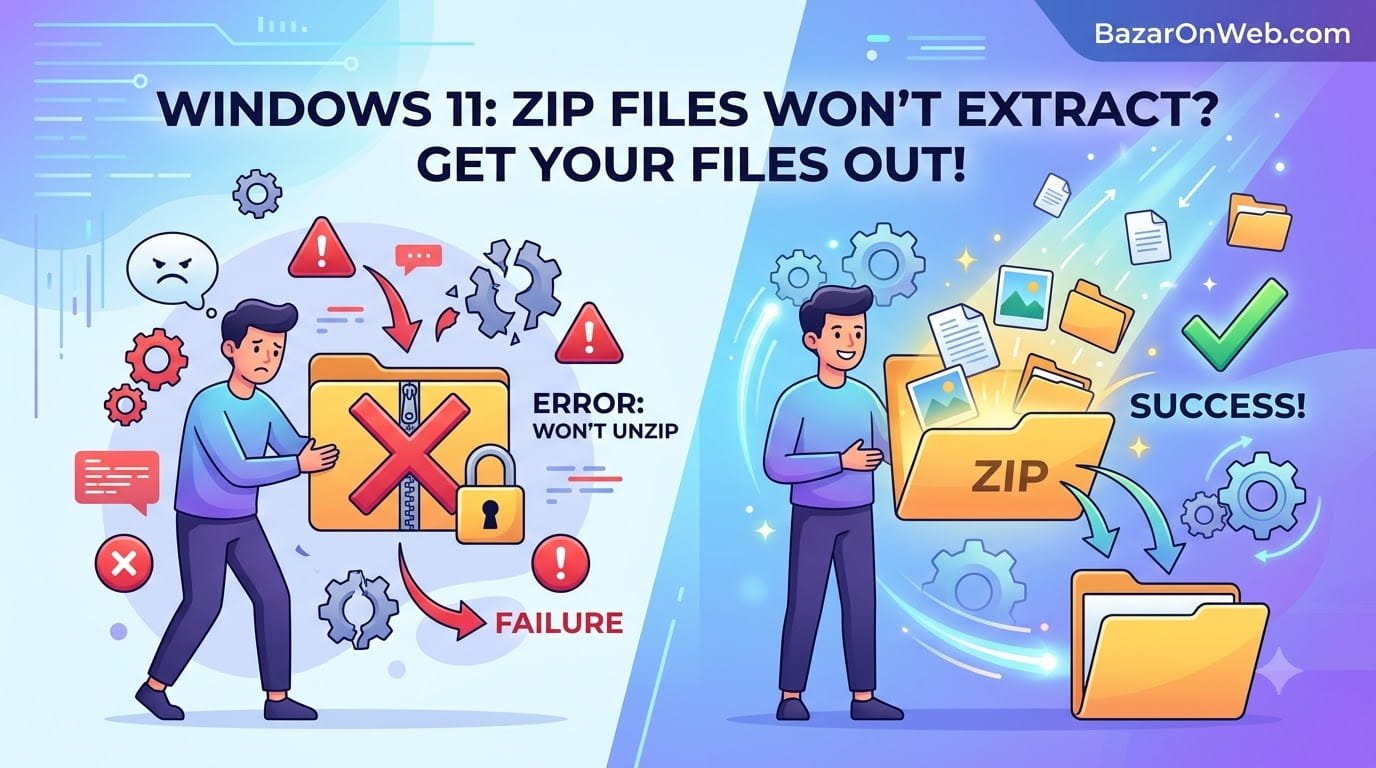
When Your ZIP File Refuses to Cooperate!
I downloaded a software package that came compressed in a ZIP file. Should be simple, right? Windows natively supports ZIP files. Just extract and I’m done. Except when I double-clicked the ZIP file, nothing happened. Literally nothing.
No extraction window appeared. No progress bar. No confirmation dialog. Just… nothing. The ZIP file opened in File Explorer showing me the contents, but there was no obvious “Extract” button anywhere. I right-clicked the file looking for context menu options. Plenty of options appeared, but nothing obviously labeled “Extract.”
I tried dragging files out of the ZIP window into my Downloads folder. That worked, but felt clunky. I tried right-clicking again and looking more carefully. Eventually I found “Extract All” buried in a submenu, but only after fumbling through several wrong options.
This shouldn’t be complicated. Windows has built-in ZIP support. It’s not like I need third-party software. But the native extraction isn’t obvious or intuitive. Most people end up downloading WinRAR or 7-Zip just because Windows’s built-in option is so poorly designed that they don’t realize it exists.
Turns out there are actually multiple ways to unzip files in Windows 11, and understanding which method works best for your situation prevents this frustration.
Understanding ZIP Files: What You’re Actually Extracting
Before unzipping anything, understanding what ZIP files are helps explain why they need extraction at all.
ZIP is a compression format that combines multiple files and folders into a single compressed archive. Compression reduces file size—sometimes dramatically. A folder containing 100MB of documents might compress to 20MB as a ZIP file.
The catch is that your computer can’t use files while they’re compressed inside a ZIP. You can’t open a Word document that’s inside a ZIP file directly. You have to extract it first—decompress it, unzip it, whatever terminology you prefer. Once extracted, the files are normal, uncompressed files you can use.
ZIP files are standard format that works across Windows, Mac, and Linux. Basically everything supports ZIP. Unlike RAR files (which require third-party software on Windows), ZIP is universal.
Your Windows 11 computer has built-in ZIP support. You don’t need to install anything. You don’t need third-party software (though it’s available if you prefer it). Windows handles ZIP extraction natively through File Explorer.
The problem isn’t that Windows can’t unzip files. It’s that the interface for doing so is unintuitive. Once you know where to look, it’s straightforward.
Method 1: Extract All Through Right-Click Context Menu
The most straightforward way to unzip in Windows 11 is right-clicking the ZIP file and selecting “Extract All.”
Locate your ZIP file in File Explorer. Right-click it. A context menu appears with various options.
Look for “Extract All” or sometimes it’s labeled as “Extract to” or similar wording depending on your Windows 11 build. Click it.
A dialog box appears asking where you want to extract the files. By default, it suggests extracting to the same folder as the ZIP file. You can accept this or browse to a different location.
Click “Extract.” Windows decompresses the ZIP file, creating normal folders and files in your chosen location.
The extracted files are now separate from the ZIP file. The original ZIP file remains unchanged.
This method works for most situations and is what most people should use.
Method 2: Drag and Drop (When You Only Want Some Files)
If your ZIP file contains many files but you only want specific ones, you can drag files out without extracting everything.
Double-click the ZIP file to open it in File Explorer. You’ll see the contents as if it were a normal folder.
Drag the files you want out of the ZIP window into another folder (your Downloads folder, Desktop, wherever).
Windows extracts just those files to your destination folder.
This is useful when you don’t want to extract everything, or when you want specific files in specific locations immediately without extracting everything to one location first.
The downside is that you can’t easily see folder structure this way. If the ZIP contains nested folders, dragging individual files loses that organization.
Method 3: File Explorer “Extract Tab” (If It Actually Appears)
Depending on your Windows 11 version, when you open a ZIP file in File Explorer, you might see a special “Extract” tab in the ribbon menu at the top.
If this tab appears, click it. Look for “Extract All” button. Click it and proceed like Method 1.
This is functionally identical to right-click Extract All, just accessed through a different interface.
Unfortunately, this tab doesn’t always appear, and it’s inconsistent which Windows builds show it. If you don’t see the Extract tab, use right-click method instead.
Method 4: Windows Terminal or PowerShell (For Command Line Users)
If you’re comfortable with command line, PowerShell can extract ZIP files without GUI.
Open PowerShell (right-click Start > Windows Terminal).
Use this command: Expand-Archive -Path "C:\Path\To\File.zip" -DestinationPath "C:\Where\To\Extract"
Replace the paths with your actual ZIP file location and where you want to extract.
For example: Expand-Archive -Path "C:\Users\YourName\Downloads\Archive.zip" -DestinationPath "C:\Users\YourName\Downloads\Extracted"
PowerShell extracts the ZIP silently. When the command completes, your files are extracted.
This method is faster for people comfortable with terminals. It’s also useful for automated extraction through scripts.
Method 5: Third-Party Software (If You Prefer More Features)
Windows’s built-in extraction works fine, but third-party software offers more features and sometimes better interfaces.
7-Zip: Free, open-source, handles ZIP and many other formats. Simple interface, straightforward extraction.
WinRAR: Paid (though with long free trial), widely used, handles ZIP and RAR files. More features than 7-Zip but costs money.
Bandizip: Free, handles many formats, simple interface.
These programs integrate with Windows context menu. Right-click a ZIP file and you’ll see their extraction options alongside Windows’s native option.
Third-party software isn’t necessary for ZIP files—Windows handles them fine. But if you work with various compression formats regularly, dedicated software provides convenience.
When Extraction Fails: Troubleshooting Common Problems
Sometimes you try extracting and something goes wrong. Here’s what to do.
“Cannot extract file”: The ZIP might be corrupted. Try re-downloading it. If re-downloading doesn’t help, the file might be damaged beyond recovery.
“Access denied” error: Windows doesn’t have permission to write to your chosen extraction location. Try extracting to a different folder (like Documents or Downloads). Or run File Explorer as administrator (right-click, Run as administrator).
Extraction appears to complete but files don’t appear: Check your chosen extraction location carefully. Files might be extracted to a subfolder rather than directly. Look for an additional folder with the ZIP filename.
ZIP file opens but Extract option doesn’t appear: Windows is treating the ZIP as a regular folder rather than an archive. Try using Command Prompt or PowerShell extraction method instead.
Extraction takes forever on large ZIP files: Large ZIP files take time to extract depending on file size and disk speed. Patience required. Don’t interrupt—let it complete.
Files have corrupted names or won’t open after extraction: The ZIP might contain non-ASCII characters in filenames. Corrupted ZIP file. Try re-downloading or using third-party software which sometimes handles corrupted files better.
You can see files inside ZIP but can’t extract them: Windows permission issue or corrupted ZIP. Try running extraction as administrator.
Extracted Files Are Duplicates (Not the Original)
Important understanding: when you extract a ZIP file, the extracted files are copies. The original ZIP file remains unchanged.
If you extract a ZIP file, then delete the extracted files, the ZIP still exists. You can extract it again.
If you delete the ZIP file, the extracted files remain. Deleting the ZIP doesn’t delete what you extracted.
Many people don’t realize this and get confused. “Where’s my original file? Did extraction move it?” No. Extraction copies. Both the ZIP and extracted files can exist simultaneously.
You can delete the ZIP file after extracting if you don’t need it anymore. The extracted files don’t depend on the ZIP existing.
Compressed vs. Uncompressed: Understanding What Actually Happened
After extraction, your files are decompressed—they’re taking up more storage space than they did in the ZIP.
A 50MB ZIP file might extract to 200MB of actual files. The compression ratio depends on file types. Text and documents compress well. Images and videos compress poorly because they’re already compressed internally.
Don’t be surprised if extracted files take up much more space than the original ZIP. This is normal.
The ZIP file is still there (until you delete it), so temporarily you have both the compressed and uncompressed versions, effectively doubling storage use. Once you confirm the extracted files are intact, you can delete the ZIP to reclaim that space.
Nested Folders and Complex ZIP Structures
Some ZIP files contain complex folder structures with subfolders and nested directories.
When you extract, Windows preserves this folder structure. The extracted files appear in the same organization they had inside the ZIP.
If a ZIP contains a folder structure like Folder1 > SubFolder > Files, extracting preserves this structure.
This is usually convenient. But sometimes you extract and end up with an extra layer of folders. You wanted the files directly, but they’re nested one folder deeper than expected.
In that case, just move the files up one level manually. Drag the files from the subfolder to your desired location.
ZIP Files Within ZIP Files (Nested Compression)
Some ZIP files contain other ZIP files inside them. This is rare but happens sometimes.
When you extract the outer ZIP, the inner ZIP files appear as normal ZIP files. You need to extract them separately.
Double-click the inner ZIP file and extract it like normal.
This is just a quirk of nested compression. It’s not broken. Just extract multiple times if you have nested ZIPs.
Password-Protected ZIP Files
Some ZIP files are password-protected. When you try extracting, Windows prompts you for a password.
Enter the password and extraction proceeds. Without the correct password, you can’t extract.
Windows’s built-in extraction handles password-protected ZIPs fine. Third-party software also handles them, often with additional features like trying multiple passwords or removing protection.
If you forgot the password, recovery is essentially impossible. Password protection on ZIPs is real encryption.
ZIP Files Won’t Open At All
Sometimes a ZIP file won’t even open in File Explorer. You double-click it and nothing happens.
Possible causes:
File association is broken: Windows isn’t recognizing ZIP as something it should handle. Right-click the ZIP, select “Open with,” choose File Explorer explicitly.
File extension is wrong: The file might have .zip extension but not actually be a ZIP file. Whoever created it mislabeled it.
ZIP is corrupted: The file might be damaged. Re-download or get a new copy.
Antivirus blocking it: Your antivirus might be preventing the ZIP from opening because it suspects malicious content. Check your antivirus settings or temporarily disable it.
File name has special characters: ZIP files with unusual characters in names sometimes cause issues. Rename the file to something simple (Archive.zip) and try again.
Extracting to a USB Drive or External Storage
You can extract ZIP files directly to USB drives or external hard drives. Just select that location when choosing where to extract.
Keep in mind that extraction speed depends on the device’s write speed. USB drives write slower than internal drives, so extraction takes longer.
Also ensure the external device has enough free space for the extracted files.
When You Actually Need Third-Party Software
Windows’s ZIP support is sufficient for standard ZIP files. But certain situations require third-party software:
Non-ZIP compression formats: RAR, 7z, TAR, GZ, ISO, and others aren’t natively supported. You need third-party software.
Very large ZIP files: Windows sometimes struggles with extremely large ZIPs (over 1GB). Third-party software handles them more reliably.
Corrupted ZIPs: Third-party software sometimes recovers files from partially corrupted ZIPs that Windows refuses to extract.
Advanced features: You want password removal, partial extraction, or other advanced features. Third-party software provides these.
For basic ZIP extraction, Windows is fine. For anything beyond that, third-party software might be necessary.
Preventing ZIP File Problems
Once you understand ZIP extraction, prevent common problems:
Download from trusted sources: Corrupt ZIPs usually come from unreliable download sources. Use official websites.
Verify after extraction: After extracting, quickly check that files look correct. Corrupted ZIPs sometimes extract with visible corruption immediately apparent.
Keep originals: Don’t immediately delete ZIPs after extracting. Keep them for a day or two in case something goes wrong with extracted files.
Backup important extractions: If you’re extracting important data, have a backup of the extracted files just in case.
Organize extracted files: Immediately move extracted files to organized locations. Don’t leave them scattered in Downloads folder.
The Reality
ZIP extraction in Windows 11 is straightforward once you know where to look. Right-click, select “Extract All,” choose location, done.
Most problems result from not knowing where the Extract option is or misunderstanding that extraction creates copies rather than moving files.
Windows’s native extraction is sufficient for most people. Third-party software is optional, not necessary.
If you frequently work with various compression formats, third-party software might be worth it. But for occasional ZIP extraction, Windows handles it fine.
Your extracted files are normal files you can use immediately. The ZIP file remains a separate compressed archive you can delete once you’ve confirmed the extraction worked.
Disclaimer: This article provides educational guidance on unzipping files in Windows 11. Results vary by OS version and configuration. Extraction may fail on corrupted files. Users assume responsibility for managing extracted files and storage space. Seek technical support if extraction persistently fails or for non-ZIP formats requiring third-party software.
Written by Jessica Miller
Jessica is a tech-savvy working mom and marketing professional who translates complex technology into practical, step-by-step advice that everyday readers can understand and apply immediately.
Latest Tech Articles
- Unzipping Files in Windows 11: Why Your ZIP Files Won’t Extract and How to Actually Get Your Files Out

- Windows 11 Emergency Restart: When Your Computer Freezes Completely and Normal Shutdown Won’t Work

- MacBook Won’t Shut Down: Why Your Apps Keep Running and How to Actually Force Them to Quit

- Delivery Optimization Files Eating Your Disk Space: What They Are and Why You Should Probably Delete Them

- Renaming Network Adapters in Windows 11: Why Your WiFi and Ethernet Need Better Names Than “Ethernet” and “WiFi”

Products
-
Apple Watch Ultra 3 [GPS + Cellular 49mm] Running & Multisport Smartwatch w/Rugged Titanium Case w/Black Titanium Milanese Loop - M. Satellite Communications, Advanced Health & Fitness Tracking
-
Apple iPad mini (A17 Pro): Apple Intelligence, 8.3-inch Liquid Retina Display, 256GB, Wi-Fi 6E, 12MP Front/12MP Back Camera, Touch ID, All-Day Battery Life — Purple
-
Apple AirPods Max Wireless Over-Ear Headphones, Active Noise Cancelling, Transparency Mode, Personalized Spatial Audio, Dolby Atmos, Bluetooth Headphones for iPhone – Space Gray
-
Apple AirPods Pro 2 Wireless Earbuds, Active Noise Cancellation, Hearing Aid Feature, Bluetooth Headphones, Transparency, Personalized Spatial Audio, High-Fidelity Sound, H2 Chip, USB-C Charging
-
Home Garage 210 TC Cotton King Floral Fitted (Elastic) Bedsheet(Pack of 1, Grey)
₹999.00Original price was: ₹999.00.₹299.00Current price is: ₹299.00.
Leave a Reply