Discounted Products
-
 Home Garage 210 TC Cotton King Floral Fitted (Elastic) Bedsheet(Pack of 1, Grey)
Original price was: ₹999.00.₹299.00Current price is: ₹299.00.
Home Garage 210 TC Cotton King Floral Fitted (Elastic) Bedsheet(Pack of 1, Grey)
Original price was: ₹999.00.₹299.00Current price is: ₹299.00.
-
 Goodrik 140 TC Cotton Double 3D Printed Flat Bedsheet(Pack of 1, Brown)
Original price was: ₹499.00.₹229.00Current price is: ₹229.00.
Goodrik 140 TC Cotton Double 3D Printed Flat Bedsheet(Pack of 1, Brown)
Original price was: ₹499.00.₹229.00Current price is: ₹229.00.
-
 GLOBALSHOP 350 TC Microfiber Double Floral Flat Bedsheet(Pack of 1, Multicolor)
Original price was: ₹1,250.00.₹263.00Current price is: ₹263.00.
GLOBALSHOP 350 TC Microfiber Double Floral Flat Bedsheet(Pack of 1, Multicolor)
Original price was: ₹1,250.00.₹263.00Current price is: ₹263.00.
-
 RisingStar 250 TC Microfiber King Printed Fitted (Elastic) Bedsheet(Pack of 1, FITTED-ROUND-CIRCLES-PREMIUM)
Original price was: ₹2,299.00.₹299.00Current price is: ₹299.00.
RisingStar 250 TC Microfiber King Printed Fitted (Elastic) Bedsheet(Pack of 1, FITTED-ROUND-CIRCLES-PREMIUM)
Original price was: ₹2,299.00.₹299.00Current price is: ₹299.00.
-
 Home Garage 210 TC Cotton King Floral Fitted (Elastic) Bedsheet(Pack of 1, Fitted Black Green)
Original price was: ₹1,299.00.₹299.00Current price is: ₹299.00.
Home Garage 210 TC Cotton King Floral Fitted (Elastic) Bedsheet(Pack of 1, Fitted Black Green)
Original price was: ₹1,299.00.₹299.00Current price is: ₹299.00.
-
 Home Garage 180 TC Cotton King 3D Printed Flat Bedsheet(Pack of 1, White)
Original price was: ₹999.00.₹229.00Current price is: ₹229.00.
Home Garage 180 TC Cotton King 3D Printed Flat Bedsheet(Pack of 1, White)
Original price was: ₹999.00.₹229.00Current price is: ₹229.00.
-
 Panipat Textile Hub 152.4 cm (5 ft) Polyester Window Curtain (Pack Of 2)(Solid, Aqua)
Original price was: ₹1,899.00.₹299.00Current price is: ₹299.00.
Panipat Textile Hub 152.4 cm (5 ft) Polyester Window Curtain (Pack Of 2)(Solid, Aqua)
Original price was: ₹1,899.00.₹299.00Current price is: ₹299.00.
-
 Home Sizzler 214 cm (7 ft) Polyester Semi Transparent Door Curtain (Pack Of 2)(Floral, Maroon)
Original price was: ₹1,199.00.₹399.00Current price is: ₹399.00.
Home Sizzler 214 cm (7 ft) Polyester Semi Transparent Door Curtain (Pack Of 2)(Floral, Maroon)
Original price was: ₹1,199.00.₹399.00Current price is: ₹399.00.
-
 Home Sizzler 153 cm (5 ft) Polyester Room Darkening Window Curtain (Pack Of 2)(Floral, Brown)
Original price was: ₹799.00.₹299.00Current price is: ₹299.00.
Home Sizzler 153 cm (5 ft) Polyester Room Darkening Window Curtain (Pack Of 2)(Floral, Brown)
Original price was: ₹799.00.₹299.00Current price is: ₹299.00.
-
 Stella Creations 214 cm (7 ft) Polyester Room Darkening Door Curtain (Pack Of 2)(Abstract, Brown)
Original price was: ₹1,299.00.₹449.00Current price is: ₹449.00.
Stella Creations 214 cm (7 ft) Polyester Room Darkening Door Curtain (Pack Of 2)(Abstract, Brown)
Original price was: ₹1,299.00.₹449.00Current price is: ₹449.00.
-
 Homefab India 152.5 cm (5 ft) Polyester Room Darkening Window Curtain (Pack Of 2)(Floral, Light Blue)
Original price was: ₹1,199.00.₹319.00Current price is: ₹319.00.
Homefab India 152.5 cm (5 ft) Polyester Room Darkening Window Curtain (Pack Of 2)(Floral, Light Blue)
Original price was: ₹1,199.00.₹319.00Current price is: ₹319.00.
-
 Urban Home 214 cm (7 ft) PVC Transparent Door Curtain Single Curtain(Solid, Off White)
Original price was: ₹699.00.₹203.00Current price is: ₹203.00.
Urban Home 214 cm (7 ft) PVC Transparent Door Curtain Single Curtain(Solid, Off White)
Original price was: ₹699.00.₹203.00Current price is: ₹203.00.
-
 Panipat Textile Hub 213 cm (7 ft) Polyester Door Curtain (Pack Of 2)(Solid, Brown)
Original price was: ₹1,199.00.₹349.00Current price is: ₹349.00.
Panipat Textile Hub 213 cm (7 ft) Polyester Door Curtain (Pack Of 2)(Solid, Brown)
Original price was: ₹1,199.00.₹349.00Current price is: ₹349.00.
-
 Home Sizzler 214 cm (7 ft) Polyester Semi Transparent Door Curtain (Pack Of 2)(Floral, Brown)
Original price was: ₹999.00.₹349.00Current price is: ₹349.00.
Home Sizzler 214 cm (7 ft) Polyester Semi Transparent Door Curtain (Pack Of 2)(Floral, Brown)
Original price was: ₹999.00.₹349.00Current price is: ₹349.00.
-
 Panipat Textile Hub 213 cm (7 ft) Polyester Semi Transparent Door Curtain (Pack Of 2)(Floral, Brown)
Original price was: ₹899.00.₹299.00Current price is: ₹299.00.
Panipat Textile Hub 213 cm (7 ft) Polyester Semi Transparent Door Curtain (Pack Of 2)(Floral, Brown)
Original price was: ₹899.00.₹299.00Current price is: ₹299.00.
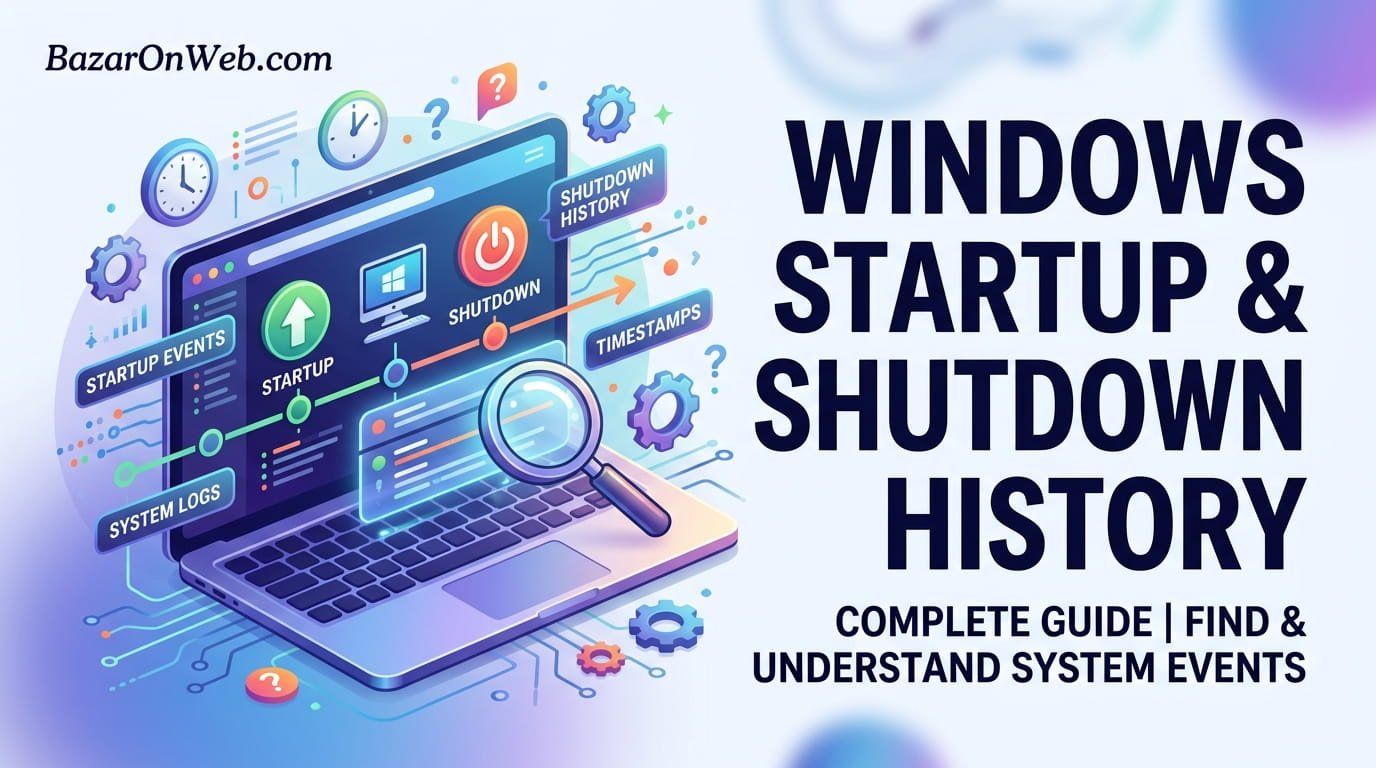
I never paid attention to my Windows startup and shutdown history until my computer started experiencing mysterious crashes that only occurred randomly during the week. After my tech-savvy friend suggested checking my startup and shutdown logs, I discovered that Windows had been recording detailed information about every boot and shutdown event all along. What surprised me most was that this valuable diagnostic information existed but was completely invisible unless I knew where to look. Windows meticulously logs every startup, every shutdown, and problems occurring during these critical system transitions—information invaluable for identifying the root cause of performance issues, unexpected restarts, or application conflicts.
Understanding how to check your startup and shutdown history transformed my approach to troubleshooting. Rather than guessing what might be causing problems, I could examine the actual system events recorded at the time problems occurred. This article will teach you exactly how to access and interpret Windows startup and shutdown logs, understand what different event codes mean, and use this information to identify underlying issues affecting your system. Whether you’re experiencing random crashes, slow startups, or mysterious shutdowns, examining your startup and shutdown history provides concrete data revealing what’s actually happening. I’ll walk you through multiple methods from simple to advanced, explain how to interpret the information you find, and show you how to use these logs for effective troubleshooting.
1. Why Startup and Shutdown History Matters: Understanding System Diagnostics
Windows records comprehensive information about every startup and shutdown event, creating a detailed historical record of your system’s boot process and shutdown events. This logging happens automatically without any user configuration required—Windows captures information about what happened during startup, what services loaded, what errors occurred, and what caused shutdown. This historical data is invaluable for diagnosing problems because it provides concrete evidence of system behavior at the exact moments problems occur. When you experience random crashes, slow startups, or unexpected shutdowns, these logs contain the diagnostic clues explaining what actually happened.
Understanding startup and shutdown logs helps you identify multiple categories of problems. Startup issues like services failing to load, drivers not initializing properly, or applications crashing during boot all leave traces in system logs. Shutdown problems like forced shutdowns, unexpected restarts, or graceful shutdown failures are recorded with timestamps and error codes. Performance issues become explicable when you examine how long different components take to load during startup. Crashes caused by specific applications or services become obvious when you see what was running at the moment the system failed. Additionally, security issues sometimes manifest during startup—malware attempting to load as a service, unauthorized applications launching automatically, or suspicious processes starting at boot are all detectable through log examination. Understanding that your system is constantly recording this diagnostic information helps you appreciate why exploring these logs is one of the most powerful troubleshooting techniques available.
2. Understanding Windows Event Viewer: The Central Log Repository
Windows Event Viewer is the built-in application that centralizes all system events, including startup and shutdown history, into searchable, organized logs. Event Viewer displays events in chronological order with detailed information about what happened, when it happened, and what caused it. The application organizes events into categories like System, Application, Security, and others, making it manageable to navigate thousands of recorded events. Each event entry includes timestamp, event ID (a unique code identifying the event type), event source (what component generated the event), and detailed description of what occurred.
The System log, specifically, contains startup and shutdown events along with hardware errors and other system-level occurrences. Understanding Event Viewer’s structure helps you navigate to relevant events efficiently rather than being overwhelmed by thousands of log entries. The System log might contain tens of thousands of events accumulated over weeks or months of operation, so knowing how to filter and search for specific events is essential for effective troubleshooting. Event Viewer provides filtering tools allowing you to view only startup-related events, only events from specific time periods, only events of specific severity levels (errors versus warnings versus information), or only events from specific sources. Learning to use these filtering capabilities transforms Event Viewer from an overwhelming data dump into a powerful diagnostic tool. Most troubleshooting involves filtering for error-level events from the last few days or weeks, then examining those events to understand what problems occurred.
3. Accessing Event Viewer and Finding Startup/Shutdown Logs
Accessing Event Viewer on Windows is straightforward and requires no special permissions. Press Windows Key + R to open the Run dialog, type “eventvwr.msc” and press Enter. The Event Viewer application opens, displaying various log categories in the left sidebar. Alternatively, right-click the Start button and search for “Event Viewer,” then select it from results. Additionally, you can access Event Viewer through Settings > System > About > Advanced system settings > System Protection > Environment Variables, though this indirect route is less common than direct access through Run or search.
Once Event Viewer opens, you’ll see several log categories in the left sidebar. Navigate to Windows Logs by clicking the expand arrow, then select “System” to access the system event log containing startup and shutdown events. The main panel displays all system events chronologically, with newest events appearing at the top. Each event shows a timestamp, severity level (indicated by icons—red X for errors, yellow exclamation for warnings, blue information icons), event ID, and source. The massive number of events (potentially tens of thousands) makes finding relevant events challenging without filtering. This is where Event Viewer’s filtering capabilities become essential. Right-click in the event list and select “Filter Current Log,” or use the Actions menu > Filter Current Log. A filter dialog appears allowing you to specify which events to display. These filtering tools make Event Viewer practical for troubleshooting despite the volume of data it contains.
4. Filtering Events to Find Startup and Shutdown Occurrences
Filtering Event Viewer to show only startup and shutdown events transforms it from overwhelming to useful. In the Filter dialog, you can filter by event ID, source, event level, and time range. Startup events typically have specific event IDs—event ID 6005 indicates “The Event log service was started,” event ID 6009 indicates “Microsoft Windows [version] startup,” and event ID 12 indicates “Windows started successfully.” Shutdown events include event ID 6006 “The Event log service was stopped” and event ID 1074 “System shutdown initiated by [user].”
To filter for startup events specifically, enter these event IDs in the filter dialog’s Event ID field (separate multiple IDs with commas). Set the time range to the period you want to examine—the last week for recent startups, or a specific date range if investigating a problem that occurred at a known time. Additionally, set event level to “Error” and “Warning” if you want to see only problematic events, or leave it unfiltered to see all events including informational ones. After applying filters, Event Viewer displays only matching events, making it manageable to review startup or shutdown history. Each event displays detailed information—click on any event to see the complete description explaining what occurred. By filtering appropriately, you can quickly identify all startups from a specific date, all shutdown errors from the past week, or all critical errors occurring during system startup. This filtered view transforms the overwhelming complete log into focused information relevant to your troubleshooting.
5. Interpreting Startup Event Codes and Understanding What They Mean
Each startup or shutdown event has an associated event ID that categorizes what occurred. Understanding common event IDs helps you immediately recognize significant events. Event ID 6005 indicates the event logging service started—this is one of the first events after Windows finishes initializing the kernel and core services. Event ID 6009 indicates the specific Windows version and configuration, providing context about what OS version is running. Event ID 12 indicates “Windows is ready for use,” meaning the entire startup process completed successfully. These informational events appearing in sequence indicate a normal, successful startup.
Error-level events during startup indicate problems. Event ID 7000 indicates a service failed to load during startup, with the event details specifying which service failed. Event ID 7001 indicates a service timed out waiting to start, suggesting the service or its dependencies are problematic. Event ID 7002 indicates a timeout related to service group ordering. Event ID 1000 in the Application log indicates an application crashed—if this occurs around startup, it suggests an application is crashing during system initialization. Event ID 41 indicates “The system has rebooted without cleanly shutting down first,” suggesting either a power failure, forced restart, or system crash. By recognizing these event IDs, you can quickly understand what happened during a particular startup. Examining the detailed description of each event provides additional context like which service failed, why it failed, or what error code resulted. This detailed information is essential for effective troubleshooting because generic error messages sometimes hide specific root causes revealed in the detailed event information.
6. Finding and Analyzing Shutdown Events and Unexpected Restarts
Shutdown events reveal important information about system shutdowns, including whether they were expected, why they occurred, and whether problems happened. Event ID 1074 indicates “System shutdown initiated” with details about who initiated the shutdown and whether it was planned maintenance or unexpected. Event ID 6006 indicates “The Event log service was stopped,” essentially marking the end of normal system operation before shutdown. These events appearing in sequence indicate normal, graceful shutdown. Event ID 41 “The system has rebooted without cleanly shutting down first” indicates the system crashed or was forcibly restarted—this event appearing frequently suggests system stability problems.
When examining shutdown events, look for the event description explaining why shutdown occurred. Descriptions might include “Reason: Software (Uninstall),” indicating you uninstalled software that triggered shutdown, or “Reason: Hardware (Thermal),” indicating the system shut down due to overheating. “Reason: No title was provided” sometimes appears for shutdown events where the reason wasn’t clearly specified. For unexpected restarts, Event ID 41 appearing frequently suggests driver problems, hardware failures, or malware. Following event ID 41 occurrences with detailed investigation often reveals the underlying cause. Additionally, blue screen error events (Event ID 1001 or similar) appearing before unexpected restarts indicate Windows crashed—these events contain error codes revealing what caused the crash. By analyzing shutdown events systematically, you identify patterns suggesting whether your system is stable, experiencing occasional problems, or consistently crashing.
7. Using PowerShell for Advanced Log Analysis and Detailed Reporting
For advanced users comfortable with command-line interfaces, PowerShell provides powerful tools for analyzing startup and shutdown logs programmatically. PowerShell scripts can filter events more flexibly than Event Viewer’s graphical interface and generate reports summarizing system behavior over extended time periods. Open PowerShell as Administrator by right-clicking Start and selecting “Windows Terminal (Admin),” then selecting the PowerShell tab. Use the Get-EventLog cmdlet or Get-WinEvent cmdlet for advanced filtering.
For example, to get all startup events from the past week, use: “Get-WinEvent -FilterHashtable @{LogName=’System’; ID=12; StartTime=(Get-Date).AddDays(-7)}” which retrieves event ID 12 (successful startup) from the past 7 days. To find shutdown events, use: “Get-WinEvent -FilterHashtable @{LogName=’System’; ID=1074; StartTime=(Get-Date).AddDays(-7)}” to retrieve shutdown events from the past week. To find all error-level events during startup, use: “Get-WinEvent -FilterHashtable @{LogName=’System’; Level=2; ID=41}” to find system restarts without clean shutdown. These PowerShell commands provide filtering impossible through the graphical Event Viewer interface. Additionally, you can export results to text files or CSV format for further analysis: “Get-WinEvent -FilterHashtable @{LogName=’System’; Level=2} | Export-Csv -Path C:\errors.csv” exports all system errors to a CSV file. PowerShell-based log analysis is particularly valuable for identifying trends over extended time periods or creating automated reports showing system stability over weeks or months.
8. Connecting Event Log Information to System Problems and Identifying Root Causes
Finding events in your startup and shutdown logs is only the first step—interpreting them to understand actual system problems is the valuable part. When troubleshooting a specific problem, match the time the problem occurred with events in your logs. If your system crashed or restarted at a specific time, examine logs from that exact timestamp to see what events preceded the crash. Frequently, problem events appear minutes before crashes, revealing the actual cause. For example, if a service failed to load followed 5 minutes later by an unexpected restart, that service failure likely caused the crash.
Additionally, examine multiple startups and shutdowns to identify patterns. If event ID 41 (unexpected restart) appears consistently every few days at roughly the same time, something is scheduled to run at that time causing crashes—perhaps antivirus scans, Windows updates, or malware. If a specific service consistently fails to load during startup, that service is problematic and needs investigation or reinstallation. If driver errors precede crashes, that driver needs updating or replacement. By connecting event log information to your actual system experiences, you develop understanding of what’s happening on your system. Document findings—when crashes occur, what events precede them, and what patterns you observe. This documentation helps when contacting support or planning fixes. The event logs provide the evidence; your interpretation of this evidence reveals the actual problems affecting your system.
9. Troubleshooting Common Startup and Shutdown Problems Using Event Logs
Event logs help diagnose specific common problems. For slow startups, examine event timestamps to see how long different components take to load. Services appearing seconds apart load quickly, while gaps of 30+ seconds between events suggest a specific component is slow. Check which service is associated with the gap—that’s your slow startup culprit. You can then disable, update, or troubleshoot that specific service rather than guessing about startup performance. For frequent crashes, examine event logs for the preceding events. If driver errors appear before crashes, update or rollback that driver. If service failures appear before crashes, investigate that service. If thermal shutdown events appear before crashes, overheating is likely—check CPU cooling and dust in fans.
For unexpected restarts, event logs often reveal whether they’re caused by Windows updates, hardware failures, malware, or specific applications. Event ID 41 frequently appearing indicates system instability requiring investigation. Event ID 1074 with “Reason: Update” indicates Windows Update caused restart—this is expected but can be frustrating if happening at inconvenient times. Event IDs related to specific drivers appearing before crashes point to driver problems. Event IDs related to security software might indicate antivirus conflicts. By systematically examining event logs, you narrow down possible causes from hundreds of possibilities to specific, fixable problems. Rather than randomly troubleshooting, event logs guide your efforts toward addressing actual causes rather than treating symptoms.
10. Maintaining System Logs and Best Practices for Ongoing Monitoring
To maintain useful startup and shutdown logs, configure appropriate retention policies. Event logs automatically limit size to prevent consuming excessive disk space—the System log typically retains events from the past 7-30 days depending on activity volume. You can customize retention by opening Event Viewer, right-clicking the System log, selecting Properties, and adjusting “Maximum log size” or setting it to overwrite events as needed. However, for troubleshooting purposes, retaining at least 2-3 weeks of logs is valuable. If you anticipate investigating problems that occurred a month ago, increase retention accordingly, though this uses more disk space.
Additionally, periodically review your event logs proactively rather than only when problems occur. Monthly reviews of error-level events help identify emerging problems before they cause obvious system failures. Export interesting logs for documentation—right-click an event log and select “Save Events As” to export to XML or TXT format for archiving or detailed review. For systems experiencing frequent problems, consider using third-party tools like EventLog Explorer that provide enhanced analysis capabilities beyond Event Viewer. Finally, keep accurate notes about what problems you experienced and when—when you later review event logs, you can match events to actual system behavior, improving your interpretation. Taking these preventive and documentation approaches transforms event logs from mysterious system artifacts into practical troubleshooting tools you understand and can use effectively. Regular monitoring helps catch developing problems early before they cause serious system instability.
Disclaimer
This article provides guidance on checking and interpreting startup and shutdown history in Windows using Event Viewer and PowerShell. The information is intended for educational purposes to help users understand system logs and troubleshoot issues. Specific event IDs, procedures, and interpretations may vary depending on your Windows version, system configuration, and individual circumstances.
Important Disclaimers:
- Event logs contain technical information that requires interpretation; not all events indicate problems
- Informational events appearing normally during startup/shutdown should not be considered errors
- Event ID meanings may vary slightly across Windows versions; consult Microsoft documentation for your specific version
- PowerShell commands require understanding what they do before executing; incorrect commands could affect system operation
- Event logs are automatically pruned; older events are deleted as new events accumulate
- Some events may appear without obvious explanation; this is normal and not necessarily indicative of problems
System Log Interpretation:
- Not all error-level events indicate serious problems; some warnings and errors are expected and recoverable
- Information-level events provide context but don’t indicate problems
- Errors appearing alone without following crashes may be minor and self-correcting
- Patterns of errors are more significant than individual isolated errors
Troubleshooting Caution:
- Examining event logs helps identify problems but shouldn’t replace other troubleshooting methods
- Event logs provide correlation, not necessarily causation; an error appearing before a crash doesn’t always mean it caused the crash
- Multiple issues sometimes occur simultaneously; addressing one event-log error may not solve all problems
- Seek professional assistance if you cannot interpret event logs despite research
Privacy and Security:
- Event logs contain system information but typically don’t contain sensitive personal information
- Some events include usernames of who initiated shutdown or other administrative actions
- Event logs should be treated as system files requiring administrative access to modify
System Impact:
- Accessing Event Viewer requires administrative privileges
- Running PowerShell commands requires administrative Command Prompt
- Exporting or analyzing large event log files may temporarily consume system resources
- Clearing event logs removes historical diagnostic information; only clear logs if you don’t need the data
Data Retention:
- Event logs automatically delete old events to prevent consuming excessive storage
- Archived logs provide historical data but consume disk storage
- Balance between retaining useful history and managing disk space
- If investigation later becomes necessary, archived logs should be available
Windows Version Variations:
- Event IDs and event meanings may vary between Windows 10, Windows 11, and other versions
- Procedures described apply generally to modern Windows versions but specific menu locations may differ
- Consult version-specific documentation if procedures don’t match your system
Third-Party Tool Considerations:
- Third-party log analysis tools provide enhanced capabilities but aren’t necessary for basic troubleshooting
- Select tools from reputable developers with verified security records
- Some advanced analysis tools require proper configuration to function correctly
When Professional Help Is Needed:
- If you cannot interpret event logs despite research, professional IT support may be necessary
- If event logs indicate hardware failure, professional diagnostics may be required
- Complex driver or service problems may require manufacturer support or professional technicians
- If system continues crashing despite identifying event log problems, deeper investigation is necessary
Liability:
We are not responsible for any misinterpretation of event logs, incorrect troubleshooting based on log analysis, or any system problems resulting from following guidance in this article. Users assume full responsibility for understanding event logs before making system changes based on log interpretation. Most event log investigation involves only viewing and filtering data without making system changes, making these activities relatively safe. However, if you use log findings to delete services, update drivers, or make other system modifications, those changes carry risks requiring careful consideration and backup before implementation.
About the Author
Jessica Miller is a marketing manager and Windows troubleshooter who believes understanding system logs empowers users to solve their own problems effectively. With expertise in Windows diagnostics, event log interpretation, and practical troubleshooting techniques, she helps busy professionals diagnose and resolve system issues using available tools. When she’s not writing comprehensive tech guides or managing her marketing team, she’s exploring Windows logs, teaching others about system diagnostics, and helping friends troubleshoot their mysterious Windows problems.

- How to Remotely Control Another Computer Using Windows Quick Assist
- 5 Must-Have Electronics Gadgets for a More Comfortable Living Room

- How to Create a Windows 11 System Backup on an External Hard Drive

- 10 Smart Home Ideas That Make Everyday Life Easier

- Gemini Live Avatar: How to Talk to Gemini Face-to-Face

Products
-
![Apple Watch Ultra 3 [GPS + Cellular 49mm] Running & Multisport Smartwatch w/Rugged Titanium Case w/Black Titanium Milanese Loop - M. Satellite Communications, Advanced Health & Fitness Tracking](https://bazaronweb.com/retailstores/wp-content/uploads/2025/09/apple-watch-320x320.jpg) Apple Watch Ultra 3 [GPS + Cellular 49mm] Running & Multisport Smartwatch w/Rugged Titanium Case w/Black Titanium Milanese Loop - M. Satellite Communications, Advanced Health & Fitness Tracking
Apple Watch Ultra 3 [GPS + Cellular 49mm] Running & Multisport Smartwatch w/Rugged Titanium Case w/Black Titanium Milanese Loop - M. Satellite Communications, Advanced Health & Fitness Tracking
-
 Apple iPad mini (A17 Pro): Apple Intelligence, 8.3-inch Liquid Retina Display, 256GB, Wi-Fi 6E, 12MP Front/12MP Back Camera, Touch ID, All-Day Battery Life — Purple
-
 Apple AirPods Max Wireless Over-Ear Headphones, Active Noise Cancelling, Transparency Mode, Personalized Spatial Audio, Dolby Atmos, Bluetooth Headphones for iPhone – Space Gray
-
 Apple AirPods Pro 2 Wireless Earbuds, Active Noise Cancellation, Hearing Aid Feature, Bluetooth Headphones, Transparency, Personalized Spatial Audio, High-Fidelity Sound, H2 Chip, USB-C Charging
-
Home Garage 210 TC Cotton King Floral Fitted (Elastic) Bedsheet(Pack of 1, Grey)
Original price was: ₹999.00.₹299.00Current price is: ₹299.00.
Leave a Reply