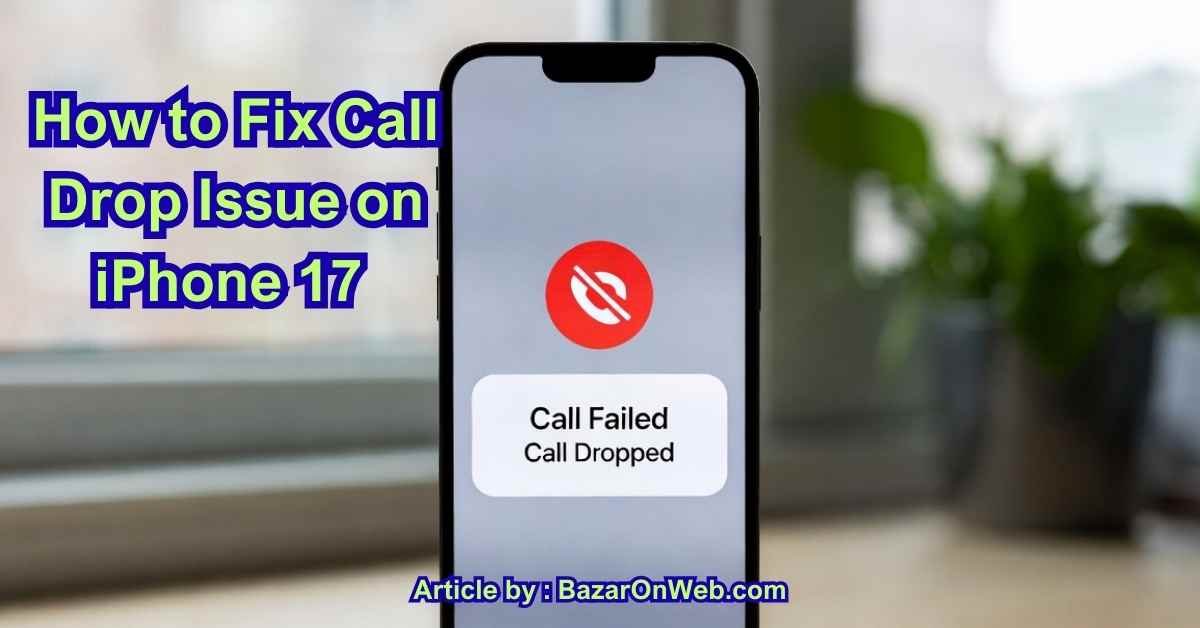
How to Fix Call Drop Issue on iPhone 17

How to Fix Call Drop Issue on iPhone 17

Introduction

Call drops are one of the most frustrating issues an iPhone user can experience—especially on a premium device like the iPhone 17, where reliability is expected as a given. A dropped call isn’t just an inconvenience; it can interrupt important business conversations, affect remote work, disrupt customer interactions, and create unnecessary stress during critical moments. When it happens repeatedly, users often assume the problem lies with the device itself, but in reality, call drops are usually the result of a combination of network conditions, software configuration, and usage patterns.

With the iPhone 17, Apple has introduced advanced modem technology, improved antenna design, and deeper integration with 5G and LTE networks. While these enhancements significantly improve call quality, they also make the device more sensitive to network transitions, software settings, and carrier-level configurations. As a result, call drops can sometimes occur even when signal bars appear strong. Factors such as unstable 5G coverage, incorrect VoLTE settings, outdated carrier profiles, or conflicting network features like Wi-Fi Calling can silently disrupt call continuity.

Another important aspect to understand is that modern smartphones no longer rely on a single network type for voice calls. Calls may shift between LTE, 5G, Wi-Fi Calling, and roaming networks during a single conversation. If any part of this handoff fails, the call may disconnect. This is especially common in urban areas with dense towers, office buildings with signal interference, or during travel.

The good news is that most call drop issues on the iPhone 17 are fixable without hardware replacement. In many cases, simple adjustments—such as updating iOS, resetting network settings, or switching network modes—can restore stable call performance. More persistent problems may require carrier-level troubleshooting or deeper system resets, but these are still manageable with the right approach.

This guide is designed to help you systematically identify and resolve call drop issues on the iPhone 17. It focuses on practical, step-by-step fixes that address the most common real-world causes, helping you restore reliable calling without unnecessary guesswork.

1. Check Network Coverage and Carrier Status

Call drops are most commonly caused by weak or unstable network signals. Start by checking whether you’re in an area with consistent cellular coverage. Dense buildings, elevators, basements, rural zones, or high-speed travel can interrupt signal handoff between towers.
Also verify if your carrier is experiencing temporary outages or maintenance. Most US and Canada carriers publish real-time service status on their websites or apps. If call drops happen only in specific locations, the issue is likely network-related rather than device-related.


2. Toggle Airplane Mode to Reset Network Connection

A quick way to refresh your iPhone’s connection to nearby towers is by toggling Airplane Mode.

  • Enable Airplane Mode for 30–60 seconds

  • Disable it and allow the phone to reconnect
    This forces the device to re-register with the carrier network and often resolves temporary signal negotiation issues that cause dropped calls.


3. Restart Your iPhone

Restarting clears temporary system processes and resets background services that may interfere with calling functions.

  • Power off the iPhone completely

  • Wait at least 30 seconds

  • Turn it back on and wait for full network reconnection
    This is especially effective after long uptime, system updates, or app-heavy usage.


4. Update iOS to the Latest Version

Apple frequently releases iOS updates that include carrier optimizations, modem firmware fixes, and call stability improvements.

  • Go to Settings → General → Software Update

  • Install the latest available update
    Outdated iOS versions may contain bugs that affect call quality or network handoffs, particularly on newer hardware.


5. Update Carrier Settings

Carrier settings updates improve connectivity, voice call routing, VoLTE performance, and 5G stability.

  • Go to Settings → General → About

  • If prompted, install the carrier update
    These updates are separate from iOS updates and are essential for optimal call performance.


6. Enable VoLTE (Voice over LTE)

VoLTE provides clearer calls and more stable connections by using LTE networks instead of legacy voice channels.

  • Go to Settings → Cellular → Cellular Data Options → Voice & Data

  • Select LTE or 5G with VoLTE enabled
    If VoLTE is disabled, calls may drop more frequently during network transitions.


7. Switch Between 5G and LTE

In some areas, unstable 5G coverage can cause call drops. Temporarily switching to LTE may improve reliability.

  • Go to Settings → Cellular → Cellular Data Options → Voice & Data

  • Choose LTE instead of 5G
    If call stability improves, the issue is likely related to inconsistent 5G coverage in your area.


8. Reset Network Settings

Resetting network settings removes saved Wi-Fi networks, VPNs, and cellular configurations that may conflict with calling services.

  • Go to Settings → General → Transfer or Reset iPhone → Reset → Reset Network Settings

  • Re-enter Wi-Fi passwords afterward
    This is one of the most effective fixes for persistent call drop issues.


9. Disable Wi-Fi Calling Temporarily

Wi-Fi Calling can cause call drops if the Wi-Fi network is unstable.

  • Go to Settings → Cellular → Wi-Fi Calling

  • Turn it off and test calls using cellular only
    If calls improve, the issue lies with Wi-Fi quality rather than the phone itself.


10. Check SIM Card Condition

A damaged, misaligned, or aging SIM card can cause frequent call drops.

  • Remove the SIM tray and inspect the SIM

  • Clean gently with a dry, lint-free cloth

  • Reinsert securely
    If problems persist, request a replacement SIM or switch to an eSIM from your carrier.


11. Disable VPN and Security Profiles

VPNs and certain device management profiles can interfere with voice traffic routing.

  • Disable any active VPN

  • Test call stability
    If call drops stop, reconfigure or replace the VPN service with one optimized for mobile networks.


12. Check for App Interference

Some apps aggressively manage background processes, network connections, or system resources.

  • Boot the iPhone normally and avoid opening third-party apps

  • Test call behavior
    If the issue disappears, uninstall recently installed or suspicious apps and monitor performance.


13. Free Up Storage Space

Low storage can affect system performance, including network services.

  • Go to Settings → General → iPhone Storage

  • Ensure at least 5–10 GB of free space
    Delete unused apps, large files, or cached media if necessary.


14. Disable Bluetooth During Calls

Connected Bluetooth devices with unstable connections can interrupt calls.

  • Turn off Bluetooth temporarily

  • Make test calls using the phone speaker or wired headphones
    If stability improves, reconnect Bluetooth devices one at a time.


15. Check Call Blocking and Focus Settings

Certain Focus modes or call filtering settings can unintentionally interrupt calls.

  • Go to Settings → Focus and disable temporarily

  • Check Settings → Phone → Call Blocking & Identification
    Ensure important contacts are not restricted.


16. Adjust Cellular Data Roaming Settings

If you travel frequently, incorrect roaming settings may cause call drops.

  • Go to Settings → Cellular → Cellular Data Options

  • Enable or disable Data Roaming based on your carrier’s recommendation
    Incorrect roaming configuration can disrupt call continuity.


17. Test Calls in Safe Conditions

Make test calls:

  • In open outdoor areas

  • With strong signal bars

  • Without movement
    If calls remain stable in these conditions, the issue is environmental rather than device-related.


18. Restore iPhone Settings Without Data Loss

If software corruption is suspected:

  • Back up your iPhone

  • Use Settings → General → Transfer or Reset iPhone → Reset → Reset All Settings
    This keeps your data intact while resetting system configurations.


19. Check for Hardware Issues

If call drops persist across multiple networks, locations, and SIM cards, hardware issues may be involved.
Possible causes include:

  • Antenna damage

  • Internal modem issues

  • Water or impact damage
    Schedule a diagnostic at an Apple Authorized Service Provider.


20. Contact Your Carrier for Line-Level Troubleshooting

Carriers can:

  • Re-provision your line

  • Refresh network registration

  • Check account-level call restrictions

  • Identify tower-level issues
    Request a network refresh or escalation if basic fixes fail.


21. Use eSIM Instead of Physical SIM

eSIMs eliminate physical SIM-related issues and often provide better reliability.

  • Ask your carrier to convert your number to eSIM

  • Test call performance afterward
    Many users experience improved stability after switching.


22. Restore iPhone Using Finder or iTunes (Last Resort)

If all else fails:

  • Back up your iPhone

  • Restore using Finder (Mac) or iTunes (Windows)

  • Set up as new temporarily and test calls
    If calls are stable, restore your backup afterward.


23. Monitor Call Drops by Time and Location

Track:

  • Time of day

  • Location

  • Network type (LTE/5G/Wi-Fi Calling)
    Patterns help identify whether the issue is device, carrier, or environment-related.


24. Avoid Using the Phone While Charging With Poor Accessories

Low-quality chargers or cables can cause interference with antennas.

  • Use Apple-certified accessories

  • Avoid calls while charging with unknown adapters


25. Enable Automatic Network Selection

Manual network selection can cause frequent disconnections.

  • Go to Settings → Cellular → Network Selection

  • Enable Automatic
    This allows seamless tower handoffs.


26. Check Hearing Aid or Accessibility Settings

Certain accessibility features may conflict with audio routing.

  • Go to Settings → Accessibility → Hearing Devices

  • Disable temporarily for testing


27. Perform Diagnostic Call Tests

Make:

  • Long calls (10–15 minutes)

  • Short repeated calls

  • Calls while stationary and moving
    This helps isolate triggering conditions.


28. Confirm No Regional Band Limitations

Some international models may lack full band support in certain regions.
Verify that your iPhone 17 variant supports your carrier’s frequency bands.


29. Replace the Device if Under Warranty

If diagnostics confirm hardware faults and the device is under warranty, request a replacement unit.


30. Maintain Optimal iPhone Usage Habits

  • Keep iOS updated

  • Avoid overcrowded signal environments

  • Restart periodically

  • Replace SIM or refresh eSIM annually

These practices significantly reduce long-term call drop issues.

Conclusion

Call drop issues on the iPhone 17 can feel complex at first, but when broken down logically, they become much easier to diagnose and fix. The key takeaway is that most call disruptions are not caused by a single fault. Instead, they stem from a combination of network behavior, device settings, software compatibility, and environmental factors. Understanding this layered relationship is essential to achieving long-term call stability.

One of the most effective strategies is to start with the simplest solutions and work your way up. Basic actions—such as restarting the device, updating iOS, installing carrier settings updates, or toggling Airplane Mode—often resolve temporary network registration issues. These steps help reset background services that silently impact call continuity. When combined with enabling VoLTE and choosing the most stable network mode (LTE or 5G, depending on coverage), they significantly reduce dropped calls.

Network settings play a larger role than many users realize. Wi-Fi Calling, VPNs, Bluetooth accessories, and roaming configurations can all interfere with voice routing if they are not optimized. Testing calls with these features temporarily disabled helps isolate the root cause. Similarly, resetting network settings remains one of the most reliable fixes for persistent call drops because it removes corrupted configurations without affecting personal data.

It’s also important to consider physical and carrier-related factors. SIM card wear, improper placement, or outdated provisioning can create instability that software fixes alone cannot solve. Switching to an eSIM or requesting a SIM replacement is often a simple but highly effective solution. Additionally, carriers can refresh your network profile, re-provision your line, or identify tower-level issues that are outside the phone’s control.

For users who continue to experience call drops after exhausting standard fixes, hardware diagnostics become necessary. Antenna damage, modem faults, or water exposure may not always be visible but can significantly affect call reliability. Apple-authorized diagnostics can confirm whether the issue is device-related and whether a replacement is warranted under warranty.

Finally, maintaining consistent usage habits plays a preventative role. Keeping the device updated, avoiding low-quality charging accessories, monitoring storage availability, and periodically restarting the phone all contribute to stable long-term performance. Call reliability isn’t just about fixing a problem once—it’s about maintaining an environment where issues are less likely to return.

By following a structured troubleshooting approach and understanding how modern voice networks operate, you can restore dependable calling on your iPhone 17 and avoid repeated disruptions. Reliable communication should be a given, and with the right steps, it can be.

Disclaimer (Bazaronweb.com)

The information provided in this article is for general informational purposes only. While Bazaronweb.com strives to ensure accuracy and relevance, mobile network performance, carrier configurations, and device behavior may vary based on location, service provider, software version, and individual usage patterns.

Bazaronweb.com does not guarantee that the solutions mentioned will resolve call drop issues in all cases. Users are advised to follow troubleshooting steps carefully and consult their mobile carrier or an Apple Authorized Service Provider for advanced diagnostics or hardware-related concerns. Bazaronweb.com is not affiliated with Apple Inc. or any mobile network operator unless explicitly stated.

Leave a Reply

Your email address will not be published. Required fields are marked *

Select the fields to be shown. Others will be hidden. Drag and drop to rearrange the order.
  • Image
  • SKU
  • Rating
  • Price
  • Stock
  • Availability
  • Add to cart
  • Description
  • Content
  • Weight
  • Dimensions
  • Additional information
Click outside to hide the comparison bar
Compare