Category
Popular Articles
- AI (20)
- Air Tag (1)
- Android (53)
- App Suggest (13)
- Apple (42)
- Apple TV (4)
- Bluetooth (3)
- Cars (2)
- ChatGpt (1)
- Chrome (3)
- Did you know? (1)
- E-Commerce News (1)
- Ecommerce Websites business (7)
- Electronics Shopping (5)
- Fashion Tips (3)
- Gaming (7)
- Google Gemini (3)
- Hair Care Tips (2)
- How to (13)
- iCloud (1)
- Infotainment System (1)
- Iphone (159)
- Job Posting (1)
- Lifestyle (3)
- MacBook (32)
- Mobile Games (1)
- Netflix (1)
- Online Shopping Websites (2)
- Personal Finance Management (3)
- Product Reviews (3)
- Roku TV (4)
- Samsung (10)
- Shopping Tips (13)
- Spotify (1)
- Tech (162)
- VPN (2)
- Windows 11 (105)
- Youtube (1)
- Zero Waste (3)
Discounted Products
-

Leo Creation 144 TC Cotton Double Jaipuri Prints Flat Bedsheet(Pack of 1, Blue, Gree, Red, Grey, Light Grey)
₹2,999.00Original price was: ₹2,999.00.₹329.00Current price is: ₹329.00. -
Home Garage 210 TC Cotton King Floral Fitted (Elastic) Bedsheet(Pack of 1, Grey)
₹999.00Original price was: ₹999.00.₹299.00Current price is: ₹299.00. -

Goodrik 140 TC Cotton Double 3D Printed Flat Bedsheet(Pack of 1, Brown)
₹499.00Original price was: ₹499.00.₹229.00Current price is: ₹229.00. -

GLOBALSHOP 350 TC Microfiber Double Floral Flat Bedsheet(Pack of 1, Multicolor)
₹1,250.00Original price was: ₹1,250.00.₹263.00Current price is: ₹263.00. -

RisingStar 250 TC Microfiber King Printed Fitted (Elastic) Bedsheet(Pack of 1, FITTED-ROUND-CIRCLES-PREMIUM)
₹2,299.00Original price was: ₹2,299.00.₹299.00Current price is: ₹299.00. -

Home Garage 210 TC Cotton King Floral Fitted (Elastic) Bedsheet(Pack of 1, Fitted Black Green)
₹1,299.00Original price was: ₹1,299.00.₹299.00Current price is: ₹299.00. -

Home Garage 180 TC Cotton King 3D Printed Flat Bedsheet(Pack of 1, White)
₹999.00Original price was: ₹999.00.₹229.00Current price is: ₹229.00. -

Home Sizzler 153 cm (5 ft) Polyester Room Darkening Window Curtain (Pack Of 2)(Floral, Maroon)
₹799.00Original price was: ₹799.00.₹299.00Current price is: ₹299.00. -

Panipat Textile Hub 152.4 cm (5 ft) Polyester Window Curtain (Pack Of 2)(Solid, Aqua)
₹1,899.00Original price was: ₹1,899.00.₹299.00Current price is: ₹299.00. -
Home Sizzler 214 cm (7 ft) Polyester Semi Transparent Door Curtain (Pack Of 2)(Floral, Maroon)
₹1,199.00Original price was: ₹1,199.00.₹399.00Current price is: ₹399.00. -

Home Sizzler 153 cm (5 ft) Polyester Room Darkening Window Curtain (Pack Of 2)(Floral, Brown)
₹799.00Original price was: ₹799.00.₹299.00Current price is: ₹299.00. -

Stella Creations 214 cm (7 ft) Polyester Room Darkening Door Curtain (Pack Of 2)(Abstract, Brown)
₹1,299.00Original price was: ₹1,299.00.₹449.00Current price is: ₹449.00. -

Homefab India 152.5 cm (5 ft) Polyester Room Darkening Window Curtain (Pack Of 2)(Floral, Light Blue)
₹1,199.00Original price was: ₹1,199.00.₹319.00Current price is: ₹319.00. -

Urban Home 214 cm (7 ft) PVC Transparent Door Curtain Single Curtain(Solid, Off White)
₹699.00Original price was: ₹699.00.₹203.00Current price is: ₹203.00. -

Panipat Textile Hub 213 cm (7 ft) Polyester Door Curtain (Pack Of 2)(Solid, Brown)
₹1,199.00Original price was: ₹1,199.00.₹349.00Current price is: ₹349.00.
Affiliate Links
Promotion
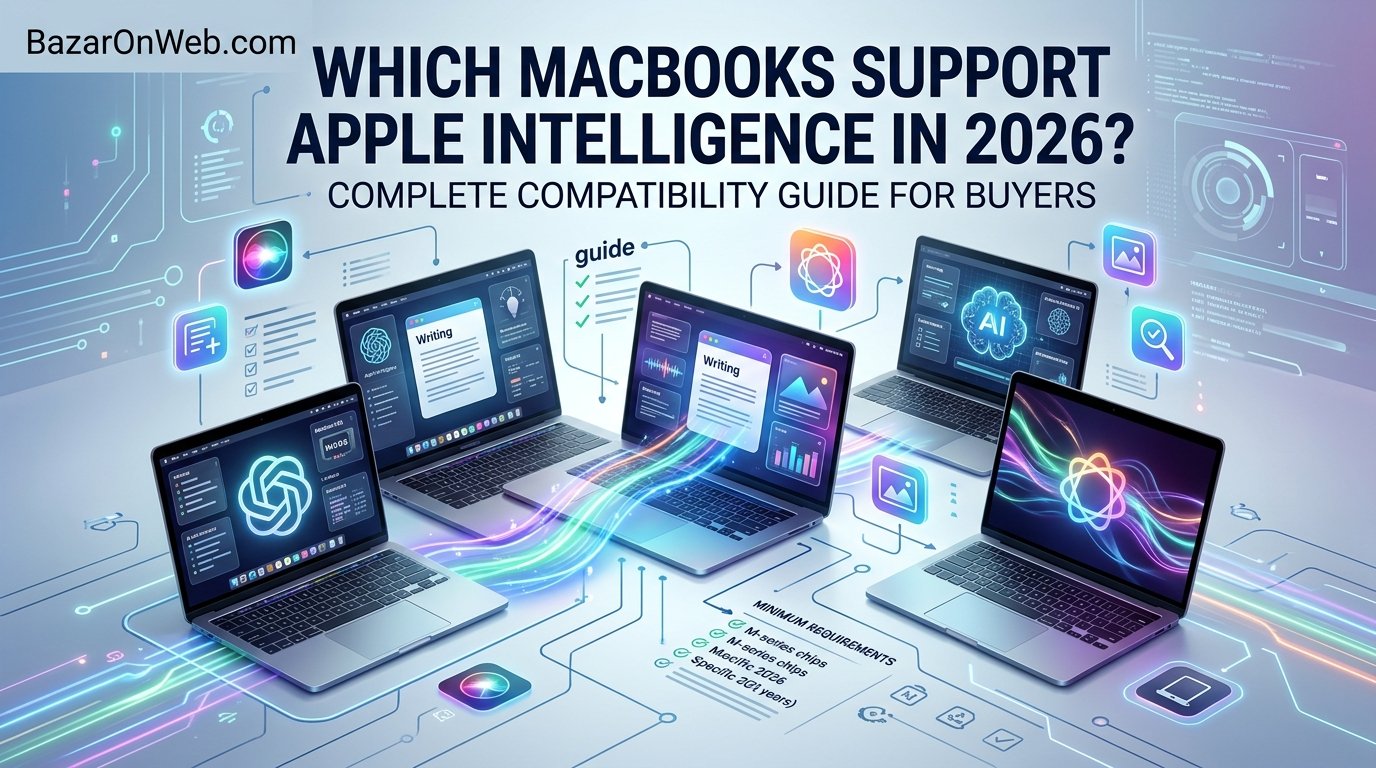
Hi, I’m Jessica, and if you’ve been shopping for a new MacBook lately, you’ve probably noticed that Apple Intelligence is now one of Apple’s biggest selling points. When I first heard about Apple Intelligence, I assumed it would only work on the newest and most expensive MacBooks. I also wondered whether older Macs would suddenly become outdated overnight. A lot of families, students, and working professionals are asking the same thing before upgrading their devices in 2026.
Apple Intelligence is designed to bring advanced AI features directly into macOS, helping users write emails, summarize notifications, organize files, create smarter workflows, and improve productivity without depending entirely on cloud-based systems. The good news is that every current MacBook lineup in 2026 supports Apple Intelligence because Apple now ships all modern MacBooks with Apple Silicon chips, Neural Engines, and at least 16GB RAM. However, Intel-based MacBooks from 2019 and earlier do not support these AI features.
Understanding compatibility matters because many buyers still own older Intel MacBooks and are unsure whether upgrading is necessary. In this guide, I’ll explain which MacBooks support Apple Intelligence, why Apple Silicon matters, how RAM affects AI performance, what features users can expect, and how to decide whether your current MacBook is still worth keeping in 2026.
What Is Apple Intelligence and Why Does It Matter?
Apple Intelligence is Apple’s integrated AI system built directly into macOS and other Apple platforms. Unlike many traditional AI systems that rely heavily on cloud servers, Apple Intelligence focuses on a combination of on-device processing and secure cloud computing. This approach allows users to benefit from advanced AI tools while maintaining Apple’s strong privacy standards. In 2026, Apple Intelligence has become deeply integrated into everyday workflows across MacBooks, making the technology much more practical than many earlier AI assistants.
The system helps users rewrite text, summarize emails, generate writing suggestions, organize notifications, improve image searches, create schedules, and even assist with productivity tasks across applications. Students can use it for note organization, professionals can automate repetitive tasks, and casual users benefit from smarter recommendations throughout macOS. The integration feels more natural because Apple designed it to work seamlessly within existing apps rather than acting like a separate chatbot.
Apple Intelligence also depends heavily on hardware acceleration. Features such as language processing, image analysis, and contextual understanding require substantial processing power. That is why Apple places strong emphasis on Neural Engines inside Apple Silicon chips. These specialized AI-processing units are optimized for machine learning workloads and help deliver real-time performance without excessive battery drain.
As AI becomes central to computing, Apple Intelligence is no longer simply an optional feature. It is becoming part of the overall macOS experience, influencing software updates, app compatibility, productivity tools, and even future hardware purchases for MacBook users.
Why Apple Silicon MacBooks Support Apple Intelligence
Apple Silicon completely changed the MacBook ecosystem after Apple transitioned away from Intel processors. Beginning with the M1 chip lineup, Apple introduced unified memory architecture, dedicated Neural Engines, and highly efficient AI processing capabilities that laid the foundation for Apple Intelligence. In 2026, every current MacBook model includes Apple Silicon, which is why all modern MacBooks officially support Apple Intelligence features.
The Neural Engine is especially important because it handles machine learning tasks efficiently without placing heavy strain on the CPU or GPU. Tasks such as text summarization, voice recognition, contextual search, image understanding, and AI-assisted writing require this dedicated hardware acceleration. Apple Silicon chips are specifically designed to process these workloads quickly while maintaining strong battery life and thermal efficiency.
Another major advantage is unified memory architecture. Unlike traditional systems where RAM is separated between CPU and GPU operations, Apple Silicon allows memory sharing across the entire system. This enables faster AI processing and smoother multitasking during complex workloads. Apple Intelligence depends heavily on rapid memory access, making this architecture highly beneficial.
Apple’s ecosystem optimization also plays a major role. Since Apple controls both hardware and software development, macOS and Apple Intelligence are deeply tuned for Apple Silicon performance. This results in smoother execution, better responsiveness, and improved efficiency compared to older Intel systems.
For most users, Apple Silicon means faster startup times, quieter operation, better battery life, and access to the newest AI-driven macOS features. These benefits collectively explain why Apple Intelligence is fully supported across the modern MacBook lineup in 2026.
Why Intel MacBooks Do Not Support Apple Intelligence
Many users still own Intel-based MacBooks purchased before Apple transitioned to Apple Silicon. While these laptops remain functional for general tasks like browsing, office work, and media consumption, they do not support Apple Intelligence in 2026. The primary reason is hardware limitation rather than software preference alone.
Intel MacBooks lack the advanced Neural Engine architecture that Apple Silicon devices include. AI workloads such as real-time language processing, contextual awareness, image generation, and intelligent automation require specialized machine learning acceleration. Older Intel systems were not designed with these modern AI demands in mind, making it difficult to deliver acceptable performance and energy efficiency.
RAM limitations are another important factor. Many Intel MacBooks shipped with 8GB RAM configurations, which struggle to handle modern AI processing requirements efficiently. Apple Intelligence is optimized around newer memory standards and system architectures that provide faster data access and better multitasking capabilities.
Thermal efficiency also matters significantly. AI workloads can generate substantial heat and sustained processing demand. Apple Silicon chips operate far more efficiently than older Intel processors, allowing MacBooks to run advanced AI features without major battery or overheating issues. Intel systems would likely experience slower performance, louder fan activity, and reduced efficiency during similar workloads.
Apple’s long-term software strategy also prioritizes unified hardware optimization. Supporting Apple Intelligence on Intel systems would require maintaining separate architectures and performance adjustments, which could reduce feature quality and increase software complexity.
Although Intel MacBooks continue receiving limited support for standard macOS functionality, Apple Intelligence is clearly designed for the Apple Silicon era, making older Intel-based systems incompatible with these advanced AI capabilities.
Which MacBook Air Models Support Apple Intelligence
In 2026, every currently sold MacBook Air supports Apple Intelligence. This includes models powered by M1, M2, M3, and newer Apple Silicon generations. Apple’s lightweight laptop lineup has evolved dramatically over the past few years, making even entry-level MacBook Air models capable of handling sophisticated AI-driven tasks.
The M1 MacBook Air was the first major step toward Apple’s AI-focused future. Despite being introduced years ago, it still supports Apple Intelligence because of its integrated Neural Engine and efficient unified memory system. Users with upgraded RAM configurations generally experience smoother multitasking and better responsiveness during demanding workflows.
The M2 and M3 MacBook Air models provide even better AI performance. Faster Neural Engines, improved GPU capabilities, and enhanced memory bandwidth allow Apple Intelligence to perform tasks more rapidly and efficiently. Features like document summarization, AI-assisted writing, image understanding, and notification prioritization operate seamlessly on these systems.
Modern MacBook Air devices are especially popular among students, remote workers, content creators, and business professionals because they balance portability and performance effectively. Apple Intelligence enhances this experience by simplifying productivity tasks and improving overall workflow efficiency without sacrificing battery life.
Apple also increased baseline memory configurations in recent MacBook Air generations, helping ensure better compatibility with AI-driven macOS features. The move toward 16GB RAM minimums across current models has strengthened long-term usability for AI applications.
For buyers seeking an affordable entry into Apple Intelligence, the MacBook Air lineup remains one of the most practical and future-ready choices available in 2026.
Which MacBook Pro Models Support Apple Intelligence
The MacBook Pro lineup offers the most advanced Apple Intelligence experience in 2026 because these systems are designed for high-performance professional workloads. Every current MacBook Pro model equipped with Apple Silicon supports Apple Intelligence fully, including devices powered by M1 Pro, M1 Max, M2 Pro, M2 Max, M3 Pro, M3 Max, and newer generations.
MacBook Pro models benefit from stronger processing capabilities, more GPU cores, larger memory capacities, and advanced cooling systems. These hardware advantages allow Apple Intelligence to operate more efficiently during demanding creative and professional tasks. Users working with video editing, software development, AI-assisted workflows, data analysis, or large-scale multitasking can especially benefit from these capabilities.
The larger Neural Engines inside Pro-class Apple Silicon chips handle machine learning operations at significantly higher speeds. This means faster content generation, smoother contextual searches, quicker summarization, and more advanced automation features. Professional users also benefit from improved multitasking when running AI-powered applications alongside heavy software workloads.
Battery efficiency remains impressive despite the increased power. Apple Silicon MacBook Pro models maintain strong battery life even during intensive AI-driven operations, making them practical for mobile professionals and remote workers.
Display quality, storage options, and expanded RAM configurations further enhance the Apple Intelligence experience. Many users investing in MacBook Pro systems view them as long-term productivity machines capable of supporting future macOS AI advancements for many years.
For creators, developers, analysts, and professionals seeking maximum AI performance and longevity, MacBook Pro models remain the strongest Apple Intelligence-compatible laptops available in 2026.
Why 16GB RAM Became Important for Apple Intelligence
One of the biggest changes in Apple’s MacBook strategy has been the move toward higher baseline memory configurations. In 2026, Apple Intelligence relies heavily on memory availability because AI systems continuously process contextual data, language models, multitasking operations, and background machine learning tasks. This is one reason modern MacBooks now emphasize 16GB RAM as a standard requirement.
AI-driven features consume considerably more system resources than traditional software tasks. Functions such as summarizing long documents, generating intelligent writing suggestions, analyzing images, prioritizing notifications, and handling contextual app interactions require fast memory access and efficient multitasking support. Systems with insufficient RAM can experience slowdowns or limited functionality during these operations.
Unified memory architecture in Apple Silicon further improves efficiency because CPU, GPU, and Neural Engine components all share the same memory pool. However, having enough total memory remains essential for maintaining smooth performance during simultaneous workloads. Users running multiple applications while using Apple Intelligence benefit greatly from higher RAM configurations.
Modern software itself has also become more demanding. Web browsers, productivity suites, creative software, and AI assistants all consume significant memory resources simultaneously. Apple’s decision to standardize higher memory capacities helps ensure future compatibility with upcoming macOS AI enhancements.
For casual users, 16GB RAM improves overall system responsiveness and longevity. For professionals, students, and multitaskers, it creates a smoother environment for intensive workflows involving Apple Intelligence tools.
The shift toward higher memory standards reflects the growing importance of AI in everyday computing and Apple’s long-term focus on intelligent device experiences.
How Apple Intelligence Improves Everyday MacBook Usage
Apple Intelligence is not just about futuristic AI demonstrations. In practical daily use, it improves many ordinary tasks that MacBook users perform regularly. The integration feels more natural because the AI works quietly within the operating system instead of functioning as a completely separate application.
Writing assistance is one of the most noticeable improvements. Apple Intelligence can help rewrite emails, summarize messages, organize notes, suggest edits, and improve communication workflows. Students benefit from better note organization, while professionals save time managing documents and communication tasks throughout the day.
Notification management also becomes smarter. Instead of overwhelming users with endless alerts, Apple Intelligence prioritizes important information and summarizes less critical notifications. This reduces distractions and helps users stay focused during work or study sessions.
Search functionality has improved significantly as well. Apple Intelligence can better understand contextual searches across files, photos, documents, and applications. Users spend less time manually locating information because the system recognizes intent more effectively.
Productivity automation is another important advantage. Apple Intelligence assists with scheduling, reminders, organization, and workflow recommendations based on user behavior patterns. These subtle improvements gradually make the overall macOS experience feel more efficient and personalized.
Battery optimization and performance balancing also benefit indirectly from Apple Silicon AI integration. Tasks are processed more intelligently, helping maintain system responsiveness without excessive resource consumption.
For most users, Apple Intelligence enhances convenience, productivity, and efficiency in small but meaningful ways that accumulate throughout everyday MacBook usage in 2026.
Should You Upgrade From an Intel MacBook in 2026?
Many people still use Intel-based MacBooks purchased several years ago and wonder whether upgrading is truly necessary. The answer depends largely on your workload, expectations, and interest in Apple Intelligence features. While older Intel Macs can still handle basic computing tasks, they are increasingly limited compared to modern Apple Silicon systems.
Users primarily performing simple browsing, document editing, streaming, and email management may continue using Intel MacBooks comfortably for a while longer. However, the lack of Apple Intelligence support means missing out on many new macOS productivity improvements and AI-driven features becoming central to Apple’s ecosystem.
Performance differences are also substantial. Apple Silicon MacBooks offer significantly better battery life, quieter operation, faster startup speeds, improved multitasking, and superior thermal efficiency. These advantages become especially noticeable during modern workloads involving creative software, multitasking, or AI-powered applications.
Software longevity is another major factor. Apple continues prioritizing Apple Silicon optimization, meaning future macOS updates may gradually reduce Intel compatibility and feature support over time. Investing in a newer MacBook can provide longer-term software relevance and better overall system performance.
For students, professionals, creators, and remote workers, upgrading often delivers meaningful productivity improvements beyond just AI features alone. The transition also provides access to newer hardware technologies, better displays, improved webcams, and stronger battery reliability.
If your Intel MacBook still meets your basic needs, an immediate upgrade may not be essential. However, for users wanting the full modern macOS experience, Apple Silicon MacBooks are clearly the future-focused choice in 2026.
Best MacBooks for Apple Intelligence Features in 2026
Choosing the best MacBook for Apple Intelligence depends on budget, workload, portability needs, and long-term expectations. Fortunately, Apple’s current lineup provides strong compatibility across multiple price ranges and user categories.
For students and everyday users, the MacBook Air remains one of the best overall choices. It combines excellent battery life, portability, silent operation, and full Apple Intelligence support at a more accessible price point. Models powered by M2 or newer chips provide especially balanced performance for typical productivity workloads.
Professionals working in content creation, programming, video editing, or advanced multitasking may benefit more from MacBook Pro systems. These devices offer stronger cooling, higher sustained performance, larger displays, and greater RAM capacity, all of which improve intensive AI-driven workflows. Users regularly running demanding applications alongside Apple Intelligence tools will appreciate the extra processing power.
Buyers focused on long-term future-proofing should consider models with higher RAM and storage configurations. AI workloads are likely to become increasingly demanding over time, making larger memory capacities valuable for extending system longevity.
Portability also matters. Travelers and remote workers often prefer MacBook Air devices because of their lighter weight and impressive battery performance. Meanwhile, desktop replacement users may prioritize larger MacBook Pro displays and advanced processing capabilities.
Ultimately, every current Apple Silicon MacBook supports Apple Intelligence effectively. The best choice depends more on personal workflow requirements than compatibility limitations, since Apple has standardized AI support across its modern MacBook lineup in 2026.
The Future of AI-Powered MacBooks Beyond 2026
Apple Intelligence represents only the beginning of AI integration within MacBooks. As Apple continues developing more advanced Neural Engines and machine learning capabilities, future MacBooks are likely to become even more deeply connected to intelligent automation and contextual computing experiences.
AI features will probably extend far beyond writing assistance and notification summaries. Future macOS versions may offer stronger predictive workflows, real-time language translation, advanced productivity automation, smarter app management, and deeper personalization based on user behavior. Apple’s hardware-first approach positions the company well for expanding AI functionality without sacrificing performance or privacy.
The role of on-device AI will also become increasingly important. Apple’s emphasis on privacy-focused local processing may help differentiate MacBooks from competitors relying heavily on cloud-based AI systems. Faster Neural Engines and larger unified memory architectures will support these evolving capabilities.
Developers are also beginning to integrate AI features directly into macOS applications. This means third-party software ecosystems will increasingly depend on Apple Silicon hardware optimization. As a result, compatibility gaps between Apple Silicon and older Intel systems may continue growing over time.
Battery efficiency improvements will likely remain a major focus. Apple aims to provide advanced AI experiences while preserving long battery life and quiet thermal performance, which has become one of the strongest advantages of modern MacBooks.
In many ways, 2026 marks a major transition point where AI becomes a core part of personal computing rather than an optional extra. MacBooks are evolving into intelligent productivity systems designed around seamless AI integration for everyday users.
Disclaimer
This article is for informational and educational purposes only. MacBook specifications, Apple Intelligence compatibility, RAM requirements, and macOS features may change based on future Apple announcements, software updates, or regional availability. Users should verify the latest compatibility information directly from Apple Official Website before purchasing or upgrading any MacBook device.
Written by Bazaronweb
Latest Tech Articles
- Which MacBooks Support Apple Intelligence in 2026? Complete Compatibility Guide for Buyers

- Why Battery Is Draining Faster After the macOS Tahoe Update on MacBook Pro

- MacBook Battery Life in 2026: What to Expect From Apple’s Latest Laptops

- Best MacBook Models Available in 2026 for Students, Professionals, Creators, and Everyday Users

- How to Disable Secure Boot in Windows 11 Safely Without Damaging Your System

Products
-
Apple Watch Ultra 3 [GPS + Cellular 49mm] Running & Multisport Smartwatch w/Rugged Titanium Case w/Black Titanium Milanese Loop - M. Satellite Communications, Advanced Health & Fitness Tracking
-
Apple iPad mini (A17 Pro): Apple Intelligence, 8.3-inch Liquid Retina Display, 256GB, Wi-Fi 6E, 12MP Front/12MP Back Camera, Touch ID, All-Day Battery Life — Purple
-
Apple AirPods Max Wireless Over-Ear Headphones, Active Noise Cancelling, Transparency Mode, Personalized Spatial Audio, Dolby Atmos, Bluetooth Headphones for iPhone – Space Gray
-

Apple AirPods Pro 2 Wireless Earbuds, Active Noise Cancellation, Hearing Aid Feature, Bluetooth Headphones, Transparency, Personalized Spatial Audio, High-Fidelity Sound, H2 Chip, USB-C Charging
-
Leo Creation 144 TC Cotton Double Jaipuri Prints Flat Bedsheet(Pack of 1, Blue, Gree, Red, Grey, Light Grey)
₹2,999.00Original price was: ₹2,999.00.₹329.00Current price is: ₹329.00.
Leave a Reply