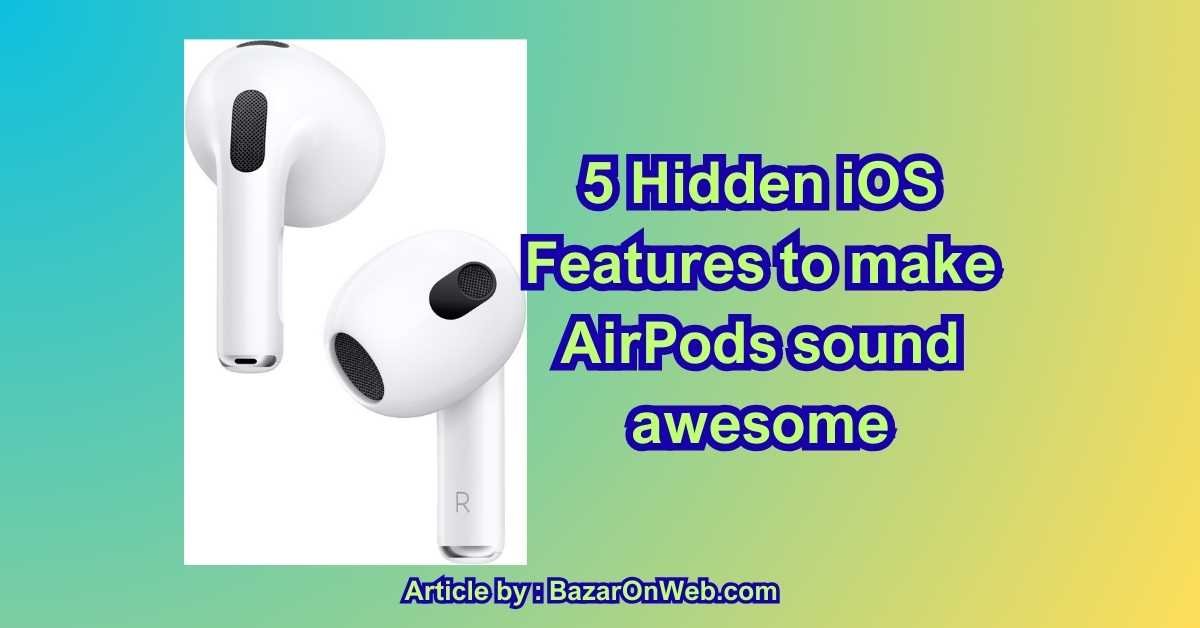
5 Hidden iOS Features to make AirPods sound awesome

5 Hidden iOS Features to make AirPods sound awesome

Discover the Hidden iOS Features That Will Transform Your AirPods’ Sound

If you’ve ever listened to your AirPods and thought, “Hmm, this could sound better,” you’re absolutely not alone. Many of us assume that the audio quality we get out of the box is the best it can be. We might fiddle with the bass booster in our music app or try different ear tips, often missing the powerful, built-in tools Apple has quietly provided.

The truth is, iOS hides a suite of incredibly sophisticated audio customization features designed to do one thing: make your AirPods sound their absolute best for your ears. These aren’t just simple equalizer presets; they’re intelligent systems that can personalize everything from vocal clarity to how music moves around you in a 3D space.

Think of your AirPods not just as speakers for your ears, but as a personalized audio system. With a few taps in your Settings, you can unlock a level of sound quality you didn’t know your little white buds were capable of. Let’s dive into the first two game-changers that will make you fall in love with your AirPods all over again.

Feature #1: Your Personal Audio Engineer – Headphone Accommodations

This is, without a doubt, one of the most powerful and overlooked audio features in iOS. Tucked away in the Accessibility settings—a place we don’t often venture for audio tweaks—Headphone Accommodations is like having a personal sound engineer who tunes your music, podcasts, and calls specifically for your hearing .

It works on a wide range of Apple audio devices, including AirPods 2nd generation and later, all AirPods Pro models, and AirPods Max . The core idea is to boost softer sounds and adjust frequencies so that everything from whispered dialogue in a movie to the subtle strum of a guitar becomes clearer and more balanced .

How to Find This Hidden Gem

The path is simple:
Settings > Accessibility > Audio/Visual > Headphone Accommodations.

Once you toggle it on, you have two brilliant paths to better sound: a guided, automatic setup or manual fine-tuning.

The Magic of “Custom Audio Setup”

For most people, the Custom Audio Setup wizard is the best place to start. Think of it as a quick hearing preference test for your AirPods. It plays a series of audio samples and asks you which one sounds clearer. Based on your choices, iOS builds a custom sound profile tailored to your unique hearing .

Pro-Tip from a User: One AirPods 4 owner found the default sound “muffled.” After using Headphone Accommodations and selecting the “Vocal Range” tuning with a “Slight” boost, they reported the “muddiness in the midrange was cleaned up, and the highs were clear and more lively” . This demonstrates how effective these subtle tweaks can be.

Manual Fine-Tuning for Perfectionists

If you prefer total control, you can skip the wizard and adjust the settings yourself:

  • Tune Audio For: This is your frequency focus. Choose Balanced Tone for an all-around enhancement, Vocal Range to make conversations and singing clearer, or Brightness to emphasize higher frequencies for more sparkle .

  • Boost Soft Sounds: This slider is a secret weapon for podcasts, audiobooks, or noisy environments. Set it to SlightModerate, or Strong to gently amplify quieter sounds without making the loud parts overpowering .

The beauty of Headphone Accommodations is its system-wide application. Unlike an EQ setting in just your Music app, this enhancement works across Spotify, Netflix, phone calls, and even podcast apps, providing a consistently improved listening experience everywhere .

Feature #2: The Dynamic Duo – Personalized Spatial Audio & Adaptive Audio

If Headphone Accommodations perfects the quality of the sound, then Personalized Spatial Audio and Adaptive Audio redefine its experience. Together, they make your audio feel immersive, alive, and smartly responsive to your world.

Personalized Spatial Audio: Your Music in 3D

Spatial Audio with dynamic head tracking is that “wow” feature that makes it feel like the instruments and singers are placed all around you in a 3D sphere, rather than just playing in the middle of your head . The “Personalized” part takes it further. Using the TrueDepth camera on your iPhone (the same one used for Face ID), iOS creates a unique acoustic map of your head and ears. This ensures the 3D audio effect is precisely calibrated for your anatomy, not just a generic average .

How to Set It Up & Use It:

  1. Ensure your AirPods (AirPods 3rd gen and later or any AirPods Pro) are connected .

  2. Go to Settings > [Your AirPods Name] > Personalized Spatial Audio.

  3. Follow the prompts to scan your ear. It’s as quick and easy as setting up Face ID.

  4. Once enabled, you can control it directly from the Control Center. Long-press the volume slider while audio is playing, and tap the Spatial Audio icon to cycle between modes .

You have two main choices:

  • Head Tracked: The full immersive experience. The sound field stays fixed in space, so if you turn your head left, the music stays centered in front of you. It’s incredible for movies and immersive music albums.

  • Fixed: The 3D effect is applied, but it moves with your head. This is often preferred for casual music listening as it remains consistent .

Adaptive Audio: Your AirPods Get Smart

While you’re exploring audio settings, you’ll likely find Adaptive Audio. This feature, available on AirPods Pro and AirPods 4 with Active Noise Cancellation, is a master of context . It doesn’t just switch between Noise Cancellation and Transparency mode; it intelligently blends them in real-time based on your environment .

Walking down a quiet street? It might stay in full Transparency so you’re aware. Step into a noisy subway station, and it will seamlessly ramp up the noise cancellation. Start a conversation with a barista, and it will instantly lower your media volume and enhance their voice so you can hear them clearly . With iOS 18, you even gained manual control over its aggressiveness via a slider in your AirPods settings .

Bringing It All Together

Imagine putting on your AirPods for your commute. Headphone Accommodations is subtly balancing the frequencies of your podcast for clarity. Adaptive Audio is managing the noise of the train around you. When you switch to a Spatial Audio-supported music track, it envelops you in a personalized, cinematic soundstage. This is the integrated, intelligent audio ecosystem Apple has built.

Feature What It Does Best For Where to Find It
Headphone Accommodations Boosts softer sounds & customizes frequencies for clarity. Improving vocal clarity in calls/podcasts, balancing music, helping in noisy environments. Settings > Accessibility > Audio/Visual
Personalized Spatial Audio Creates an immersive, three-dimensional soundfield personalized to your ears. Movies, immersive music (like Apple Music Dolby Atmos), and gaming. Settings > [Your AirPods] > Personalized Spatial Audio
Adaptive Audio Intelligently blends Noise Cancellation and Transparency based on your surroundings. Dynamic environments (e.g., commuting, moving between quiet/ noisy spaces). Control Center (long-press volume) or Settings > [Your AirPods]

These two features alone can fundamentally upgrade how you hear everything through your AirPods. They move you from being a passive listener to an active participant in a sound experience crafted for you. And the best part? They’re already on your iPhone, just waiting to be discovered.

I hope this deep dive into the first two features helps you unlock a new level of enjoyment from your AirPods. In the next part, we’ll explore how to use your AirPods to protect your hearing health, how to ensure they’re always performing at their best with firmware updates, and a powerful trick to make phone calls crystal clear in any environment.

Feature #3: Crystal Clear Conversations with Conversation Awareness

Ever had to yank out an AirPod mid-song because someone started talking to you? Or missed a crucial part of a podcast because you answered a quick “yes”? Conversation Awareness on AirPods Pro (2nd generation) is the elegant solution to this daily friction.

This brilliant feature uses the advanced beamforming microphones and processing power in your AirPods Pro 2 to detect when you start speaking. The moment it hears your voice, it automatically takes three smart actions to seamlessly blend your digital and physical worlds:

  1. Lowers your media volume (music, podcast, video).

  2. Enhances the voices in front of you by boosting Transparency mode.

  3. Reduces background noise around you, like a fan or street sounds.

The result? You can have a natural conversation without fumbling with your phone or removing your AirPods. When you stop talking, your media volume gracefully fades back up to its previous level. It’s one of those “it just works” Apple features that feels like magic once you experience it.

How to Enable & Use It:

  • Prerequisites: You need AirPods Pro (2nd generation) running the latest firmware and an iPhone with a recent version of iOS.

  • Activation: Go to Settings > [Your AirPods Name] > Conversation Awareness and toggle it on. You can also press and hold the stem of your AirPods Pro to quickly turn it on or off.

  • Pro Tip: You can adjust how aggressively it reacts. In the same settings menu, you’ll find a slider to control the “Volume Decrease” level when you speak, allowing you to fine-tune it from a slight dip to a more significant drop.

Feature #4: Perfecting Your Seal with the Ear Tip Fit Test

The single most important factor for getting great bass, effective Active Noise Cancellation (ANC), and overall sound quality from your in-ear AirPods is getting a proper seal. If the ear tips don’t fit snugly, sound leaks out, bass disappears, and ANC becomes far less effective. You might be using the wrong size without even knowing it.

Apple provides a clever, built-in tool to solve this: the Ear Tip Fit Test. It uses the microphones in your AirPods (Pro or regular AirPods with silicone tips) to analyze the sound inside your ear and determine if you have a good seal.

How to Run the Fit Test:

  1. Ensure your AirPods are connected and in your ears.

  2. Go to Settings > [Your AirPods Name].

  3. Select “Ear Tip Fit Test.”

  4. Tap “Continue” and then “Play.” You’ll hear a few seconds of test tones while the iPhone analyzes the results.

  5. You’ll get a clear result for each ear: “Good Seal” or “Adjust or Try a Different Size.”

Why It’s a Game-Changer:

  • Objective Fit: It removes the guesswork. The medium tips might feel fine, but the test could reveal you actually get a perfect seal with the large tips in one ear.

  • Maximizes Sound Quality: A good seal ensures you hear the full frequency range as intended, with deep, rich bass and clear highs.

  • Optimizes ANC & Battery: With a proper seal, ANC works at peak efficiency, which means it doesn’t have to work as hard, potentially saving battery life. It also makes Transparency mode sound more natural.

Feature #5: The Simplicity of Mono Audio for Focus & Clarity

This feature, found in your iPhone’s Accessibility settings, is incredibly powerful in its simplicity. By default, your music and podcasts are in stereo—meaning different sounds are sent to the left and right channels to create a wide, immersive soundstage.

Mono Audio combines these two channels into one identical signal sent to both ears.

Why would you want to do that? Here are two key scenarios where it makes your AirPods sound “awesome” in a very practical way:

  1. For the Hard of Hearing: If you have better hearing in one ear, Mono Audio ensures you don’t miss any audio cues, lyrics, or dialogue that are panned exclusively to your weaker side.

  2. For Intensive Focus: When you’re studying, working, or listening to a dense audiobook, having the same audio in both ears can reduce listening fatigue and help you focus on the content rather than the stereo effects. It’s also perfect for phone calls, ensuring the caller’s voice is centered and clear in both ears.

How to Enable Mono Audio:
Go to Settings > Accessibility > Audio/Visual. Toggle on “Mono Audio.” It’s a system-wide setting that will apply to all audio played through your AirPods.

Feature What It Does Best For Where to Find It
Conversation Awareness Automatically lowers media and boosts voices when you speak. Having quick conversations without pausing or removing AirPods. Settings > [Your AirPods] (AirPods Pro 2 only)
Ear Tip Fit Test Checks if your ear tips create a proper acoustic seal. Maximizing bass, ANC effectiveness, and overall sound quality. Settings > [Your AirPods] > Ear Tip Fit Test
Mono Audio Combines stereo left/right channels into a single center channel. Focus, accessibility, or ensuring you miss no audio. Settings > Accessibility > Audio/Visual

Bringing It All Together

Think of these five features as your personal AirPods toolkit. Start with the Ear Tip Fit Test to build your foundation—great sound starts with a great seal. Then, use Headphone Accommodations to tune the audio profile to your hearing. Immerse yourself in music or movies with Personalized Spatial Audio. Let Conversation Awareness handle social interactions seamlessly. And use Mono Audio when you need absolute focus or accessibility.

Finally, remember to keep your AirPods’ firmware updated (it happens automatically when they’re charging near your iPhone) to ensure you have access to the latest audio tuning and features from Apple.

By mastering these hidden settings, you’re not just using AirPods; you’re curating a personalized, intelligent, and truly awesome sound experience that adapts to your life.

Disclaimer:

Apple frequently updates iOS and its features, so menu names, paths, and functionality may change after this guide is published. Always ensure your iPhone and AirPods firmware are up to date for the best and safest experience.
Bazaronweb.com and I are not responsible for any unintended changes to your device’s performance, settings, or any other outcomes resulting from following this guide. The goal is to share knowledge that empowers you to get the most out of your technology

Leave a Reply

Your email address will not be published. Required fields are marked *

Select the fields to be shown. Others will be hidden. Drag and drop to rearrange the order.
  • Image
  • SKU
  • Rating
  • Price
  • Stock
  • Availability
  • Add to cart
  • Description
  • Content
  • Weight
  • Dimensions
  • Additional information
Click outside to hide the comparison bar
Compare