Category
Popular Articles
- AI (20)
- Air Tag (1)
- Android (53)
- App Suggest (13)
- Apple (44)
- Apple TV (4)
- Bluetooth (3)
- Cars (2)
- ChatGpt (1)
- Chrome (3)
- Did you know? (1)
- E-Commerce News (1)
- Ecommerce Websites business (7)
- Electronics Shopping (5)
- Fashion Tips (3)
- Gaming (7)
- Google Gemini (3)
- Hair Care Tips (2)
- How to (13)
- iCloud (1)
- Infotainment System (1)
- Iphone (161)
- Job Posting (1)
- Lifestyle (3)
- MacBook (37)
- Mobile Games (1)
- Netflix (1)
- Online Shopping Websites (2)
- Personal Finance Management (3)
- Product Reviews (3)
- Roku TV (4)
- Samsung (10)
- Shopping Tips (13)
- Spotify (1)
- Tech (162)
- VPN (2)
- Windows 11 (105)
- Youtube (1)
- Zero Waste (3)
Discounted Products
-

Leo Creation 144 TC Cotton Double Jaipuri Prints Flat Bedsheet(Pack of 1, Blue, Gree, Red, Grey, Light Grey)
₹2,999.00Original price was: ₹2,999.00.₹329.00Current price is: ₹329.00. -
Home Garage 210 TC Cotton King Floral Fitted (Elastic) Bedsheet(Pack of 1, Grey)
₹999.00Original price was: ₹999.00.₹299.00Current price is: ₹299.00. -

Goodrik 140 TC Cotton Double 3D Printed Flat Bedsheet(Pack of 1, Brown)
₹499.00Original price was: ₹499.00.₹229.00Current price is: ₹229.00. -

GLOBALSHOP 350 TC Microfiber Double Floral Flat Bedsheet(Pack of 1, Multicolor)
₹1,250.00Original price was: ₹1,250.00.₹263.00Current price is: ₹263.00. -

RisingStar 250 TC Microfiber King Printed Fitted (Elastic) Bedsheet(Pack of 1, FITTED-ROUND-CIRCLES-PREMIUM)
₹2,299.00Original price was: ₹2,299.00.₹299.00Current price is: ₹299.00. -

Home Garage 210 TC Cotton King Floral Fitted (Elastic) Bedsheet(Pack of 1, Fitted Black Green)
₹1,299.00Original price was: ₹1,299.00.₹299.00Current price is: ₹299.00. -

Home Garage 180 TC Cotton King 3D Printed Flat Bedsheet(Pack of 1, White)
₹999.00Original price was: ₹999.00.₹229.00Current price is: ₹229.00. -

Home Sizzler 153 cm (5 ft) Polyester Room Darkening Window Curtain (Pack Of 2)(Floral, Maroon)
₹799.00Original price was: ₹799.00.₹299.00Current price is: ₹299.00. -

Panipat Textile Hub 152.4 cm (5 ft) Polyester Window Curtain (Pack Of 2)(Solid, Aqua)
₹1,899.00Original price was: ₹1,899.00.₹299.00Current price is: ₹299.00. -
Home Sizzler 214 cm (7 ft) Polyester Semi Transparent Door Curtain (Pack Of 2)(Floral, Maroon)
₹1,199.00Original price was: ₹1,199.00.₹399.00Current price is: ₹399.00. -

Home Sizzler 153 cm (5 ft) Polyester Room Darkening Window Curtain (Pack Of 2)(Floral, Brown)
₹799.00Original price was: ₹799.00.₹299.00Current price is: ₹299.00. -

Stella Creations 214 cm (7 ft) Polyester Room Darkening Door Curtain (Pack Of 2)(Abstract, Brown)
₹1,299.00Original price was: ₹1,299.00.₹449.00Current price is: ₹449.00. -

Homefab India 152.5 cm (5 ft) Polyester Room Darkening Window Curtain (Pack Of 2)(Floral, Light Blue)
₹1,199.00Original price was: ₹1,199.00.₹319.00Current price is: ₹319.00. -

Urban Home 214 cm (7 ft) PVC Transparent Door Curtain Single Curtain(Solid, Off White)
₹699.00Original price was: ₹699.00.₹203.00Current price is: ₹203.00. -

Panipat Textile Hub 213 cm (7 ft) Polyester Door Curtain (Pack Of 2)(Solid, Brown)
₹1,199.00Original price was: ₹1,199.00.₹349.00Current price is: ₹349.00.
Affiliate Links
Promotion
Hi, I’m Jessica, and honestly, this has become one of the most confusing questions for iPhone buyers in 2026. A few months ago, my younger brother asked me whether his iPhone 14 would get Apple Intelligence features after updating iOS. He assumed every modern iPhone would support Apple’s new AI tools because the software update was available for his device. But after downloading the update, he realized that features like Genmoji, Writing Tools, Visual Intelligence, and AI-powered Siri were missing. That moment perfectly showed how Apple Intelligence has quietly divided iPhones into two different generations.
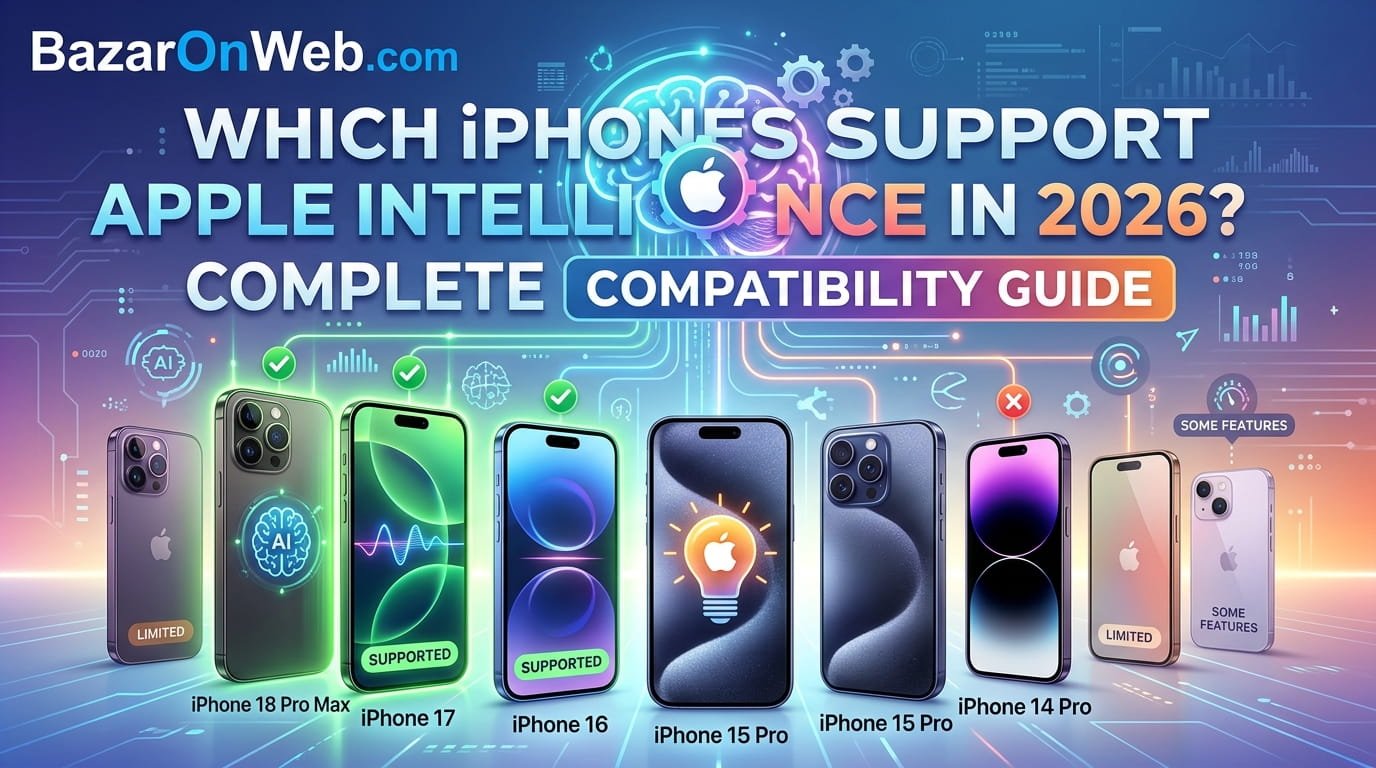
If you are planning to buy a new iPhone or wondering whether your current device supports Apple Intelligence, this guide will make everything simple. Apple has introduced advanced on-device AI processing that requires powerful hardware, especially newer neural engines and RAM configurations. Because of this, many older iPhones cannot run the latest AI experiences even though they still receive iOS updates. In 2026, only the iPhone 15 Pro series and all iPhone 16 and iPhone 17 models fully support Apple Intelligence. Devices older than that miss several major features entirely. This compatibility gap is now one of the biggest deciding factors when purchasing an iPhone in 2026, especially for students, creators, professionals, and productivity-focused users.
What Exactly Is Apple Intelligence and Why Does It Matter?
Apple Intelligence is Apple’s integrated artificial intelligence system designed specifically for iPhones, iPads, and Macs. Unlike many cloud-based AI platforms that rely heavily on internet servers, Apple Intelligence combines on-device processing with private cloud computing to deliver smart features while maintaining privacy. In 2026, it has become one of the biggest selling points of modern iPhones because it changes how people interact with their devices daily.
The system includes features such as smart writing assistance, notification summaries, AI-generated images, Genmoji creation, advanced Siri conversations, automatic email drafting, smart photo editing, contextual understanding, and Visual Intelligence capabilities. Instead of simply responding to commands, iPhones with Apple Intelligence can now understand intent, analyze context, and assist users in more natural ways. Students use it for notes and summaries, professionals use it for emails and scheduling, and creators use it for brainstorming and content generation.
However, Apple Intelligence requires substantial processing power. Apple designed many AI tasks to run directly on the phone for better speed and privacy protection. That means devices need newer chipsets with advanced neural processing units and higher RAM capacity. This is why many older iPhones cannot fully support these features even if they can technically run the latest iOS version. The shift has created a clear distinction between AI-capable iPhones and standard iPhones, making hardware specifications more important than ever before.
Why Older iPhones Do Not Support Apple Intelligence
Many iPhone users were surprised when Apple announced that older premium devices like the iPhone 14 Pro would not support Apple Intelligence. At first glance, it seemed unfair because those devices are still fast and expensive even in 2026. However, the limitation mainly comes down to hardware architecture rather than software restrictions alone.
Apple Intelligence relies heavily on neural processing performance and memory bandwidth. Older iPhones, including the iPhone 14 lineup and earlier models, were not built with these AI workloads in mind. Features such as contextual Siri interactions, AI-generated content, and live image analysis require constant high-speed processing. Apple determined that older chips would either perform too slowly or consume excessive battery power while handling these tasks.
RAM also plays a major role. AI systems need larger memory allocation to manage language models, predictive systems, and real-time contextual processing. Devices like the iPhone 15 Pro series introduced hardware improvements specifically designed to support generative AI experiences. This included upgraded neural engines and more optimized memory handling systems.
Another reason is Apple’s focus on user experience consistency. The company prefers launching features only when devices can run them smoothly and efficiently. Apple Intelligence is designed to feel fast, natural, and responsive. If older devices delivered laggy or limited experiences, it could negatively impact customer perception. As a result, Apple drew a firm hardware line, and that decision now defines the modern AI era of iPhones in 2026.
iPhone Models That Fully Support Apple Intelligence in 2026
In 2026, the list of fully supported Apple Intelligence devices is actually quite simple. Apple currently supports Apple Intelligence on the iPhone 15 Pro, iPhone 15 Pro Max, and every iPhone 16 and iPhone 17 model. These devices include the hardware necessary to handle advanced AI workloads effectively.
The iPhone 15 Pro series was the first lineup to introduce Apple Intelligence support. Even though standard iPhone 15 and iPhone 15 Plus models were released during the same generation, they do not support the complete AI system because they use older chipset architecture. This created a major difference between Pro and non-Pro models for the first time in iPhone history.
The entire iPhone 16 lineup supports Apple Intelligence, including standard, Plus, Pro, and Pro Max variants. Apple expanded AI compatibility across the whole generation because the hardware baseline improved significantly. The same approach continues with the iPhone 17 series in 2026, making Apple Intelligence a standard feature rather than a premium-only advantage.
Users with these supported devices gain access to features like Genmoji, advanced Siri conversations, intelligent writing tools, image generation, Visual Intelligence, notification summaries, contextual recommendations, and AI-enhanced productivity systems. These features continue to evolve through software updates, meaning supported devices become more capable over time. For many consumers in 2026, Apple Intelligence support has become as important as camera quality or battery life when choosing a new iPhone.
Which iPhones Miss Out on Apple Intelligence Features
A surprisingly large number of iPhones still sold or actively used in 2026 do not support Apple Intelligence. This includes the entire iPhone 14 lineup, iPhone 13 series, iPhone 12 models, iPhone 11 family, XR, XS, and older devices. Even though many of these phones continue receiving security updates and basic iOS features, they cannot access Apple’s latest AI ecosystem.
Users of unsupported devices still get standard Siri functionality, traditional keyboard predictions, and regular software updates. However, they miss the advanced AI layer that Apple now heavily promotes. Features unavailable on unsupported devices include Genmoji creation, intelligent writing assistance, advanced image editing AI, Visual Intelligence tools, contextual app actions, and conversational Siri upgrades.
This divide has significantly changed the resale market in 2026. AI-supported devices hold higher resale value because buyers increasingly prioritize long-term compatibility with future Apple Intelligence features. Many consumers who originally planned to keep older iPhones for several more years are now considering upgrades sooner than expected.
The limitation also affects productivity. Students and professionals using unsupported devices cannot access integrated summarization tools, AI-generated responses, and contextual assistance features available on newer models. As more apps integrate Apple Intelligence frameworks, this gap may continue growing over time.
For users with unsupported devices, the phones still function extremely well for everyday communication, photography, streaming, and social media. However, they are now considered outside Apple’s next-generation AI ecosystem, which has become a major transition point in the iPhone market.
How Apple Intelligence Changes Daily iPhone Usage
One reason Apple Intelligence has become such a huge discussion point in 2026 is because it changes everyday phone usage more than many people initially expected. At first, some users assumed it was simply another voice assistant upgrade. But over time, Apple Intelligence has evolved into a deeply integrated productivity and lifestyle system.
Writing Tools are among the most commonly used features. Users can rewrite messages, summarize long emails, correct tone, and create drafts directly inside apps. This saves time during work, school, and communication tasks. Students especially benefit from summarization features when reviewing notes or preparing assignments.
Genmoji has also become extremely popular among younger users and content creators. Instead of relying on static emojis, users can generate custom AI-based emoji designs based on prompts or conversations. Social media creators frequently use these tools for branding and engagement.
Visual Intelligence adds another layer by helping users analyze objects, text, products, or environments through the camera. Instead of manually searching online, users can point the camera toward an item and receive contextual information instantly. Shopping, studying, travel, and productivity tasks all become faster with this feature.
AI-enhanced Siri is perhaps the most transformative improvement. Siri now remembers context better, understands follow-up questions naturally, and performs multi-step tasks more efficiently. These upgrades make iPhones feel less like traditional smartphones and more like intelligent digital assistants. For many users in 2026, Apple Intelligence has fundamentally changed expectations for what a modern smartphone should do.
The Difference Between Apple Intelligence and Traditional Siri
Before Apple Intelligence arrived, Siri mainly functioned as a voice-command assistant. It could set alarms, answer basic questions, open apps, and perform limited tasks. While useful, it often struggled with context and complex interactions. Apple Intelligence has dramatically changed that experience in supported iPhones.
Traditional Siri operated mostly on predefined commands and internet searches. The upgraded AI-powered Siri now understands conversational intent much more effectively. Users can ask follow-up questions naturally without repeating context every time. For example, someone can ask Siri about a restaurant, then immediately request directions or reservations without restarting the conversation.
Apple Intelligence also improves personalization. Siri can now understand information displayed on the screen, analyze ongoing conversations, and interact with apps more intelligently. This creates smoother workflows for messaging, scheduling, research, and productivity tasks. Users no longer need to memorize rigid commands because the system interprets natural language better.
Privacy remains one of Apple’s biggest selling points. Many AI tasks happen directly on the device instead of sending personal information to external servers. Apple uses private cloud computing only when necessary, reducing concerns about sensitive data exposure. This approach differentiates Apple Intelligence from many competing AI ecosystems.
For unsupported iPhones, Siri still works similarly to previous years, but it lacks the advanced contextual intelligence and integrated AI assistance now available on newer devices. This difference is one reason many consumers upgrading in 2026 prioritize Apple Intelligence compatibility above nearly every other feature.
Is It Worth Upgrading to an AI-Supported iPhone?
For many people in 2026, the decision to upgrade depends on how important AI-powered productivity and convenience features are in daily life. If you mainly use your iPhone for calls, messaging, social media, streaming, and casual photography, older devices like the iPhone 13 or iPhone 14 still perform very well. However, users deeply involved in productivity, content creation, education, or business workflows may benefit significantly from Apple Intelligence support.
The biggest advantage of upgrading is future readiness. Apple is clearly investing heavily in AI integration across its ecosystem. More apps and services are expected to rely on Apple Intelligence frameworks over the coming years. Buying a compatible device now ensures longer relevance and software feature access.
Battery optimization and performance also improve on AI-supported devices because the hardware was designed specifically for these workloads. Tasks such as summarization, AI editing, and contextual assistance feel seamless instead of resource-heavy. Users who multitask frequently often notice major productivity improvements.
Students can use AI tools for note organization, rewriting assistance, research summaries, and study efficiency. Professionals benefit from email drafting, scheduling help, and intelligent workflow support. Content creators gain access to advanced creative tools and faster idea generation systems.
For users planning to keep a phone for several years, upgrading to at least an iPhone 16 or iPhone 17 model makes strategic sense in 2026. Apple Intelligence is no longer just a bonus feature — it is becoming central to the modern iPhone experience.
Why the iPhone 15 Pro Became a Historic Turning Point
The iPhone 15 Pro series now holds a unique place in Apple history because it marked the beginning of the Apple Intelligence era. Before its release, Pro models mainly focused on camera improvements, premium materials, and higher-end displays. But the iPhone 15 Pro changed the meaning of “Pro” by introducing hardware built specifically for advanced AI processing.
Apple equipped the iPhone 15 Pro and Pro Max with the A17 Pro chip, which included significantly enhanced neural processing capabilities. At the time, many consumers did not realize how important that upgrade would become. In 2026, it is now clear that those devices were designed with generative AI support in mind from the beginning.
This transition created one of the biggest generation divides Apple has ever introduced. Standard iPhone 15 models lack Apple Intelligence support despite belonging to the same family. That surprised many buyers and changed purchasing behavior dramatically. Consumers now pay closer attention to processor architecture and AI compatibility instead of focusing only on cameras or storage.
The iPhone 15 Pro also became extremely popular in the second-hand market because it offers the most affordable entry point into Apple Intelligence. Many users who cannot justify purchasing an iPhone 17 still choose the 15 Pro for long-term AI support.
Looking back, the iPhone 15 Pro series represented more than just another smartphone release. It introduced the hardware foundation that now powers Apple’s AI ecosystem across millions of devices worldwide.
How Apple Intelligence Impacts Future iPhone Buying Decisions
In previous years, iPhone purchasing decisions were usually based on camera quality, battery life, display size, or storage capacity. In 2026, Apple Intelligence support has become equally important, and for some buyers, it is now the primary factor influencing upgrades.
Consumers increasingly view unsupported devices as limited in long-term value. Even if older iPhones still perform well, buyers worry about missing future AI-based features that could become essential over the next few years. This has changed how people evaluate smartphone longevity.
Parents buying phones for students often prioritize AI-compatible devices because educational workflows now rely heavily on summarization tools, writing assistance, and smart productivity systems. Professionals similarly value AI-driven communication and organizational tools that save time throughout the workday.
The resale market has also adapted quickly. AI-supported iPhones retain stronger resale value because demand remains high. Devices without Apple Intelligence support depreciate faster, especially premium older models that consumers previously expected to hold value longer.
Apple’s software strategy suggests the company will continue expanding AI integration across apps, operating systems, and services. That means Apple Intelligence compatibility today may determine how useful a device feels several years from now. For buyers planning long-term ownership, choosing an AI-supported iPhone has become one of the smartest investment decisions in the modern smartphone market.
The Future of Apple Intelligence Beyond 2026
Apple Intelligence is still in its early stages, which means the features available today are likely only the beginning. Apple continues investing heavily in generative AI, contextual computing, and personalized digital assistance. In the coming years, iPhones may become even more capable of understanding user habits, predicting needs, and automating complex tasks.
Future updates are expected to improve Siri’s conversational depth, app integration, personalization systems, and real-time assistance. Apple may also expand AI features into health tracking, productivity automation, education tools, and creative workflows. As these capabilities grow, hardware requirements could increase further, potentially creating even wider differences between older and newer devices.
The integration between iPhone, iPad, Mac, Apple Watch, and Vision products is also expected to become more intelligent. Apple Intelligence could eventually provide seamless contextual awareness across devices, helping users continue tasks automatically without manual switching or setup.
Privacy will likely remain a core competitive advantage. Apple continues emphasizing on-device processing and secure AI infrastructure as major differentiators compared to competitors relying more heavily on cloud processing.
For consumers, this means buying an Apple Intelligence-supported iPhone today is not only about current features. It is about entering Apple’s evolving AI ecosystem for the future. The iPhone is gradually shifting from a communication device into a highly personalized intelligent assistant, and 2026 appears to be only the beginning of that transformation.
Disclaimer
This article is for informational and educational purposes only. Apple may change device compatibility, software availability, regional access, and Apple Intelligence features through future iOS updates or hardware announcements. Features mentioned in this article may vary depending on language support, region, device configuration, and software version. Users should verify official compatibility details through Apple Official Website before purchasing or upgrading any iPhone model.
Written by Bazaronweb
Latest Tech Articles
- Which iPhones Support Apple Intelligence in 2026? Complete Compatibility Guide for Every Model

- Current iPhone Models in 2026: Complete Guide to Apple’s Latest iPhone 17 Lineup

- Is It Worth Upgrading to macOS Tahoe on an Older MacBook? Full Performance, Battery, and Stability Analysis

- Best MacBook Chargers in 2026 What Charger Does Your MacBook Really Need

- M4 vs M5 Chip Comparison: Is Apple’s 2026 MacBook Performance Leap Really Worth It?

Products
-
Apple Watch Ultra 3 [GPS + Cellular 49mm] Running & Multisport Smartwatch w/Rugged Titanium Case w/Black Titanium Milanese Loop - M. Satellite Communications, Advanced Health & Fitness Tracking
-
Apple iPad mini (A17 Pro): Apple Intelligence, 8.3-inch Liquid Retina Display, 256GB, Wi-Fi 6E, 12MP Front/12MP Back Camera, Touch ID, All-Day Battery Life — Purple
-
Apple AirPods Max Wireless Over-Ear Headphones, Active Noise Cancelling, Transparency Mode, Personalized Spatial Audio, Dolby Atmos, Bluetooth Headphones for iPhone – Space Gray
-
Apple AirPods Pro 2 Wireless Earbuds, Active Noise Cancellation, Hearing Aid Feature, Bluetooth Headphones, Transparency, Personalized Spatial Audio, High-Fidelity Sound, H2 Chip, USB-C Charging
-
Leo Creation 144 TC Cotton Double Jaipuri Prints Flat Bedsheet(Pack of 1, Blue, Gree, Red, Grey, Light Grey)
₹2,999.00Original price was: ₹2,999.00.₹329.00Current price is: ₹329.00.
Leave a Reply