Discounted Products
-
 Home Garage 210 TC Cotton King Floral Fitted (Elastic) Bedsheet(Pack of 1, Grey)
Original price was: ₹999.00.₹299.00Current price is: ₹299.00.
Home Garage 210 TC Cotton King Floral Fitted (Elastic) Bedsheet(Pack of 1, Grey)
Original price was: ₹999.00.₹299.00Current price is: ₹299.00.
-
 Goodrik 140 TC Cotton Double 3D Printed Flat Bedsheet(Pack of 1, Brown)
Original price was: ₹499.00.₹229.00Current price is: ₹229.00.
Goodrik 140 TC Cotton Double 3D Printed Flat Bedsheet(Pack of 1, Brown)
Original price was: ₹499.00.₹229.00Current price is: ₹229.00.
-
 GLOBALSHOP 350 TC Microfiber Double Floral Flat Bedsheet(Pack of 1, Multicolor)
Original price was: ₹1,250.00.₹263.00Current price is: ₹263.00.
GLOBALSHOP 350 TC Microfiber Double Floral Flat Bedsheet(Pack of 1, Multicolor)
Original price was: ₹1,250.00.₹263.00Current price is: ₹263.00.
-
 RisingStar 250 TC Microfiber King Printed Fitted (Elastic) Bedsheet(Pack of 1, FITTED-ROUND-CIRCLES-PREMIUM)
Original price was: ₹2,299.00.₹299.00Current price is: ₹299.00.
RisingStar 250 TC Microfiber King Printed Fitted (Elastic) Bedsheet(Pack of 1, FITTED-ROUND-CIRCLES-PREMIUM)
Original price was: ₹2,299.00.₹299.00Current price is: ₹299.00.
-
 Home Garage 210 TC Cotton King Floral Fitted (Elastic) Bedsheet(Pack of 1, Fitted Black Green)
Original price was: ₹1,299.00.₹299.00Current price is: ₹299.00.
Home Garage 210 TC Cotton King Floral Fitted (Elastic) Bedsheet(Pack of 1, Fitted Black Green)
Original price was: ₹1,299.00.₹299.00Current price is: ₹299.00.
-
 Home Garage 180 TC Cotton King 3D Printed Flat Bedsheet(Pack of 1, White)
Original price was: ₹999.00.₹229.00Current price is: ₹229.00.
Home Garage 180 TC Cotton King 3D Printed Flat Bedsheet(Pack of 1, White)
Original price was: ₹999.00.₹229.00Current price is: ₹229.00.
-
 Panipat Textile Hub 152.4 cm (5 ft) Polyester Window Curtain (Pack Of 2)(Solid, Aqua)
Original price was: ₹1,899.00.₹299.00Current price is: ₹299.00.
Panipat Textile Hub 152.4 cm (5 ft) Polyester Window Curtain (Pack Of 2)(Solid, Aqua)
Original price was: ₹1,899.00.₹299.00Current price is: ₹299.00.
-
 Home Sizzler 214 cm (7 ft) Polyester Semi Transparent Door Curtain (Pack Of 2)(Floral, Maroon)
Original price was: ₹1,199.00.₹399.00Current price is: ₹399.00.
Home Sizzler 214 cm (7 ft) Polyester Semi Transparent Door Curtain (Pack Of 2)(Floral, Maroon)
Original price was: ₹1,199.00.₹399.00Current price is: ₹399.00.
-
 Home Sizzler 153 cm (5 ft) Polyester Room Darkening Window Curtain (Pack Of 2)(Floral, Brown)
Original price was: ₹799.00.₹299.00Current price is: ₹299.00.
Home Sizzler 153 cm (5 ft) Polyester Room Darkening Window Curtain (Pack Of 2)(Floral, Brown)
Original price was: ₹799.00.₹299.00Current price is: ₹299.00.
-
 Stella Creations 214 cm (7 ft) Polyester Room Darkening Door Curtain (Pack Of 2)(Abstract, Brown)
Original price was: ₹1,299.00.₹449.00Current price is: ₹449.00.
Stella Creations 214 cm (7 ft) Polyester Room Darkening Door Curtain (Pack Of 2)(Abstract, Brown)
Original price was: ₹1,299.00.₹449.00Current price is: ₹449.00.
-
 Homefab India 152.5 cm (5 ft) Polyester Room Darkening Window Curtain (Pack Of 2)(Floral, Light Blue)
Original price was: ₹1,199.00.₹319.00Current price is: ₹319.00.
Homefab India 152.5 cm (5 ft) Polyester Room Darkening Window Curtain (Pack Of 2)(Floral, Light Blue)
Original price was: ₹1,199.00.₹319.00Current price is: ₹319.00.
-
 Urban Home 214 cm (7 ft) PVC Transparent Door Curtain Single Curtain(Solid, Off White)
Original price was: ₹699.00.₹203.00Current price is: ₹203.00.
Urban Home 214 cm (7 ft) PVC Transparent Door Curtain Single Curtain(Solid, Off White)
Original price was: ₹699.00.₹203.00Current price is: ₹203.00.
-
 Panipat Textile Hub 213 cm (7 ft) Polyester Door Curtain (Pack Of 2)(Solid, Brown)
Original price was: ₹1,199.00.₹349.00Current price is: ₹349.00.
Panipat Textile Hub 213 cm (7 ft) Polyester Door Curtain (Pack Of 2)(Solid, Brown)
Original price was: ₹1,199.00.₹349.00Current price is: ₹349.00.
-
 Home Sizzler 214 cm (7 ft) Polyester Semi Transparent Door Curtain (Pack Of 2)(Floral, Brown)
Original price was: ₹999.00.₹349.00Current price is: ₹349.00.
Home Sizzler 214 cm (7 ft) Polyester Semi Transparent Door Curtain (Pack Of 2)(Floral, Brown)
Original price was: ₹999.00.₹349.00Current price is: ₹349.00.
-
 Panipat Textile Hub 213 cm (7 ft) Polyester Semi Transparent Door Curtain (Pack Of 2)(Floral, Brown)
Original price was: ₹899.00.₹299.00Current price is: ₹299.00.
Panipat Textile Hub 213 cm (7 ft) Polyester Semi Transparent Door Curtain (Pack Of 2)(Floral, Brown)
Original price was: ₹899.00.₹299.00Current price is: ₹299.00.
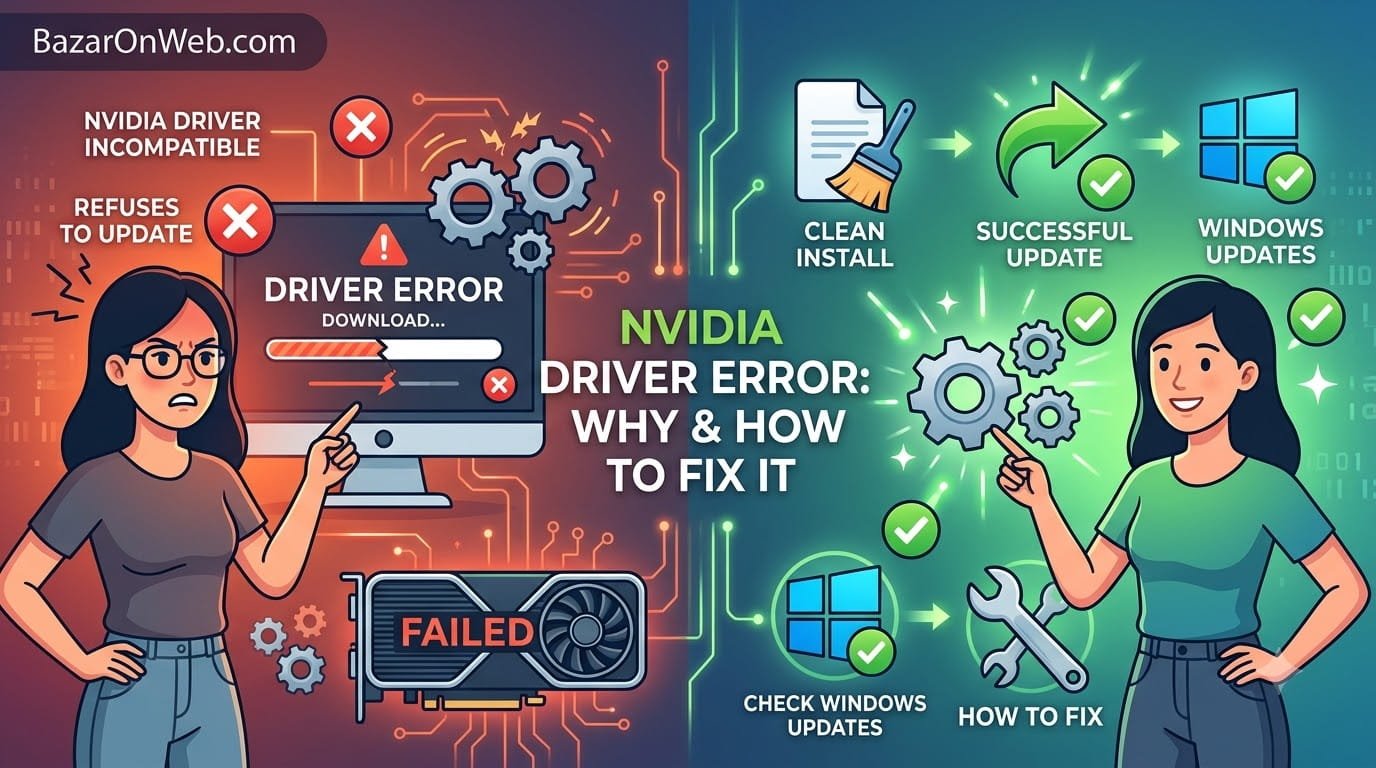
I was excited about updating my NVIDIA driver. New driver version promised better performance, bug fixes, and support for new games. I downloaded it from NVIDIA’s website, ran the installer, and waited for the update to complete.
Halfway through installation, a dialog box appeared: “NVIDIA Driver is Not Compatible With This Version.”
Not compatible? But I downloaded this directly from NVIDIA’s official website. I followed their automatic driver detection tool. It said this driver was compatible with my graphics card. So why was it suddenly telling me it wasn’t compatible?
The installation stopped. The new driver didn’t install. I was stuck with my old driver, frustrated and confused.
I tried again. Same error. Downloaded it again thinking maybe the file was corrupted. Same error. At this point I had no idea what was happening. The error message was unhelpful—it just said incompatible without explaining why or what to do about it.
After hours of research, I discovered there are actually multiple reasons this error appears. Most of them are fixable. Some are frustrating hardware issues. Some are user errors. Some are NVIDIA’s fault.
The error message itself is useless at diagnosing the actual problem. But once you understand what causes it, fixing it becomes straightforward.
Understanding This Error (And Why It’s So Vague)
The “NVIDIA Driver is Not Compatible With This Version” error is infuriatingly vague. It doesn’t tell you what specifically is incompatible. The driver? Your graphics card? Your Windows version? The error message doesn’t clarify.
What it usually means: the installer detected a mismatch between what you’re trying to install and what your system actually has.
This could be:
- Your graphics card model doesn’t support this driver version
- Your Windows version isn’t compatible with this driver
- Your system architecture (32-bit vs 64-bit) doesn’t match the driver
- Your current driver installation is corrupted, preventing new installation
- Your graphics card isn’t properly detected by Windows
- Your graphics card hardware is failing
- You downloaded the wrong driver version
- Your GPU is too old or too new for the driver version
Each of these requires different solutions. The generic error message doesn’t help you identify which one actually applies.
Cause 1: You Downloaded the Wrong Driver Version
The most common reason: you literally downloaded a driver version incompatible with your specific graphics card.
NVIDIA has many driver versions. Different versions support different GPU generations. A driver for GeForce RTX 40-series cards doesn’t work on older GTX 10-series cards. A driver for professional Quadro cards doesn’t work on gaming GeForce cards.
When you go to download drivers, you need to specify:
- Your graphics card exact model (not just “NVIDIA,” but specifically “RTX 4090” or “GTX 1080” or whatever you have)
- Your operating system (Windows 11, Windows 10, etc.)
- Your system architecture (64-bit or 32-bit)
- Whether you want the game-ready driver or professional driver (different branches)
If you get any of these wrong, the driver you download won’t install because it’s literally incompatible with your system.
The fix: Identify your exact graphics card model, then download the correct driver.
Go to NVIDIA’s website and use their “Find Your Graphics Card” tool. Specify your exact GPU model. Let it auto-detect compatible drivers. Download the one it recommends.
Alternatively, open Device Manager (right-click Start > Device Manager). Expand “Display adapters.” You’ll see your GPU listed with its exact model name. Note this name. Then download the matching driver from NVIDIA.
Cause 2: Windows Version Incompatibility
Different NVIDIA driver versions support different Windows versions.
Newer drivers often drop support for older Windows versions. A driver released in 2024 might not support Windows 10 anymore. Only Windows 11 and later.
Conversely, very old drivers might not work on newer Windows versions.
Check Windows version compatibility:
Visit NVIDIA’s driver download page for your GPU. Look at the driver version you’re trying to install. Scroll down to see system requirements. It specifies which Windows versions are supported.
If your Windows version isn’t listed, that driver won’t install on your system.
Solutions:
- Update Windows to a supported version (Settings > System > Windows Update > Check for updates)
- Download an older driver version that supports your Windows version
- Accept that you might not get the latest driver features if you’re on unsupported Windows
Cause 3: 32-bit vs 64-bit Mismatch
This error sometimes appears if you’re trying to install a 64-bit driver on a 32-bit Windows installation (or vice versa, though that’s rarer).
Most modern systems run 64-bit Windows. But some specialized or older systems still use 32-bit.
Check your system architecture:
Settings > System > About > look for “System type.” It shows either “64-bit” or “32-bit.”
When downloading drivers, make sure you select the version matching your system architecture.
If you downloaded the wrong one, delete it and download the correct version.
Cause 4: Graphics Card Hardware Issue
This is more serious: your graphics card might not be properly detected by Windows, preventing driver installation.
Symptoms of detection problems:
- Device Manager shows your GPU with a yellow exclamation mark or question mark
- Device Manager shows “Unknown device” instead of your GPU model
- Windows doesn’t recognize the GPU at all
Possible causes:
- Graphics card isn’t fully seated in the PCIe slot (loose connection)
- PCIe slot is damaged
- Graphics card connector cable isn’t plugged in properly
- Graphics card is physically failing
- BIOS doesn’t detect the graphics card
Basic hardware checks:
First, power down your computer completely. Unplug it from power.
Open your case (might require unscrewing panels). Locate your graphics card in the PCIe slot.
Firmly reseat the graphics card: push it down until it clicks into place. Make sure the metal bracket is firmly attached to your case.
For dedicated power connections (6-pin or 8-pin connectors), verify they’re plugged in firmly.
Close your case. Power on your computer.
Check Device Manager. If your GPU now appears properly, the loose connection was the problem.
If GPU still doesn’t appear or appears with yellow exclamation mark, the hardware might be damaged.
Cause 5: Corrupted Current Driver Installation
Sometimes your existing NVIDIA driver installation is corrupted, preventing new drivers from installing over it.
The fix: Completely uninstall your current driver before installing the new one.
Go to Settings > Apps > Apps & features. Search for “NVIDIA.” Look for items like “NVIDIA Graphics Driver” or “NVIDIA Control Panel.”
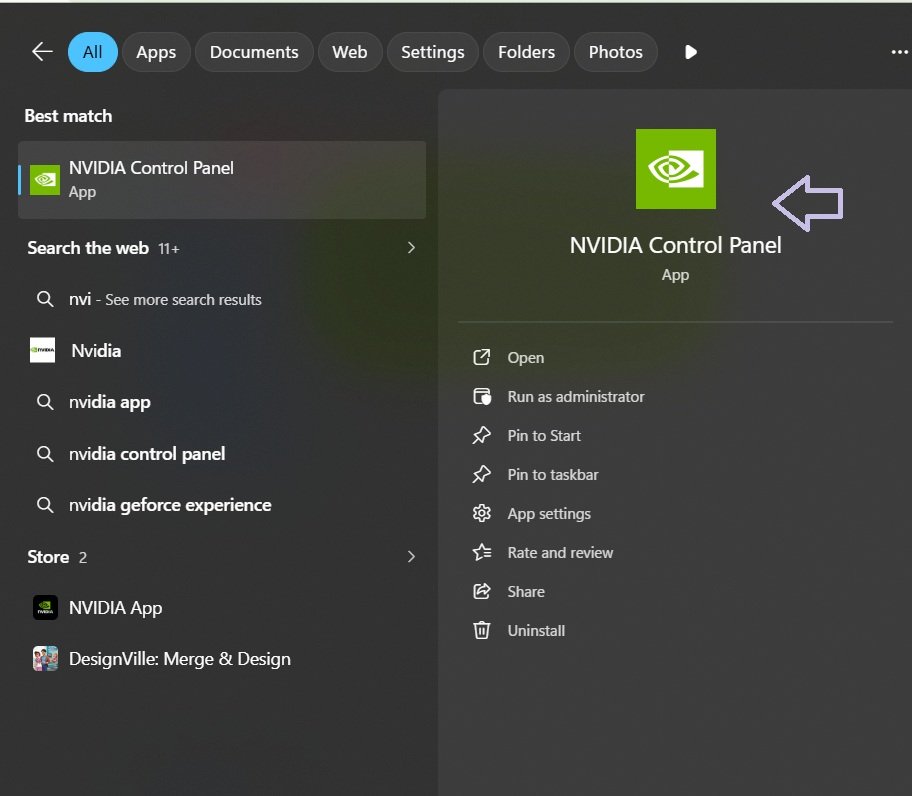
Click each and select “Uninstall.” Follow prompts to completely remove the driver.
Restart your computer.
After restart, your system uses generic Microsoft graphics drivers (basic, unstable). Your display might look odd or resolution might be wrong. This is temporary.
Now download and install the new NVIDIA driver. With the old driver completely removed, the new installation should succeed without incompatibility errors.
Cause 6: Using Wrong Driver Branch
NVIDIA maintains multiple driver branches:
- Game Ready Drivers: Optimized for gaming, released frequently
- Studio Drivers: Optimized for creative professionals, more stable
- DCH (Data Center) Drivers: For data center GPUs
If you need a Gaming driver but accidentally download a Studio driver (or vice versa), you get incompatibility errors.
Solution: Make sure you’re downloading from the correct branch for your use case.
Most gamers want Game Ready Drivers. Creative professionals want Studio Drivers. Data center users want DCH drivers.
Specifying the correct branch during download prevents this error.
Cause 7: Outdated BIOS
Rarely, your motherboard BIOS is so outdated it doesn’t properly support your graphics card. This prevents the driver from installing correctly.
Solution: Update your motherboard BIOS.
This is technical and varies significantly by motherboard manufacturer. Visit your motherboard manufacturer’s website (ASUS, MSI, Gigabyte, etc.). Download the latest BIOS for your specific motherboard model.
Follow their BIOS update process carefully. Interrupting BIOS updates can brick your motherboard permanently.
After updating BIOS, restart and try installing the NVIDIA driver again.
This solution is rarely necessary but worth considering if other fixes fail.
Method 1: Clean Driver Removal Using DDU (Display Driver Uninstaller)
If standard uninstall doesn’t fully remove corrupted driver, DDU (Display Driver Uninstaller) does a thorough removal.
Download DDU from guru3d.com/files (official source).
Boot into Safe Mode: Restart your computer, press F8 repeatedly during startup, select “Safe Mode with Networking.”
In Safe Mode, run DDU. Select your GPU manufacturer (NVIDIA) and GPU series. Click “Clean and restart.”
DDU completely removes all NVIDIA driver files and registry entries, then restarts.
After restart in normal mode, install your new NVIDIA driver.
Complete removal via DDU often fixes stubborn incompatibility errors.
Method 2: Download Driver Directly From NVIDIA With Correct Specifications
Use NVIDIA’s official driver auto-detection tool to ensure you’re downloading the exact compatible version.
Visit https://www.nvidia.com/en-in/drivers/details/
Or https://www.nvidia.com/en-us/drivers/ For Automatic Driver Updates.
The page auto-detects your GPU, Windows version, and system architecture.
It shows the latest compatible driver for your exact configuration.
Download this version. If you can’t find it on auto-detect, that indicates your GPU or Windows version might not support latest drivers.
If auto-detect finds a driver, that version will install without incompatibility errors (assuming no corruption or hardware issues).
Method 3: Check Compatibility Through Device Manager
Verify Windows actually recognizes your GPU before installing drivers.
Right-click Start > Device Manager.
Expand “Display adapters.”
Look for your GPU. If it shows your GPU model name (like “NVIDIA GeForce RTX 4090”), Windows recognizes it.
If it shows “Unknown device” or displays with yellow exclamation mark, Windows doesn’t properly recognize the GPU.
Only proceed with driver installation if Windows properly recognizes the GPU. If it shows “Unknown device,” fix the hardware detection first (reseat the card, check connections).
Method 4: Manually Run Installer With Compatibility Mode
Sometimes running the installer with compatibility settings helps.
Right-click the NVIDIA driver installer > Properties > Compatibility tab.
Check “Run this program in compatibility mode for:” and select an older Windows version.
Try running in compatibility mode for the Windows version your GPU was originally released for.
Click Apply > OK > run the installer.
Sometimes compatibility mode allows installation despite the error message.
Method 5: Update Windows First
Ensure your Windows installation is completely updated before installing drivers.
Settings > System > Windows Update > Check for updates.
Install all available updates. Restart if prompted.
After Windows is fully current, try installing the NVIDIA driver.
Outdated Windows sometimes causes driver incompatibility. Updating Windows first often resolves it.
Method 6: Disable Antivirus Temporarily
Aggressive antivirus sometimes blocks driver installation believing it’s a threat.
Temporarily disable your third-party antivirus (Windows Defender can stay on). Don’t uninstall it, just disable it temporarily.
Run the NVIDIA driver installer.
After installation completes, re-enable antivirus.
Some security software incorrectly identifies driver installers as malicious. Disabling it temporarily often allows installation to proceed.
When Hardware Is Actually Failing
If you’ve tried multiple fixes and still get incompatibility errors, your graphics card hardware might be failing.
Signs of hardware failure:
- GPU doesn’t appear in Device Manager at all
- GPU appears with yellow exclamation mark despite reseating
- Computer crashes or displays corruption when using graphics
- Card is extremely old (5+ years) and has declining performance
- Card was dropped or physically damaged
What to do:
- Try the card in a different PCIe slot (if your motherboard has multiple)
- Try the card in a completely different computer to test
- Contact NVIDIA support with detailed error information
- Consider GPU replacement if hardware is actually failing
Preventing This Error Going Forward
After successfully installing drivers:
Always use GPU-Z or similar to verify your exact GPU model. When downloading drivers, triple-check you’re selecting the right GPU model.
Keep drivers updated but don’t rush. Wait a few days after new driver release. Let others discover bugs. Then update.
Before updating, back up current driver. Use DDU or driver backup software. If new driver causes problems, you can quickly revert.
Download directly from NVIDIA. Don’t use third-party driver installer software. Use NVIDIA’s official website.
Don’t update drivers unnecessarily. If your current driver works fine, there’s no need to update. Only update if you need new features or bug fixes.
Keep your motherboard BIOS current. Not critical for drivers, but helps overall hardware compatibility.
The Frustrating Reality
Driver incompatibility errors are annoying because the error message tells you nothing useful. You know something isn’t compatible, but not what or why.
Usually, the issue is simple: wrong GPU model selected, wrong Windows version, or corrupted current installation.
Occasionally, it’s hardware issues requiring reseating or physical inspection.
Rarely, it’s fundamental incompatibility between your very old/new GPU and available drivers.
Work through these fixes systematically. Start with verification (confirm GPU model, Windows version, architecture). Move to cleanup (uninstall corrupted driver with DDU). Try installation again.
Most people’s incompatibility errors resolve with proper uninstall and reinstall using the correct driver version.
Your graphics card will work again. You just need to identify what specifically is incompatible and fix the actual problem rather than just trying different driver versions randomly.
Disclaimer: This article provides troubleshooting guidance for NVIDIA driver incompatibility errors. Results vary by GPU model, Windows version, driver version, and hardware configuration. Some methods require technical knowledge. Complete driver removal requires restarting in Safe Mode. BIOS updates carry risk of hardware damage if interrupted. Users assume responsibility for troubleshooting steps. If incompatibility persists despite multiple attempts, seek professional technical support or contact NVIDIA support with detailed error information.

- How to Transcribe Audio Live on Your iPhone

- Killer Network Service: Is It a Virus or Safe to Disable?

- How to Set Up Parental Controls on Windows 11: A Step-by-Step Guide

- How to Extract Audio From a Video: Easy Ways to Save Audio

- How to Set a Photo Album as Your Wallpaper on iPhone: Step-by-Step Guide

Products
-
![Apple Watch Ultra 3 [GPS + Cellular 49mm] Running & Multisport Smartwatch w/Rugged Titanium Case w/Black Titanium Milanese Loop - M. Satellite Communications, Advanced Health & Fitness Tracking](https://bazaronweb.com/retailstores/wp-content/uploads/2025/09/apple-watch-320x320.jpg) Apple Watch Ultra 3 [GPS + Cellular 49mm] Running & Multisport Smartwatch w/Rugged Titanium Case w/Black Titanium Milanese Loop - M. Satellite Communications, Advanced Health & Fitness Tracking
Apple Watch Ultra 3 [GPS + Cellular 49mm] Running & Multisport Smartwatch w/Rugged Titanium Case w/Black Titanium Milanese Loop - M. Satellite Communications, Advanced Health & Fitness Tracking
-
 Apple iPad mini (A17 Pro): Apple Intelligence, 8.3-inch Liquid Retina Display, 256GB, Wi-Fi 6E, 12MP Front/12MP Back Camera, Touch ID, All-Day Battery Life — Purple
-
 Apple AirPods Max Wireless Over-Ear Headphones, Active Noise Cancelling, Transparency Mode, Personalized Spatial Audio, Dolby Atmos, Bluetooth Headphones for iPhone – Space Gray
-
 Apple AirPods Pro 2 Wireless Earbuds, Active Noise Cancellation, Hearing Aid Feature, Bluetooth Headphones, Transparency, Personalized Spatial Audio, High-Fidelity Sound, H2 Chip, USB-C Charging
-
Home Garage 210 TC Cotton King Floral Fitted (Elastic) Bedsheet(Pack of 1, Grey)
Original price was: ₹999.00.₹299.00Current price is: ₹299.00.
Leave a Reply